Transcription of Taperloc Complete Microplasty vs Taperloc Complete ...
1 Clinical Research Protocol Study: Taperloc Microplasty vs. Standard Page 1 of 17 Version Taperloc Complete Microplasty vs Taperloc Complete Standard: Randomized Controlled Study on Bone Mineral Density PROTOCOL NUMBER (Study ID): PROTOCOL VERSION: (Amendment 1) PROTOCOL DATE: 12 January 2017 Clinical Research Protocol Study: Taperloc Microplasty vs. Standard Page 2 of 17 Version Table of Contents 1. INTRODUCTION BACKGROUND DEVICE DESIGN AND DESCRIPTION RATIONALE FOR CURRENT STUDY STUDY PURPOSES 2. STUDY DESIGN OVERALL DESIGN STUDY GROUPS/TREAMENTS NUMBER OF SITES AND SUBJECTS/PROCEDURES EFFICACY AND/OR SAFETY HYPOTHESES PRIMARY AND SECONDARY ENDPOINTS ASSESSMENT PROCEDURE ASSESSMENT PARAMETERS AND METHODS ASSESSMENT TIMELINES/SCHEDULE ALLOWED WINDOW OF EACH SCHEDULE STUDY DURATION 3.
2 SELECTION AND WITHDRAWAL OF SUBJECTS INCLUSION CRITERIA EXCLUSION CRITERIA SUBJECT WITHDRAWAL 4. PROTOCOL DEVIATION MANAGEMENT AND REPORTING Clinical Research Protocol Study: Taperloc Microplasty vs. Standard Page 3 of 17 Version 5. ADVERSE EVENT MANAGEMENT AND REPORTING 6. DATA ANALYSES SAMPLE SIZE JUSTIFICATION DESCRIPTION OF STATISTICAL ANALYSES 7. DATA COLLECTION, HANDLING AND RETENTION SOURCE DOCUMENT REQUIREMENTS CASE REPORT FORMS ELECTRONIC DATA ENTRY STUDY DOCUMENT RETENTION 8. DATA REPORTING 9. MONITORING PLAN FREQUENCY SAMPLING PLAN MONITORING TASKS STUDY CLOSE-OUT 10. LABELING 11. ETHICAL AND REGULATORY REQUIREMENTS CODE OF CONDUCT INSTITUTIONAL REVIEW BOARDS INFORMED CONSENT SUBJECT CONFIDENTIALITY 12.
3 INSURANCE AND INDEMNIFICATION 13. APPENDICS Clinical Research Protocol Study: Taperloc Microplasty vs. Standard Page 4 of 17 Version STUDY SUMMARY TITLE Taperloc Microplasty vs. Taperloc Standard: Randomized Controlled Study on Bone Mineral Density DESIGN Multi-Center Comparative Two Armed Randomized Controlled Study (Centralized Randomization run by Sponsor) PURPOSE The primary purpose of this study is to measure the postoperative changes in bone mineral density, comparing the Taperloc Complete Reduced Distal Microplasty stem and the standard length Taperloc Complete Reduced Distal stem. OUTCOME MEASURES The primary outcome measures are the change in bone mineral density in the Gruen zones surrounding the stem measured by DEXA and incidence of thigh pain.
4 The secondary outcome measures are the assessment of leg length and femoral offset, to determine the suitability of the implant size range and neck geometry, standard clinical scores ( modified Harris Hip Score), complications, and survivorship analysis. POPULATION 100 Patients: 50 with Taperloc Complete Reduced Distal stem. 50 with Taperloc Complete Reduced Distal Microplasty stem Up to four sites will be used to enroll patients into this study ELIGIBILITY To be included in the study, a patient must be prescribed a primary total hip arthroplasty with the Taperloc system . The Taperloc system is to be used in accordance to the indications for use and contraindications detailed in the approved labeling of the device.
5 DURATION 1 year recruitment, and 5 years follow up STUDY SPONSOR Zimmer Biomet Clinical Research Protocol Study: Taperloc Microplasty vs. Standard Page 5 of 17 Version 1. INTRODUCTION BACKGROUND The Taperloc Microplasty cementless stem is designed to transmit load to the proximal femur, thereby preserving bone density, and preventing long term instability and loosening secondary to proximal bone resorption. The primary aim of this study is therefore to compare the postoperative changes in bone density with the Taperloc Microplasty stem, using the standard length Taperloc stem as a control. In addition, the Taperloc stem has historically had a neck angle of 138.
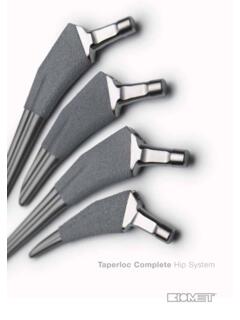
6 There have been criticisms that this neck angle is too high for the typical Korean population. The newer Taperloc Complete system (both Microplasty and standard length) has a neck angle of 133 . A secondary aim is occurrence ratio of thigh pain difference between Microplasty and standard stem in Korean population DEVICE DESIGN AND DESCRIPTION The Taperloc stem is designed after the philosophy of a flat tapered wedge. It has evolved to incorporate the Reduced Distal and Microplasty stems to better address all patient anatomies, and facilitate multiple surgical techniques. The Flat Tapered Wedge Geometry enhances proximal loading, preserves bone, and provides rotational stability.
7 Standard and lateralized options reproduce various patient anatomies without lengthening the leg The stem is manufactured from Titanium Alloy Ti-6AL-4V, which allows for stress transfer to preserve cortical density. Titanium alloy porous plasma spray coating allows for initial scratch-fit stability and bone fixation. The Reduced Distal Stem Option allows the stem to be used in femoral canals with proximal/distal mismatch The Microplasty Stem has a stem length reduced by 35 mm. This accommodates a minimally invasive approach, preserves soft tissues and bony structures, and ensures proximal stress transfer. Clinical Research Protocol Study: Taperloc Microplasty vs.
8 Standard Page 6 of 17 Version Product codes for the stems to be used in this study are listed below: Full Length, Reduced Distal Microplasty Size Standard Offset High Offset Size Standard Offset High Offset 5x130 51-100050 51-101050 5x95 51-108050 51-109050 6x132 51-100060 51-101060 51-108060 51-109060 7x134 51-100070 51-101070 7x99 51-108070 51-109070 8x136 51-100080 51-101080 8x101 51-108080 51-109080 9x137 51-103090 51-104090 51-106090 51-107090 10x140 51-103100 51-104100 10x105 51-106100 51-107100 11x142 51-103110 51-104110 51-106110 51-107110 12x144 51-103120 51-104120 12x109 51-106120 51-107120 13x146 51-103130 51-104130 13x111 51-106130 51-107130 14x148 51-103140 51-104140 14x113 51-106140 51-107140 15x150 51-103150 51-104150 15x115 51-106150
9 51-107150 16x152 51-103160 51-104160 16x117 51-106160 51-107160 17x154 51-103170 51-104170 17x119 51-106170 51-107170 18x156 51-103180 51-104180 18x121 51-106180 51-107180 20x160 51-103200 51-104200 20x125 51-106200 51-107200 22x164 51-103220 51-104220 22x129 51-106220 51-107220 24x167 51-103240 51-104240 24x132 51-106240 51-107240 RATIONALE FOR CURRENT STUDY Stress shielding in cementless hip replacement leads to bone resorption. Not only does that increase the likelihood of long term aseptic loosening, but the reduction in bone stock could compromise the outcome of revision surgery. This is particularly important considering that cementless components are frequently used preferentially in young patients.
10 Not only is the revision risk for a given implantation time higher with young patients, but life expectancy is higher as well. This means that young patients are much more likely to need revision surgery in their lifetime. Preservation of bone stock in order to keep revision options open is therefore a very important consideration. One way to preserve the bone stock and to reduce stress-shielding bone resorption of the proximal femur is by removing the distal stem of the femoral component and providing metaphyseal fixation. Alternatively, reducing the size of the distal stem could also encourage metaphyseal fixation. The questions arise which is most effective at encouraging proximal load Clinical Research Protocol Study: Taperloc Microplasty vs.