Transcription of TeachingEnglish | Lesson plans
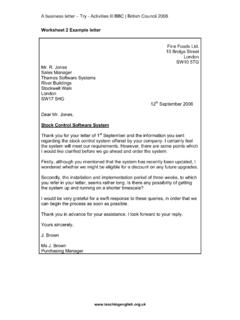
1 TeachingEnglish | Lesson plans BBC | British Council 2011 Worksheets - Meetings (3): Managing a meeting Dear all As you may know, we are developing a major new project, Project Z. I am attaching a short summary of the project for your information. In order for the project to be a success, we need to get input and support from as many departments as possible. With this in mind, I d like to set up a Project Team, including at least one member from each department, to meet once a month to discuss the project. I realise this is a busy time of year for many departments, but I d like to stress that this project is of vital importance to the future growth of our organisation. There is no work involved for team members, apart from reading project documentation, attending the monthly team meetings, offering ideas and helping us to identify and solve potential problems.
2 I believe membership of the team will also be beneficial for individual members, as they will gain a better understanding of this project and, more generally, the way the organisation works as a whole. Members will also gain invaluable experience of project management. Also, as the meetings will be conducted in English, it will be a good chance for team members to develop their communication skills in English. So could I ask each of you to nominate one or two suitable people from your department to be on the team? Please could you get back to me by the end of this week with your nominations? Many thanks and best regards AngelaFott, Project Co-ordinator Dear all First of all, welcome to the Project Z Team. I m very excited about this project, and I m convinced that with your support and ideas, we can make it a tremendous success. I m attaching some background documents so you can familiarise yourself with the project aims and scope.
3 I d like to organise the first meeting some time next week, as early as possible (preferably on Monday or Tuesday). Could I therefore ask you to let me know your availability for next week, so I can find a time that suits most people? The first meeting should last no more than one hour. Please email me with your availability, ideallytoday (Monday) or tomorrow morning at the latest. Thanks a lot Angela Fott, Project Co-ordinator TeachingEnglish | Lesson plans BBC | British Council 2011 Dear all Thanks to everyone who sent me their availability. Based on the information I received, I d like to invite you to our first meeting on Tuesday 21stFebruary from to in the small conference room.
4 Coffee and biscuits will be provided. I m attaching an agenda. Please make sure you have read the agenda carefully before the meeting, as well as the briefing documents that I sent on Monday (attached again for your reference). Thanks a lot and see you on Tuesday. AngelaFott, Project Co-ordinator Agenda Date: 21st February Time: Location: Small conference room 1. Presentation: Background to the project, aims, scope 2. Questions and answers 3. Brainstorming: ideas for the launch event 4. Action points 5. Schedule for next month s meeting 6. AOB Dear all Thanks to everyone who came to our first meeting yesterday. I think it was an incredibly productive meeting, and your contributions and ideas were extremely valuable. As promised, I m attaching the meeting minutes. Please check them carefully, especially the list of Action Points at the end, to make sure I have recorded everything correctly, and let me know if I need to correct anything.
5 I ll email people individually about specific Action Points. As we discussed, our next meeting will be on 20th March from to I ll be in touch closer to that date with an agenda for that meeting. Thanks again for all your the best. Angela Fott, Project Co-ordinator TeachingEnglish | Lesson plans BBC | British Council 2011 Analysis 1. Look at the first email. Discuss these questions. a. Why do you think Angela didn t start with a full explanation of the project? b. In the second paragraph, which two phrases does Angela use to show the reason for something? c. What is the purpose of the third paragraph? What two techniques does she use to achieve this purpose? d. What is the purpose of the fourth paragraph?
6 What short word does Angela use twice to explain reasons? e. Do you think Angela is specific enough in her call to action in the final paragraph? 2. Look at the second email. Discuss these questions. a. How does Angela try to develop motivation and enthusiasm in her first paragraph? b. What techniques does Angela use in the second paragraph to be flexible but still guide the decision-making process? 3. Look at the third email and the agenda. Discuss these questions. a. What important information does Angela include in the first paragraph? b. Which of her two requests sounds stronger, the one in the first paragraph or the one in the second? Why do you think this is? c. Do you think the agenda contains too much or too little information? d. What does AOB mean at the end of the agenda? 4. Look at the fourth email. Discuss these questions. a.
7 Why do you think Angela is so enthusiastic in her opening paragraph? b. Why does Angela stress the importance of checking and correcting the minutes? c. How does Angela refer to previous conversation in paragraphs 2 and 3? 5. Underline all the useful phrases and techniques that you could use in your own emails. Try to find at least one phrase for each of the following functions. a. Referring to previous knowledge or conversations b. Referring to attachments c. Explaining reasons d. Explaining what you want to do e. Showing understanding f. Emphasising key information g. Dealing with potential problems h. Explaining key benefits i. Making requests j. Setting deadlines k. Expressing enthusiasm l. Making suggestions m. Explaining practical details n. Expressing thanks o. Explaining your plans TeachingEnglish | Lesson plans BBC | British Council 2011 Practice In pairs, plan a large meeting involving people from several departments.
8 First, decide what your meeting will be about. You can use these ideas to help you: What is your organisation? What do you make / do? What is your role in the organisation? Is the meeting about something that is going to happen ( a new project or procedure) or something that has happened ( an accident, a failure)? Be as specific as possible. Is it a one-off meeting or the first of a series? How long do you expect the meeting will last? Who are you going to invite? Why do you want them to come? How can you persuade people to come to your meeting? When you have a strong idea about the purpose of your meeting, write one or more emails to set up the meeting and invite participants. You can use Angela s writing to give you ideas, copying as much as you like from her emails. You don t have to write three emails: just write as much or as little as you think necessary to set up your meeting.
9 TeachingEnglish | Lesson plans BBC | British Council 2011 1 Angela: OK, so let me start by welcoming you all to our first meeting. Thanks a lot for volunteering to join the team, and thanks also for coming. Your support is very much appreciated. I m going to begin with a brief presentation now on the background to the project [..] Angela: [..] Right .. so that brings me to the end of the presentation. Are there any questions? Bruno: Er .. yes, I have a question. It all seems like a nice idea, but I m really not sure it s going to work in practice. Christina: Yeah, me too. Where s the money coming from, for example? Angela: Well, that s really two questions. Christina, I ll come back to your question in a moment.
10 Bruno, what exactly is it that you re worried about? Bruno: I think you re being too ambitious about the number of customers who are going to be interested. 7 Diego: No, I disagree. I think it s a really interesting project. I d certainly be interested. Angela: OK, that s great to hear, Diego, but I m not sure that s what Bruno s worried about. Bruno, do you think the project isn t interesting enough, or that only a small number will be interested? Bruno: Well, a bit of both, but mainly it s about reaching large numbers of people with our marketing campaign. If we can get the marketing right, then the numbers are fine. Angela: So you re saying we need to give more thought to the marketing side of things, rather than changing the project itself? Bruno: Well, both really. 12 Angela: OK .. so let s take them one at a time. What would you say are the main issues related to marketing?