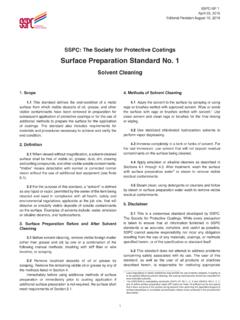
Transcription of Technical Data Sheet Application Guide
1 Hardtop XPProduct descriptionThis is a two component chemically curing aliphatic acrylic polyurethane coating. It has a glossy finish with very good gloss retention. It is a high solids product. The product has good Application properties with low dry be used as topcoat in atmospheric Data SheetApplication Guide3140;3240;43201,23140 ScopeThe Application Guide offers product details and recommended practices for the use of the Application Guide (AG) must be read in conjunction with the relevant specification, Technical Data Sheet (TDS) and Safety Data Sheet (SDS) for all the products used as part of the coating standardsReference is generally made to ISO Standards. When using standards from other regions it is recommended to reference only one corresponding standard for the substrate being preparation and coating should normally be commenced only after all welding, degreasing, removal of sharp edges, weld spatter and treatment of welds is complete.
2 It is important that all hot work is completed before coating required quality of surface preparation can vary depending on the area of use, expected durability and if applicable, project preparationProcess sequenceWhen preparing new surfaces , maintaining already coated surfaces or aged coatings it is necessary to remove all contamination that can interfere with coating adhesion, and prepare a sound substrate for the subsequent the surface for hydrocarbon and other contamination and if present, remove with an alkaline the surface to activate the cleaner and before it dries, wash the treated area using fresh solvents (thinners) shall not be used for general degreasing or preparation of the surface for painting due to the risk of spreading dissolved hydrocarbon contamination. Paint thinners can be used to treat small localized areas of contamination such as marks from marker pens.
3 Use clean, white cotton cloths that are turned and replaced often. Do not bundle used solvent saturated cloths. Place used cloths into ^(ValidationDate)The data and information provided are not definite requirements. They are guidelines to assist with efficient and safe use, and optimum service of the product. Adherence to the guidelines does not relieve the applicator of responsibility for ensuring that the work meets specification liability is in accordance with general product liability surfacesVerification of existing coatings including primersOrganic primers/intermediatesWhen the surface is an existing coating, verify with Technical data Sheet and Application Guide of the involved products, both over coatability and the given maximum over coating of issue:6 September 2018 Page: 1/7 This Application Guide supersedes those previously Application Guide (AG) must be read in conjunction with the relevant specification, Technical Data Sheet (TDS) and Safety Data Sheet (SDS) for all the products used as part of the coating your nearest local Jotun office, please visit our website at GuideHardtop XPThe surface of previous coats shall be free from contamination by water, hydrocarbon based products, wax, mud,mortar droppings and loose, chalked and flaking the surface for hydrocarbon and other contamination and if present, remove with an alkaline emulsifying detergent.
4 Agitate the surface to activate the cleaner and before it dries, wash the treated area by low-pressure waterjetting method to Wa 1 (ISO 8501-4) using fresh water. surfaces not contaminated with hydrocarbon deposits shall be washed to Wa 1 (ISO 8501-4) using fresh water to reduce surface applied on coatings past maximum over coating interval light abrading may be required to achieve proper intercoat environmental conditions - before and during applicationAir temperatureSubstrate temperatureRelative Humidity (RH)550- C5-60 C10-85% Only apply the coating when the substrate temperature is at least 3 C (5 F) above the dew point Do not apply the coating if the substrate is wet or likely to become wet Do not apply the coating if the weather is clearly deteriorating or unfavourable for Application or curing Do not apply the coating in high wind conditionsBefore Application , test the atmospheric conditions in the vicinity of the substrate for the dew formation according to ISO following restrictions must be observed:Product mixingProduct mixing ratio (by volume)Hardtop XP Comp A10part(s)part(s)1 Hardtop XP Comp BProduct mixingThe coating shall be mixed with an air powered mechanical paint mixing tool that is clean and fit for complete units temperature of base and curing agent is recommended to be 18 C or higher when the product is that pot life is not exceeded during Application .
5 Special care must be taken at temperatures above 40 viscosity will increase very fast at such solventThinner:Jotun Thinner No. 10 Jotun Thinner No. 26/Induction time and Pot lifePot h50 minPaint temperature23 C40 CDate of issue:6 September 2018 Page: 2/7 This Application Guide supersedes those previously Application Guide (AG) must be read in conjunction with the relevant specification, Technical Data Sheet (TDS) and Safety Data Sheet (SDS) for all the products used as part of the coating your nearest local Jotun office, please visit our website at GuideHardtop XPJotun Thinner No. 26 is supplied and used in USA due to tip (inch/1000) :Pressure at nozzle (minimum) :Airless Spray Equipment150 bar/2100 psiAir Spray EquipmentPump ratio (minimum) :Nozzle output (litres/minute) :42 (mesh) :Several factors influence, and need to be observed to maintain the recommended pressure at the nozzle.
6 Among factors causing pressure drop are:- extended hoses or hose bundles- extended hose whip-end line- small internal diameter hoses- high paint viscosity- large spray nozzle size- inadequate air capacity from compressor- incorrect or clogged filters13-197011-19 (HVLP) / mm (pressure pot) Application dataSpray applicationNozzle tip:Pressure at nozzle (minimum) bar/30 psi (HVLP) / bar/30 psi (pressure pot)Other Application toolsRoller applicationCan be applied by roller. The addition of a small volume of thinner is recommended to achieve better flow. As with brush, it will be necessary to apply additional coats to achieve a similar dry film thickness when the coating is applied by airless or conventional spray. Roller is not recommended for Application direct to prepared metal,and for stripe thickness per coatDry film thicknessWet film thicknessTheoretical spreading rateTypical recommended specification colours may need film thickness in the high end of the recommended specification range to achieve effect colours may have diverging specification range.
7 Refer to the Application Guide (AG) for additional information or contact your nearest Jotun office. m mm /l---RAL 1026, Luminous yellow, has recommended dry film specification range 90 - 120 m. To maintain the gloss and the special effect colour over coating with Hardtop Clear is product can be applied up to 50 % higher than maximum specified film thickness without loss of Technical of issue:6 September 2018 Page: 3/7 This Application Guide supersedes those previously Application Guide (AG) must be read in conjunction with the relevant specification, Technical Data Sheet (TDS) and Safety Data Sheet (SDS) for all the products used as part of the coating your nearest local Jotun office, please visit our website at GuideHardtop XPDry film thickness (DFT) measurementWet film thickness (WFT) measurement and calculationVentilationCoating lossFilm thickness measurementTo ensure correct film thickness, it is recommended to measure the wet film thickness continuously during Application using a painter's wet film comb (ISO 2808 Method 1A).
8 Use a wet-to-dry film calculation table to calculate the required wet film thickness per wet to dry film thickness chart is available on the Jotun Web the coating has cured to hard dry state the dry film thickness can be checked to SSPC PA 2 or equivalent standard using statistical sampling to verify the actual dry film thickness. Measurement and control of the WFT and DFT on welds is done by measuring adjacent to and no further than 15 cm from the ventilation is very important to ensure proper drying/curing of the consumption of paint should be controlled carefully, with thorough planning and a practical approach to reducing loss. Application of liquid coatings will result in some material loss. Understanding the ways that coating can be lost during the Application process, and making appropriate changes, can help reducing material of the factors that can influence the loss of coating material are:- type of spray gun/unit used- air pressure used for airless pump or for atomization- orifice size of the spray tip or nozzle- fan width of the spray tip or nozzle- the amount of thinner added- the distance between spray gun and substrate- the profile or surface roughness of the substrate.
9 Higher profiles will lead to a higher "dead volume"- the shape of the substrate target- environmental conditions such as wind and air temperatureDrying and Curing timeSurface (touch) dryWalk-on-dry16 h6 h2 h24 h14 h7 h4 h21 d14 d7 d3 dSubstrate temperature5 C10 C23 C40 CDried/cured for serviceDry to over coat, minimum24 h14 h7 h4 hWalk-on-dry: Minimum time before the coating can tolerate normal foot traffic without permanent marks,imprints or other physical and curing times are determined under controlled temperatures and relative humidity below 85 %, and at average of the DFT range for the to over coat, minimum: The recommended shortest time before the next coat can be (touch) dry: The state of drying when slight pressure with a finger does not leave an imprint or reveal for service: Minimum time before the coating can be permanently exposed to the intended of issue:6 September 2018 Page: 4/7 This Application Guide supersedes those previously Application Guide (AG) must be read in conjunction with the relevant specification, Technical Data Sheet (TDS) and Safety Data Sheet (SDS) for all the products used as part of the coating your nearest local Jotun office, please visit our website at GuideHardtop XPMaximum over coating intervalsItselfextendedextendedextendede xtendedAverage temperature during drying/curing5 C10 C23 C40 CMaximum time before thorough surface preparation is required.
10 The surface must be clean and dry and suitable for over coating. Inspect the surface for chalking and other contamination and if present, remove with an alkaline detergent. Agitate the surface to activate the cleaner and before it dries, wash the treated area by low-pressure water jetting to Wa 1 (ISO 8501-4) using fresh maximum over coating interval is exceeded the surface should in addition be carefully roughened to ensure good inter coat for atmospheric exposureOther conditions that can affect drying / curing / over coatingAdding anti-skid to the coating systemWater contaminationRepair of coating systemSurface finishCoating film continuityWhen required by the specification, the coating shall be tested for film discontinuity according to ASTM D 5162,test method A or B as appropriate for the actual dry film recorded defects shall be repaired by best practical skid aggregate should only be added in the final coat, and should not be used in single coat the aggregate evenly on the surface before half of time to Surface dry.