Transcription of Test Objectives and Descriptions - Pearson Clinical
1 Test Objectives and DescriptionsElisabeth H. Wiig, PhD, Eleanor Semel, EdD & Wayne A. Secord, PhDOverviewClinical Evaluation of Language Fundamentals Fifth EditionThe new Clinical Evaluation of Language Fundamentals -Fifth Edition (CELF -5) is a flexible system of individually administered tests used to assist a clinician to accurately diagnose a language disorder in children and adolescents ages 5 through 21 years. Using the CELF-5 s battery of structured tasks that test the limits of a student s language abilities as well as observation- and interaction-based tasks.
2 Clinicians can effectively pinpoint a student s strengths and weaknesses to make appropriate placement and intervention Assessment ProcessThe CELF-5 Assessment Process mirrors the changes in the current educational practices requiring that a student s performance be evaluated in classroom settings and that classroom strategies be developed to address performance concerns before formal assessment begins. Current best practices in assessment require a process that includes multiple sources of evidence of language disability, including observation-based measures, authentic assessment, and norm-referenced data.
3 The new CELF-5 provides each of these sources of evidence in an updated assessment H. Wiig, PhD, Eleanor Semel, EdD & Wayne A. Secord, PhDIs a language disorder affecting classroom performance?Evaluate language and communication in context using the Observational Rating Scale (ORS) and other authentic and descriptive measures to provide information needed to design classroom accommodations, adaptations, and enhancements. If the student does not respond to a variety of classroom interventions, is his or her performance due to language skill deficits?
4 Administer tests appropriate to the student s age to answer the referral questions. If a language disorder is identified, what do I need to know to plan for intervention?Identify the nature of the disorder by answering the following there significant differences in comprehension and expression?Administer tests comprising the Receptive and the Expressive Index scores. Are weaknesses related to the interaction of language and memory?Administer tests comprising the Language Memory index there weaknesses in the areas of morphology, syntax, or semantics?
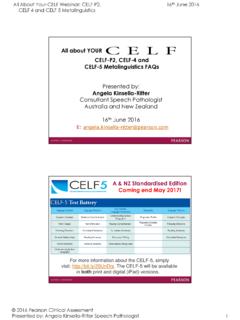
5 Administer tests comprising the Language Content or Language Structure index does the disorder affect written language? Administer the Reading Comprehension and Structured Writing the disorder affect social interactions? Complete the Pragmatics Profile and/or the Pragmatics Activities on the CELF-5 test results and additional assessment information you have collected, what is the best way to address the student s needs? CELF-5 Assessment ProcessObservational Rating ScalesSentence ComprehensionLinguistic ConceptsWord StructureWord ClassesFollowing DirectionsFormulated SentencesRecalling SentencesUnderstanding Spoken ParagraphsWord DefinitionsSentence AssemblySemantic RelationshipsReading ComprehensionStructured WritingPragmatics ProfilePragmatics Activities ChecklistSummary at a glanceFull text for the references can be found in the CELF-5 Examiner s CELF-5 Observational Rating Scale (ORS)
6 Documents a student s ability to manage classroom behaviors and interactions, and to meet school curriculum Objectives for following teacher instructions. Use the ORS when there is a concern about a student s language performance within the classroom, or when there is a need to identify situations or contexts in which reduced language performance CELF-5 ORS can be used before or after standardized assessment. In an educational setting, a school clinician may ask teachers and parents to complete the ORS as part of the data gathering process to identify situations or contexts in which the student s reduced language performance occurs, and to help plan classroom interventions that may enable the student to improve language performance without placing him or her in special education programming.
7 Use the ORS information to target communication behaviors that are affecting a student s classroom performance most significantly, or to prioritize a student s assessment needs. The ORS results may provide a rationale or justification for a more in-depth diagnostic evaluation. When information from parents, teachers, and the student is considered early in the assessment process, clinicians can obtain a realistic view of a student s everyday performance analyze aspects of communication that are difficult for the student identify a student s strengths and interests, and establish a plan for further assessment and Rating Scale ObjectiveTo evaluate the student s ability to (a) interpret spoken sentences of increasing length and complexity, and (b)
8 Select the pictures that illustrate referential meaning of the to CurriculumThe abilities evaluated relate to kindergarten and elementary school curriculum Objectives for creating meaning and context in response to pictures or spoken sentences, and creating stories or descriptive to Classroom ActivitiesSentence comprehension and the understanding of relationships among spoken language, real-life references, and situations are emphasized when listening to stories or Descriptions of events, as well as when matching sentences that are spoken or read to pictured for InterventionIf the student receives a below average score, you can categorize errors according to the variables in the item analysis table.
9 This identifies the semantic, morphological, and syntactic structures that interfere with a student s comprehension. Intervention should focus on developing the student s receptive vocabulary and explicit (conscious) awareness of the structure of words and sentences using spoken sentences associated with illustrations and familiar, illustrated stories. During intervention it is important to talk about and illustrate the function of specific words and structural rules to increase semantic and syntactic awareness (Beck, McKeown, & Kucan, 2002; Rice & Blossom, 2013; Thompson & Shapiro, 2007).
10 Sentence Comprehension ObjectiveTo evaluate the student s ability to interpret spoken directions with basic concepts, which requires logical operationssuch as inclusion and exclusion, orientation and timing, and identifying mentioned objects from among several pictured to CurriculumThe abilities evaluated relate to kindergarten and early elementary curriculum Objectives of following spoken directions with basic concepts while completing seat work and other to Classroom ActivitiesUnderstanding of basic concepts such as and, before, or after is essential for following directions for hands-on activities, lessons, projects, and other for InterventionIf the student receives a below-average score.