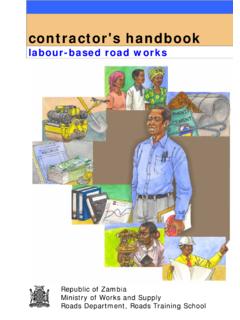
Transcription of The cover design is
1 The International Programme for the Improvement of Working Conditions and Environment (PIACT) waslaunched by the International Labour Organisation in 1976 at the request of the International LabourConference and after extensive consultations with member is designed to promote or support action by member States to set and attain definite objectivesaiming at "making work more human". The Programme is thus concerned with improving the quality ofworking life in all its aspects: for example, the prevention of occupational accidents and diseases, a widerapplication of the principles of ergonomics, the arrangement of working time, the improvement of thecontent and organisation of work and of conditions of work in general, a greater concern for the humanelement in the transfer of technology. To achieve these aims, PIACT makes use of and co-ordinates thetraditional means of ILO action, including: the preparation and revision of international labour standards; operational activities, including the dispatch of multidisciplinary teams to assist member States onrequest; tripartite meetings between representatives of governments, employers and workers, includingindustrial committees to study the problems facing major industries, regional meetings and meetings ofexperts; action-oriented studies and research.
2 And clearing-house activities, especially through the International Occupational Safety and HealthInformation Centre (CIS) and the Clearing-house for the Dissemination of Information on Conditionsof publication is the outcome of a PIACT cover design is based on an original drawing by Ms. Noha and healthin construction An ILO code of practiceSafety and healthin constructionInternational Labour Office GenevaCopyright International Labour Organization 1992 First published 1992 Publications of the International Labour Office enjoy copyright under Protocol 2 of the UniversalCopyright Convention. Nevertheless, short excerpts from them may be reproduced without authorisation,on condition that the source is indicated. For rights of reproduction or translation, application should bemade to the Publications Branch (Rights and Permissions), International Labour Office, CH-1211 Geneva22, Switzerland.
3 The International Labour Office welcomes such designations employed in ILO publications, which are in conformity with United Nations practice,and the presentation of material therein do not imply the expression of any opinion whatsoever on the partof the International Labour Office concerning the legal status of any country, area or territory or of itsauthorities, or concerning the delimitation of its responsibility for opinions expressed in signed articles, studies and other contributions rests solelywith their authors, and publication does not constitute an endorsement by the International Labour Officeof the opinions expressed in to names of firms and commercial products and processes does not imply their endorsement bythe International Labour Office, and any failure to mention a particular firm, commercial product orprocess is not a sign of publications can be obtained through major booksellers or ILO local offices in many countries, ordirect from ILO Publications, International Labour Office, CH-1211 Geneva 22, Switzerland.
4 A catalogueor list of new publications will be sent free of charge from the above in SwitzerlandATAILOS afety and health in construction: An ILO code of practiceGeneva, International Labour Office, 1992/Code of practice/, /Occupational safety/, /Occupational health/, /Construction industry/. 92-2-107104-9 Also published in French: S curit et sant dans la construction. Recueil de directivespratiques du BIT (ISBN 92-2-207104-2), Geneva, 1992; and in Spanish: Seguridad y salud enla construcci n. Repertorio de recomendaciones pr cticas de la OIT (ISBN 92-2-307104-6),Geneva, 1992 ILO Cataloguing in Publication DataVPrefaceIn accordance with the decision taken by the Governing Body of the ILO at its244th Session (November 1989), a meeting of experts was convened in Geneva from 12to 19 March 1991 to draw up a code of practice on safety and health in construction.
5 Themeeting was composed of 21 experts, seven appointed following consultations withgovernments, seven following consultations with the Employers' group and sevenfollowing consultations with the Workers' group of the Governing After 1 Experts appointed following consultations with governments:Mr. Cl ment, Ministry of Labour, Employment and Vocational Training, Paris (France).Mr. D. G. Kibara, Ministry of Labour, Nairobi (Kenya).Mr. W. Kukulski, Institute for Building Technology, Warsaw (Poland).Mr. S. S. Msangi, Ministry of Labour and Youth Development, Dar es Salaam (United Republic ofTanzania).Ms. M. H. Negr o, Ministry of Labour and Social Welfare, S o Paulo (Brazil).Mr. A. Sanchez, Director, Department of Labour and Employment, Manila (Philippines).
6 Mr. H. Wong Kok Choy, Ministry of Labour, Singapore (Singapore).Experts appointed following consultations with the Employers' group:Mr. J. A. DeVries, Canadian Construction Association, Ottawa, Ontario (Canada).Mr. H. Georget, National Union for Small and Medium Industrial Enterprises in the Niger(SYNAPEMEIN), Niamey (Niger).Mr. W. M. Nasr, Fana Investment and Trading Inc., Beirut (Lebanon).Dr. E. J. R os M rquez, Uruguayan Construction League, Montevideo (Uruguay).Mr. J. Skau-Jacobsen, Associated General Contractors of Norway, Oslo (Norway), replaced in thesecond part of the meeting by Mr. G. Berglund, Swedish Construction Federation, Stockholm(Sweden).Mr. P. M. Walsh, National Authority for Health and Safety, G T Crampton Ltd., Dublin (Ireland).Mr. Wan Hock Leong, Sato Kogyo Co. Ltd., Kuala Lumpur (Malaysia).
7 Experts appointed following consultations with the Workers' group:Mr. T. Escorial Clemente, State Federation for Wood, Construction and Related Industries(FEMCAUGT), Madrid (Spain).Mr. B. Laguna, Workers' Federation for the Construction Industry in Venezuela(FETRACONSTRUCCION), Caracas (Venezuela).Mr. J. Martins, Union for Technicians and Employees in Civil Engineering, Public Works and RelatedIndustries (SETACOOP), Lisbon (Portugal).Mr. A. Russ, New Zealand Building Trades Union, Wellington (New Zealand).Mr. M. F. Sissoko, National Workers' Union of Mali (UNTM), Bamako (Mali).Mr. N. Tobiassen, Trade Safety Council Workers' Secretariat, Copenhagen (Denmark).Mr. A. Zverev, Building Workers' Federation, c/o General Confederation of Soviet Trade Unions,Moscow (USSR).International governmental and non-governmental organisations represented:World Health of European Organization for Social Security Organisation of Confederation of Free Trade Confederation of Federation of Trade Federation of Building and and health in constructionVIexamining and finalising the text, based on a draft prepared by the Office, the expertsadopted this practical recommendations of this code of practice are intended for the use ofall those, both in public and the private sectors, who have responsibility for safety andhealth in construction.
8 The code is not intended to replace national laws or regulations oraccepted standards. It has been drawn up with the object of providing guidance to thosewho may be engaged in the framing of provisions of this kind; in particular,governmental or other public authorities, committees, management or employers' andworkers' organisations in this industrial circumstances and technical possibilities will determine how far it ispracticable to follow its provisions. Furthermore, these provisions should be read in thecontext of conditions in the country proposing to use this information, the scale ofoperation involved and technical text of the code was approved for publication by the Governing Body of theILO at its 250th Session (May-June 1991). Trade Unions International of Workers in the Building, Wood and Building Materials representatives:Dr.
9 K. Kogi, Chief, Occupational Safety and Health J. Serbitzer, Safety Engineer, Occupational Safety and Health consultants:Mr. K. C. Gupta, Director-General, Directorate General, Factory Advice Service and Labour Institutes,Bombay (India).Mr. J. Hinksman, Regional Director of Field Operations, Health and Safety Executive, London (UnitedKingdom). provisions .. duties of competent authorities .. duties of employers .. duties of self-employed persons .. and rights and duties of duties of designers, engineers, duties of clients .. of of access and egress .. against the fall of materials and persons, andcollapse of structures .. of unauthorised prevention and fire .. and ladders .. General provisions .. and construction .. and maintenance .. appliances on scaffolds.
10 Of scaffolds .. scaffolds .. appliances and gear .. Stiff-leg derricks .. cranes .. ropes .. , earth-moving and materials-handling equipment .. General shovels, .. 32 Safety and health in asphalt layers and finishers .. , machinery, equipment and hand tools .. provisions .. tools .. tools .. tools .. machines .. work Pressure Conveyors .. Crusher plants .. Power generators .. at heights including roof work .. provisions .. work .. on tall , shafts, earthworks, underground works and provisions .. construction .. protection .. lighting .. , storage and handling of explosives .. control .. 5410. Cofferdams and caissons and work in compressed air .. General provisions .. Work in cofferdams and caissons .. Work in tunnels in compressed air.