Transcription of The Electromagnetic Spectrum - Weebly
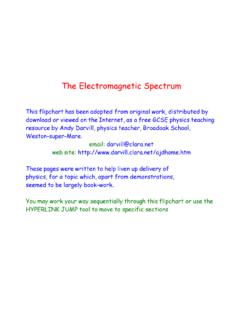
1 NAME_____ HOUR_____ The Electromagnetic Spectrum Label the parts of a wave using the terms: crest, trough, frequency, wavelength, amplitude 1. _____ 2. _____ 3. _____ 4. _____ 5. _____ 6. Circle the appropriate words to describe the waves at the LEFT end of this wave Spectrum a. Long / Short wavelength b. High / Low frequency c. High / Low energy 7. Circle the appropriate words to describe the waves at the RIGHT end of this wave Spectrum a. Long / Short wavelength b. High / Low frequency c. High / Low energy 8. Fill in the blanks underneath the wave Spectrum to indicate the relative positions of each type of Electromagnetic radiation from the given word bank. 9.
2 Look carefully at the Electromagnetic Spectrum shown below paying attention to the wavelengths and frequencies indicated. The visible portion of the Electromagnetic Spectrum has been enlarged below the Spectrum . Fill in the blanks with the correct colors from the visible Spectrum according to their wavelength, frequency and energy. gamma ultraviolet visible x-rays microwaves infrared radio/tv 10. Circle the correct answer a. Which has a longer wavelength? Microwaves or Infrared b. Which has a lower frequency? X rays or Gamma rays c. Which has a higher frequency? Visible or Ultraviolet d. Which has more energy? Radio/TV or Infrared e. Which has more energy? Red light or Green light f.
3 Which has a higher frequency? Orange light or Blue light g. Which has a shorter wavelength? Ultraviolet or X rays 11. The radio station broadcasts radio waves . What do the numbers represent? 12. Compare the radio waves broadcast by the two stations, and a. Which station broadcasts waves with more energy? b. Which station broadcasts waves with a shorter wavelength? c. Which station broadcasts waves with a higher frequency? 13. What is the relationship between frequency and wavelength? 14. What is the relationship between frequency and energy? 15. What is the relationship between wavelength and energy?