Transcription of The First Epistle To The Corinthians - Executable …
1 The First Epistle To The Corinthians A Study Guide With Introductory Comments, Summaries, And Review Questions (Student Edition). This material is from , a web site containing sermon outlines and Bible studies by Mark A. Copeland. Visit the web site to browse or download additional material for church or personal use. The outlines were developed in the course of my ministry as a preacher of the gospel. Feel free to use them as they are, or adapt them to suit your own personal style. To God Be The Glory! Executable Outlines, Copyright Mark A. Copeland, 2006. Mark A. Copeland The First Epistle To The Corinthians Table Of Contents Introduction 3. Chapter One 6. Chapter Two 9. Chapter Three 12. Chapter Four 14. Chapter Five 17. Chapter Six 19. Chapter Seven 22. Chapter Eight 24. Chapter Nine 26. Chapter Ten 29. Chapter Eleven 32. Chapter Twelve 35. Chapter Thirteen 38. Chapter Fourteen 41. Chapter Fifteen 44. Chapter Sixteen 47. This study guide was developed in preparation for teaching adult Bible classes.
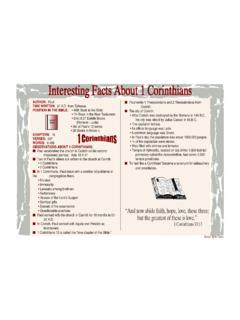
2 W The objectives for each section are usually things I plan to emphasize during the class. w I have found that summarizing and outlining helps me to better understand the Word of God. It is a practice I highly recommend to others. The First Epistle To The Corinthians 2. Mark A. Copeland The First Epistle To The Corinthians Introduction AUTHOR. Paul, the apostle (1:1; 16:21), joined by Sosthenes, who some think may be the same as mentioned in Ac 18:17. The authorship of this Epistle is attributed to Paul by Clement of Rome in 95 PLACE OF WRITING. The city of Ephesus (16:8). TIME OF WRITING. Probably in the spring of 57 , shortly before the Jewish feast of Pentecost (16:8), during his third missionary journey (Ac 19:1-41). BACKGROUND OF THE CITY OF CORINTH. Corinth was situated on the Isthmus of Greece (called Achaia in the Bible) between the Ionian Sea and the Aegean Sea, above the Mediterranean Sea. About 50 miles to the east was the city of Athens.
3 The Corinth of Paul's day was relatively new. The old Corinth (which was famous and powerful in the days of the Peloponnesian War) was burned in 146 by the Roman proconsul, L. Mummius. Because it was a city devoted to the gods, a hundred years were required to pass before the city could be rebuilt. In 46 , Julius Caesar rebuilt the city, populated it with a colony of veterans and freedmen, and named it Julia Corinthus. It soon became a very important commercial center. With a population of 400,000 and being a prominent center of commerce in the Mediterranean world, it was a place for all sorts of vice. An example of its immorality was found in the temple of Venus (Aphrodite), which hosted 1000 priestesses dedicated to prostitution in the name of religion. The city's close proximity to the city of Athens probably added the problem of intellectualism. As noticed in the Epistle , such an environment had its effect upon the church in Corinth.
4 It is amazing that a church existed at all in such a city. BACKGROUND OF THE CHURCH AT CORINTH. The establishment of the church occurred during Paul's second missionary journey. It is recorded by Luke in Ac 18:1-18, which can be divided into three sections: w Abiding with Aquila and Priscilla, fellow tentmakers; reasoning in the synagogue every Sabbath (Ac 18:1-6). w In the house of Justus, abiding there and teaching for a year and six months (Ac 18:7- 11). The First Epistle To The Corinthians 3. Mark A. Copeland w An incident before Gallio, proconsul of Achaia (Ac 18:12-18). It appears from reading the Epistle that the church was adversely affected by the immoral environment found in the city. Pride caused division in the church and disruption in the services (1 Co 1-4, 11). Immorality and immodesty found its way into the church, which gave it a bad reputation (1 Co 5). The brethren were taking their personal problems with each other before the heathen courts instead of working them out among themselves (1 Co 6).
5 Other issues affecting the church included questions about marriage (1 Co 7), meats sacrificed to idols (1 Co 8-10), women praying and prophesying with heads uncovered (1 Co 11), abusing the Lord's Supper (1 Co 11), the use of spiritual gifts (1 Co 12-14), the resurrection from the dead (1 Co 15), and the collection for the saints in Jerusalem (1 Co 16). Thus the church was one beset with problems and questions that needed to be answered. PURPOSE OF WRITING. The bad news concerning the problems at Corinth had reached Paul in Ephesus. It seems that this news came from at least two sources: 1) the household of Chloe (1:11); and 2) a letter sent to him (7:1), possibly by the hands of Stephanas, Fortunatus, and Achaicus (16:17). Therefore, in answer to these reports Paul writes: TO CORRECT SINFUL PRACTICES AND REFUTE FALSE DOCTRINE. THEME: 1 Corinthians 1:10. "Now I plead with you, brethren, by the name of our Lord Jesus Christ, that you all speak the same thing, and that there be no divisions among you, but that you be perfectly joined together in the same mind and in the same judgment.
6 ". BRIEF OUTLINE (adapted from Dextor Sammons). INTRODUCTION (1:1-9). I. PROBLEMS REPORTED BY THE HOUSE OF CHLOE (1:10-6:20). A. FACTIONS IN THE CHURCH (1:1-4:21). B. SEXUAL IMMORALITY (5:1-13). C. LAWSUITS AMONG BRETHREN (6:1-11). D. MORAL DEFILEMENTS (6:12-20). II. PROBLEMS MENTIONED IN THE LETTER FROM CORINTH (7:1-16:9). A. MARRIAGE & CELIBACY (7:1-40). B. EATING MEATS SACRIFICED TO IDOLS (8:1-11:1). C. WOMEN PRAYING AND PROPHESYING WITH HEADS UNCOVERED (11:2-16). D. THE LORD'S SUPPER (11:17-34). E. SPIRITUAL GIFTS (12:1-14:40). F. RESURRECTION FROM THE DEAD (15:1-58). G. COLLECTION FOR THE SAINTS (16:1-4). CONCLUDING REMARKS, INSTRUCTIONS, AND BENEDICTION (16:5-24). The First Epistle To The Corinthians 4. Mark A. Copeland REVIEW QUESTIONS FOR THE INTRODUCTION. 1) On which journey did the apostle Paul establish the church in Corinth? 2) Where do we read of the establishment of the Corinthian church? 3) Who did Paul First stay with in Corinth?
7 What did they have in common? (Ac 18:1-3). 4) Which chief ruler of the synagogue was converted? (Ac 18:8). 5) Approximately how long did Paul stay in Corinth? (Ac 18:11). 6) Who did Aquila and Priscilla convert in Ephesus who later went to Corinth? (Ac 18:24- 19:1). 7) From where did Paul write this First Epistle to Corinth? (16:8). 8) What is the approximate date of writing? 9) What two things existed in Corinth that appeared to have an adverse effect on the church? 10) What is the purpose of this Epistle ? 11) Where is the theme of the Epistle stated? The First Epistle To The Corinthians 5. Mark A. Copeland The First Epistle To The Corinthians Chapter One OBJECTIVES IN STUDYING THIS CHAPTER. 1) To understand how division is unacceptable is the Body of Christ 2) To see why our boasting should be only in the Lord SUMMARY. In his opening remarks Paul expresses gratitude that the Corinthians had been enriched by God, came behind in no gift, and were eagerly waiting for the revelation of the Lord (1-9).
8 He immediately begins dealing with the First problem, that of division which manifested itself in what we might call "preacheritis" (10-17). Discerning that the underlying cause concerns the exaltation of human wisdom, Paul demonstrates the folly of boasting in such (18-31). OUTLINE. I. INTRODUCTION (1-9). A. GREETINGS FROM PAUL AND SOSTHENES (1-3). 1. To the church at Corinth, and those who in every place call on the name of Jesus (2). 2. Grace and peace from God our Father and the Lord Jesus (3). B. THANKSGIVING FOR GOD'S GRACE TOWARDS THEM (4-9). 1. Enriching them in all knowledge, even as Christ's testimony was confirmed in them (5-6). 2. Coming short in no gift as they eagerly await the revelation of the Lord Jesus Christ (7). 3. Who will confirm them so they may be blameless (8). 4. For God is faithful, who called them into the fellowship of His Son (9). II. THE NATURE OF THE DIVISION AT CORINTH (10-17). A. AS REPORTED TO PAUL (10-12).
9 1. His plea for unity (10). 2. For those of Chloe's household have reported contentions among them (11). 3. Evidently involving "preacheritis" (12). B. PAUL'S INITIAL REACTION (13-17). 1. Rhetorical questions to illustrate the absurdity of what we would call "preacheritis" (13). 2. Gratitude that he personally baptized few of them (14-17). a. Lest any should accuse him of baptizing in his own name (14-15). b. Administering baptism was not his chief calling anyway (16-17). III. THE FOLLY OF BOASTING IN HUMAN WISDOM (18-31). The First Epistle To The Corinthians 6. Mark A. Copeland A. GOD WILL DESTROY THE WISDOM OF THE WISE (18-25). 1. Granted, the message of the cross is foolish to some, but not to the saved (18). 2. But God will the destroy the wisdom of the world (19-20). 3. God chose to use His foolishness and His weakness to save those who believe (21-25). a. Because the world through its wisdom knew not God (21a). b. So God chose to save mankind through a "foolish" message about Christ crucified (21b-24).
10 C. But even God's "foolishness" and "weakness" is wiser and stronger than men (25). B. THE Corinthians ' OWN CALLING DEMONSTRATES THIS TRUTH (26-29). 1. Not many of them were "wise, mighty, or noble" (26). 2. But God has chosen those things that are "foolish, weak, base, despised, and which are not", so that no flesh should glory in His presence (27-29). C. INSTEAD, BOAST IN THE LORD (30-31). 1. He provides true wisdom, plus righteousness and sanctification and redemption (30). 2. We should glory only in Him (31). REVIEW QUESTIONS FOR THE CHAPTER. 1) List the main points of this chapter 2) Who joined with Paul in addressing this letter to the Corinthians ? (1). 3) What was one thing the church did not lack in Corinth? (7). 4) What is the First problem Paul deals with in this Epistle ? (10). 5) Who reported this problem to him? (11). 6) How was their divisiveness expressed? (12). 7) Who had Paul personally baptized at Corinth? (14,16). 8) Why was Paul thankful that he had not baptized any other?