Transcription of The Laplace Transform (Sect. 6.1). - users.math.msu.edu
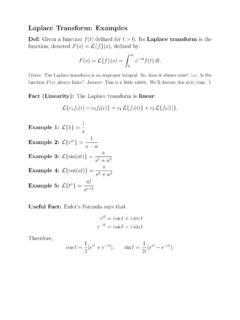
1 The Laplace Transform (Sect. ).IThe definition of the Laplace : Improper of Laplace table of Laplace of the Laplace Transform and differential Laplace Transform (Sect. ).IThe definition of the Laplace : Improper of Laplace table of Laplace of the Laplace Transform and differential definition of the Laplace functionF:DF Ris theLaplace transformof a functionf: [0, ) Riff for alls DFholds,F(s) = 0e stf(t)dt,whereDF Ris the set where the integral :The domainDFofFdepends on the :We often denote:F(s) =L[f(t)].IThis notationL[ ] emphasizes that the Laplace transformdefines a map from a set of functions into a set of are denoted ast7 f(t).IThe Laplace Transform is also a function:f7 L[f].The Laplace Transform (Sect. ).IThe definition of the Laplace : Improper of Laplace table of Laplace of the Laplace Transform and differential : Improper :Improper integral are defined as a limit.]
2 T0g(t)dt= limN Nt0g(t) integralconvergesiff the limit integraldivergesiff the limit does not the improper integral 0e atdt, witha> : 0e atdt= limN N0e atdt= limN 1a(e aN 1).Since limN e aN= 0 fora>0,we conclude 0e atdt= Laplace Transform (Sect. ).IThe definition of the Laplace : Improper of Laplace table of Laplace of the Laplace Transform and differential of Laplace [1].Solution:We have to find the Laplace Transform off(t) = the definition we obtain,L[1] = 0e st1dt= 0e stdtBut 0e atdt=1afora>0,and diverges [1] =1s, fors>0,andL[1] does not exists other words,F(s) =L[1] is the functionF:DF Rgiven byf(t) = 1,F(s) =1s,DF= (0, ).CExamples of Laplace [eat], wherea :Following the definition of Laplace Transform ,L[eat] = 0e steatdt= 0e (s a) have seen that the improper integral is given by 0e (s a)dt=1(s a)for (s a)> conclude thatL[eat] =1s afors> other words,f(t) =eat,F(s) =1(s a),s> of Laplace [sin(at)], wherea :In this case we need to computeL[sin(at)] = limN N0e stsin(at) by parts twice it is not difficult to obtain: N0e stsin(at)dt= 1s[e stsin(at)] N0 as2[e stcos(at)] N0 a2s2 N0e stsin(at) identity implies(1 +a2s2) N0e stsin(at)dt= 1s[e stsin(at)] N0 as2[e stcos(at)] of Laplace [sin(at)], wherea :Recall the identity.
3 (1 +a2s2) N0e stsin(at)dt= 1s[e stsin(at)] N0 as2[e stcos(at)] , it is not difficult to see that(s2+a2s2) 0e stsin(at)dt=as2,s>0,which is equivalent toL[sin(at)] =as2+a2,s> Laplace Transform (Sect. ).IThe definition of the Laplace : Improper of Laplace table of Laplace of the Laplace Transform and differential table of Laplace (t) = 1F(s) =1ss>0,f(t) =eatF(s) =1s as>max{a,0},f(t) =tnF(s) =n!s(n+1)s>0,f(t) = sin(at)F(s) =as2+a2s>0,f(t) = cos(at)F(s) =ss2+a2s>0,f(t) = sinh(at)F(s) =as2 a2s>0,f(t) = cosh(at)F(s) =ss2 a2s>0,f(t) =tneatF(s) =n!(s a)(n+1)s>max{a,0},f(t) =eatsin(bt)F(s) =b(s a)2+b2s>max{a,0}.The Laplace Transform (Sect. ).IThe definition of the Laplace : Improper of Laplace table of Laplace of the Laplace Transform and differential of the Laplace (Sufficient conditions)If the function f: [0, ) Ris piecewise continuous and thereexist positive constants k and a such that|f(t)|6k eat,then the Laplace Transform of f exists for all s> (Linear combination)If theL[f]andL[g]are well-defined and a, b are constants, thenL[af+bg] =aL[f] +bL[g].]
4 Proof:Integration is a linear operation: [a f(t) +b g(t)]dt=a f(t)dt+b g(t) of the Laplace (Derivatives)If theL[f]andL[f ]are well-defined, then holds,L[f ] =sL[f] f(0).(1)Furthermore, ifL[f ]is well-defined, then it also holdsL[f ] =s2L[f] s f(0) f (0).(2)Proof of Eq (2):Use Eq. (1) twice:L[f ] =L[(f ) ]=sL[(f )] f (0)=s(sL[f] f(0)) f (0),that is,L[f ] =s2L[f] s f(0) f (0).Properties of the Laplace of Eq (1):Recall the definition of the Laplace Transform ,L[f ] = 0e stf (t)dt= limn n0e stf (t)dtIntegrating by parts,limn n0e stf (t)dt= limn [(e stf(t)) n0 n0( s)e stf(t)dt]L[f ] = limn [e snf(n) f(0)]+s 0e stf(t)dt= f(0)+sL[f],where we used that limn e snf(n) = 0 forsbig enough,and wealso used thatL[f] is then conclude thatL[f ] =sL[f] f(0).The Laplace Transform (Sect.)
5 IThe definition of the Laplace : Improper of Laplace table of Laplace of the Laplace Transform and differential Transform and differential : Laplace Transforms can be used to find solutions todifferential equations withconstant of the method:L[Differential (t).](1) Algebraic [y(t)].(2) (2) Solve theAlgebraic [y(t)].(3) Transform backto obtainy(t).(Using the table.) Laplace Transform and differential the Laplace Transform to find the solutiony(t) to the IVPy + 2y= 0,y(0) = :We know the solution:y(t) = 3e 2t.(1):Compute the Laplace Transform of the differential equation,L[y + 2y] =L[0] L[y + 2y] = an algebraic equation forL[y].Recall linearity:L[y ] + 2L[y] = recall the property:L[y ] =sL[y] y(0),that is,[sL[y] y(0)]+ 2L[y] = 0 (s+ 2)L[y] =y(0).
6 Laplace Transform and differential the Laplace Transform to find the solutiony(t) to the IVPy + 2y= 0,y(0) = :Recall:(s+ 2)L[y] =y(0).(2):Solve the algebraic equation forL[y].L[y] =y(0)s+ 2,y(0) = 3, L[y] =3s+ 2.(3): Transform back toy(t).From the table:L[eat] =1s a 3s+ 2= 3L[e 2t] 3s+ 2=L[3e 2t].Hence,L[y] =L[3e 2t] y(t) = 3e