Transcription of The Relationship between ADHD and Problem …
1 The Relationship between adhd and Problem Gambling Student Presenter: Oliver R Waluk. Supervisor: Dr. Nicki Dowling S. What do we mean by Problem Gambling ? S Problem Gambling S Characterised by difficulties in limiting time and/or money spent gambling, which leads to undesirable consequences for the individual, others, and/or the community . S Includes but is not limited to DSM-5 Pathological Gambling What do we mean by Problem Gambling ? S Prevalence rates range from to , with the average rate across all countries reported at What do we mean by adhd ?
2 S Attention Deficit-Hyperactivity Disorder ( adhd ). S Characterised by significant problems with attention, hyperactivity, and/or acting impulsively that are deemed not appropriate for the persons age S Symptoms must occur before the age of 12. years according to DSM-5 criteria S Prevalence of adhd in the community has been shown to be as high as 14% (Kessler et al., 2007). S adhd occurs between 3 to 7% of school-aged children in the US and between to of children and adolescents worldwide S Young boys are more likely to be diagnosed with the disorder than girls.
3 Why study adhd and Problem Gambling? S Both adhd and Problem gambling place considerable social, psychological, and financial burdens on patients and their families. S Problem gambling is related to: S Higher amount of legal problems, bankruptcy, incarceration, divorce, and an overall reduced quality of life. S Patients with adhd often: S Underachieve in educational settings, experience a large amount of parental and peer rejection, are under-employed or unemployed, retain a higher risk for accidental injury, and are more often arrested and convicted of criminal offences Complicating the clinical profile.
4 Comorbidities S Both Problem gambling and adhd have been found to be comorbid with other disorders S This complicates the clinical profile of patients with implications for screening, assessment, management and overall treatment. S Problem gamblers have high rates comorbidity for any type of anxiety disorder ( ), substance use disorders ( ), any type of mood disorder ( ), and nicotine dependence ( ). S 70-75% of clinic-referred adults with adhd have at least one co-occurring psychiatric condition S adhd is often comorbid with depression (16-31%), anxiety (24-60%), obsessive-compulsive disorder (4-14%), and substance abuse (32-53% alcohol abuse, 8-32% other).
5 Previous Studies: Relationship of adhd and Problem Gambling S Adolescents and young adults who screen positively for adhd are: S more likely to engage in gambling S develop gambling problems S experience a greater severity in gambling problems S Conversely, adolescents who report Problem gambling behaviours are more likely to possess a larger proportion of adhd . symptoms. Previous Studies: Relationship of adhd and Problem Gambling S There is evidence to suggest that between and of Problem gamblers seeking treatment for their gambling problems have a comorbid psychiatric diagnosis of adhd .
6 S Problem gamblers with a history of adhd have more severe: S gambling related cognitions S a higher frequency of psychiatric comorbidities S and an elevated risk of suicide S adhd impulsivity symptoms in childhood, may predate the onset of future Problem gambling behaviour S adhd Problem gamblers may comprise a special at-risk group . Previous Studies: Pathways to Gambling S adhd is a key risk factor in Blaszczynski & Nower, (2002) Pathways model of Problem gambling. S adhd is implicated in the Third pathway, known as the antisocial impulsivist , along with impulsivity, antisocial personality disorder, and substance use.
7 S Neurobiological studies support the existence of adhd as a risk factor of Problem gambling and the significant relationships between substance abuse, impulsivity and Problem gambling. S Subtypes that most closely resemble the antisocial impulsivist pathway are most likely comprised of young, male Problem gamblers. Limitations of Previous Studies S Past studies are often limited to predominantly adolescent or young adult samples. S The quantity of studies is quite sparse as this is a relatively new area of research. Our Study Aims S Our study aimed to investigate the Relationship between adhd and Problem gambling in a clinical sample of adult treatment seeking Problem gamblers by: S (a) exploring the prevalence of adhd in a clinical sample compared to the 14%.
8 Prevalence in the community (Kessler et al. 2007). S (b) identify any key relationships between adhd and Problem gambling severity, impulsivity, Cluster B personality disorders, alcohol use, substance use, gender, and age S (c) investigate the degree to which these factors moderate the Relationship between adhd and Problem gambling severity. Participants and Procedure S Participants S 189 adult treatment-seeking Problem gamblers (137 males, 50. females, 2 unspecified). S Aged 21-74 years old S Majority were Australian born ( ), single, and in full time employment S Procedures S We used previously collected data S Participants presented to a Problem gambling treatment service in Melbourne, Australia S Upon a first appointment participants were asked to complete the questionnaire in the waiting area.
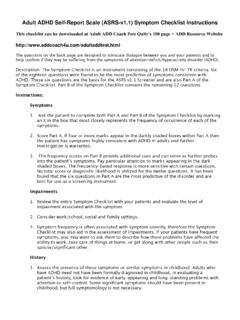
9 S Data was collected from August 2009 to July 2011 (response rate 88%). S Questionnaires were collated and responses entered into SPSS. Measures and Data Analysis S Measures/Scales S adhd = ASRS S Problem Gambling Severity = PGSI. S Impulsivity = BIS-SF. S Cluster B disorders = IOWA. S Alcohol and Substance use = separate single question items S Gender and Age = separate single items S Data Analysis S A series of descriptive statistics S one-sample z-test S Spearman's rho S Ordinal regression S Linear regression analyses Results of Study S Results showed that: S (a) the prevalence of adhd in our clinical sample was significantly higher than the 14% prevalence in a community sample (Kessler et al.)
10 , 2007). S (b) adhd was significantly positively correlated with Problem gambling severity (PGSI), impulsivity (BIS-SF), Cluster B. personality disorders (IOWA), and substance use. S (c) none of the factors significantly moderated the Relationship between adhd and Problem gambling. Discussion: Implications S Problem gambling treatment services must ensure they screen for adhd . whenever Problem gambling is present S adhd complicates the clinical profile of Problem gamblers S Comorbid adhd may influence the outcomes of treatment S Problem gamblers with adhd may require different management strategies than those without Problem gambling Discussion: Limitations and Future Research S Study Limitations: S A clinical sample of treatment-seeking Problem gamblers precludes generalization of the results to the greater population.