Transcription of The Scientific Method - kennedyacademy.org
1 The Scientific Method Exploring Experimental Design Unit Overview OBJECTIVE Students will identify and apply the steps of the Scientific Method . LEVEL All NATIONAL STANDARDS , , , , , CONNECTIONS TO AP All AP Science courses contain a laboratory component where the Scientific Method will be used. TIME FRAME Two 45 minute class periods MATERIALS Come Fly With Us student pages Scientific Method Practice 1 student pages penny Lab student pages Scientific Method Practice 2 student pages TEACHER PAGES Suggested Teaching Procedure Day 1 1. Present notes on the steps of the Scientific Method as you see fit. Although this part is teacher directed, ideally the steps should be presented as more of a discussion. Some questions to ask during your discussion include: What is the variable that the experimenter changes? What makes a valid experiment? Why is it important to have detailed procedures? Why is the control such an important part of the experiment?
2 2. After students take notes, pass out the student activity pages for Come Fly With Us. 3. Students should read the directions and perform the prescribed tasks in the procedure, applying there Scientific Method knowledge. Students should complete and turn in Come Fly with Us before leaving. 4. Distribute Scientific Method Practice 1, and have students read and answer the questions for homework. Students are to return the completed questions the following class period. Day 2 1. After collecting the students papers, review the correct answers with the class. 2. Pass out the student activity pages for the penny Lab. Students should read the instructions and perform the lab during class. 3. After completing the lab, students should turn in a laboratory report before the end of the period. 4. Assign Scientific Method Practice 2 as homework. Students should return the completed assignment the following class period. Day 3 1.
3 After collecting the students papers, review the correct answers with the class. TEACHER PAGES TEACHER NOTES Modern Scientific inquiry or science (from scientia, Latin for knowledge) is generally attributed to the historical contributions of Galileo Galilei and Roger Bacon. However, some historians believe that their practices were inspired by earlier Islamic tradition. In spite of the rich human tradition of Scientific inquiry, today there is no single or universal Method of performing science. According to the National Science Teachers Association, science is characterized by the systematic gathering of information through various forms of direct and indirect observations and the testing of this information by methods including, but not limited to, experimentation. Although this definition is helpful in explaining the process of science, it does not specify a list of experimental steps that one should logically progress through to perform an experiment.
4 (An experiment can be defined as an organized series of steps used to test a probable solution to a problem, commonly called a hypothesis.) Despite the absence of a standard Scientific Method , there is a generally agreed upon model that describes how science operates. Steps of the Scientific Method 1. State the problem: What is the problem? This is typically stated in a question format. EXAMPLE: Will taking one aspirin per day for 60 days decrease blood pressure in females ages 12-14? 2. Research the problem: The researcher will typically gather information on the problem. They may read accounts and journals on the subject, or be involved in communications with other scientists. EXAMPLE: Some people relate stories to doctors that they feel relief from high blood pressure after taking one aspirin per day. The idea is not Scientific if it is untested or if one person reports this (called anecdotal evidence).
5 3. Form a probable solution, or hypothesis, to your problem: Make an educated guess as to what will solve the problem. Ideally this should be written in an if-then format. EXAMPLE: If a female aged 12-14 takes one aspirin per day for 60 days, then her blood pressure will decrease. 4. Test your hypothesis: Do an experiment. EXAMPLE: Test 100 females, ages 12-14, to see if taking one aspirin a day for 60 days lowers blood pressure in those females. Independent Variable ( ): The variable you change, on purpose, in the experiment. To help students remember it, suggest the phrase I change it emphasizing the Independent variable. EXAMPLE: In this described experiment, taking an aspirin or not would be the independent variable. This is what the experimenter changes between his groups in the experiment. TEACHER PAGES Dependent Variable ( ): The response to the EXAMPLE: The blood pressure of the individuals in the experiment, which may change from the administration of aspirin.
6 Control: The group, or experimental subject, which does not receive the EXAMPLE: The group of females that does not get the dose of aspirin. Constants: Conditions that remain the same in the experiment. EXAMPLE: In this scenario some probable constants would include: only females were used, only females around the same age, the same dosage of aspirin was given to all the individuals in the experimental group for the same defined time interval 60 days, the same brand of aspirin was given, the same type of diet was ideally given to the members of both groups as well as the same activity level prescribed. 5. Recording and analyzing the data: What sort of results did you get? Data is typically organized into data tables. The data is then graphed for ease of understanding and visual appeal. EXAMPLE: Out of 100 females, ages 12-14 yrs., 76 had lower blood pressure readings after taking one aspirin per day for 60 days.
7 6. Stating a conclusion: What does all the data mean? Is your hypothesis supported? EXAMPLE: The data shows that taking one aspirin per day for 60 days decreases blood pressure in 76% of the tested females ages 12-14 compared to a decrease in blood pressure in 11% of the control group. Therefore, the original hypothesis has been supported, that taking one aspirin per day can decrease blood pressure. 7. Repeating the work: Arguably, the most important part of Scientific inquiry! When an experiment can be repeated and the same results obtained by different experimenters, that experiment is validated. Included in this unit is a hands-on lab entitled Come Fly with Us. This activity makes a great first day activity to get kids warmed up to the Scientific Method . They will examine what happens to the spin direction of a paper helicopter when they fold the blades in different directions. Students construct a paper helicopter to test their hypothesis on how the helicopter will fly upon folding the blades in different directions.
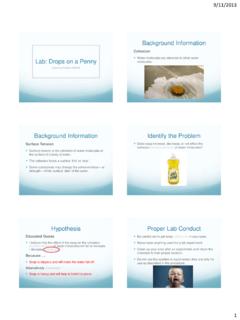
8 The lab is well designed for pointing out the steps of the Scientific Method . Another student-centered activity which has been included is the penny Lab. Although it was initially designed for middle school use, this activity can be modified for use at any level to reinforce the steps of the Scientific Method . Students are given the simple task of determining the number of drops that can fit on the Lincoln side of a penny . As the lab is designed, the students quickly learn that even the most simple of experiments can contain many hidden variables that decrease the validity of the experiment. TEACHER PAGES The Scientific Method Exploring Experimental Design Come Fly With Us OBJECTIVE Students will practice applying the steps of the Scientific Method to a problem. LEVEL All levels NATIONAL STANDARDS , , , , , CONNECTIONS TO AP Using the Scientific Method by acquiring data through experimentation and design of experiments are all fundamental skills needed for the AP Science courses.
9 TIME FRAME 45 minutes MATERIALS (For a class of 28) TEACHER NOTES Come Fly With Us is an effective way for students to experimentally test a variable in a simple activity. This activity is designed to be the first activity that students complete after learning the steps of the Scientific Method . The students can apply their learning in a meaningful way. Students cut out and fold a paper helicopter according to the instructions provided. After constructing the simple helicopter, students are instructed to fold the blades of the helicopter in opposing directions. 28 copies of the helicopter model (provided in the student pages) 14 pairs of scissors 28 pens or pencils TEACHER PAGES Students generate a hypothesis as to how they think changing the direction of the fold of the wings will affect the direction of spin. The students then test their hypothesis and fly the helicopter. The students will discover that folding the blade one way will produce a clockwise spin of the helicopter.
10 Folding the blades in the opposite direction will produce a counterclockwise spin of the helicopter. The students should solidify their understanding that by manipulating the independent variable (direction of fold) the dependent variable (spin direction) responds. The students must also take into consideration the constants in their experiment: holding the helicopter at the same initial height, maintaining a stable wind environment, no other external forces acting on the helicopter, and holding the helicopter at the T each time. The concept of a control group is best illustrated in the second half of Come Fly With Us. A fictitious student, Bonita, believes that adding mass (paper clips) will stabilize her paper helicopter and increase the flight time. The independent variable is the presence or absence of the added mass. The control group, by definition, does not receive the independent variable. Therefore, the control in Bonita s experiment is a paper helicopter with no paper clips added.