Example: confidence
The Water Cycle - NCSE
The Water Cycle What is the Water Cycle? The water cycle is a way that water moves all around the Earth. It never stops, it does not have a beginning or an end. It's like a big circle! Did you know? The water cycle is also known as the “hydrologic cycle” Earth has been recycling water for over 4 billion years! Do plants sweat?
Tags:
Information
Domain:
Source:
Link to this page:
Documents from same domain
Information for Parents and Guardians of Children …
ncse.ieInformation for Parents/Guardians of Children and Young People with Specific Learning Disabilities (including dyslexia, dyscalculia, dysgraphia)

Parents of children with ASD - NCSE
ncse.iePARENTS OF CHILDREN WITH ASD 3 EXECUTIVE SUMMARY The primary aim of this study was to explore the information and education needs of parents of children with Autistic Spectrum Disorder (ASD).
GUIDELINES ON THE INDIVIDUAL EDUCATION …
ncse.ieGUIDELINES ON THE INDIVIDUAL EDUCATION PLAN PROCESS MAY 2006 v FOREWORD The value of the preparation and implementation of Individual Education Plans (IEPs) for children with
Leaving School? – Information on Post-School …
ncse.ieLeaving School? Information on some Post-School Options for School Leavers and other Adults with Disabilities FURTHER EDUCATION AND TRAINING
Supporting Students with Special Educational …
ncse.ieSupporting Students with Special Educational Needs in Schools NCSE POLICY ADVICE PAPER NO. 4
NCSE - Starting School - Guidelines for …
ncse.ieNCSE 2016 Starting School Guidelines for Parents/Guardians of Children with Special Educational Needs
Literature Review of the Principles and Practices …
ncse.ieLiterature Review of the Principles and Practices relating to Inclusive Education for Children with Special Educational Needs Prepared by …
Delivery for Students with Special Educational Needs - NCSE
ncse.iencse working group on a proposed new model . for allocating teaching resources for students with special educational needs. delivery for students

Procedures used to Diagnose a Disability and to Assess ...
ncse.ieProcedures used to Diagnose a Disability and to Assess Special Educational Needs: An International Review 1 Procedures used to Diagnose a Disability and to Assess Special
NCSE HQ Contact Details
ncse.ieNCSE HQ Contact Details ===== National Council for Special Education 1-2 Mill St Trim
Related documents

3 What Makes Plants Grow? Plant Connections PURPOSE ...
edis.ifas.ufl.eduThe hydrologic cycle. The hydrologic cycle is the cycle of water in the environment. Water moves in a series of processes. Water moves by precipitation, evaporation, transpiration, and condensation. The sun provides the energy for water to move in a cycle. All water on earth is part of the water cycle regardless if it is in a lake, our bodies ...
Lesson 1: Aquatic Ecosystems - USF
www.marine.usf.eduThe Hydrologic Cycle The hydrologic cycle is the circulation of water among the oceans, the atmosphere, and the land masses, through evaporation, precipitation, surface runoff, and groundwater percolation. The cycle has no beginning and no end. This means there is no new water put into the cycle, the same water is used over and over again.

Chapter 2 The hydrological cycle - hi
notendur.hi.isThe hydrologic cycle is a model of the movement of water through the Earth system. It also is a pathway throughwhich energy is transferred between the surface of the earth and the atmosphere. The unequal distributionof water leaves its imprint on the surface of the earth through the mosaic of biomes and landforms sculpted

General Guidelines for Calculating a Water Budget - …
www.michigan.govPrecipitation is the primary water input to the hydrologic cycle and is evaluated for all water budget calculations. Precipitation data for a normal year should be used to evaluate the long-term impacts of a project. The precipitation data can be obtained from various NOAA . 3/3/2010 General Guidelines for Calculating a Water Budget page 2

BIOGEOCHEMICAL CYCLES Name KEY Name the 4 …
www.lcps.org__NITROGEN_____ Cycle which is dependent on bacteria for nitrogen fixation and denitrification __CARBON_____ Cycle in which volcanic activity and burning fossil fuels plays a role __HYDROLOGIC_____ Another name for the water cycle __CARBON_____ Cycle which includes an underground reservoir in the form of fossil fuels
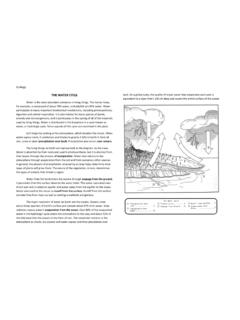
THE WATER CYCLE - Mustang Public Schools
www.mustangps.orgwater, or hydrologic cycle. Some aspects of this cycle are examined in this plate. Let’s begin by looking at the atmosphere, which includes the clouds. When water vapour cools, it condenses and thanks to gravity it falls to Earth in form of rain, snow or sleet (precipitation over land).

Introduction to Hydrology and Meteorology
www.seu.ac.lkHydrologic Cycle • natural circulation of water from the oceans and land surface to the air, air to land, and back to the ocean • driving force - radiant energy of the sun. Water in the earth Source Volume ( 106 km3) % Exchange Rate (Year) Ocean 1338.0 96.5 3000 Groundwater (fresh and

The Water Cycle - Winston-Salem/Forsyth County Schools
www.wsfcs.k12.nc.usThe Water Cycle. Our bodies are made of 70% water. It is vital for all life on Earth. Almost 75% of the earth’s surface is covered with water. Water is everywhere. The same water that existed on the earth millions of years ago is still present today. …

HYDROLOGICAL MODEL HEC - HMS (Hydrologic Engineering ...
www.mona.uwi.eduHYDROLOGIC MODELING • HEC HMS-(Hydrologic Modeling System) is designed to simulate precipitation- runoff processes of dendritic water systems . • HEC RAS- (River Analysis System) is a hydraulic model that calculates one-dimensional steady and unsteady flow. The inputs for this model are the hydrograph output from HMS.