Transcription of THEORY-BASED EVALUATION - INTRAC
1 INTRAC 2017 THEORY-BASED EVALUATION A THEORY-BASED EVALUATION is usually based on an explicit theory of change or logic model that explains the theory of a development intervention. The EVALUATION is designed to test the theory to see if it holds true. If it does, the task of the evaluator is to produce a plausible case, with evidence, that shows what has changed at each level of the theory, and explores the linkages between those changes. A THEORY-BASED EVALUATION is usually based on an explicit theory of change or logic model that explains the theory of a development intervention or set of interventions. Theories of change (or logic models) generally include a chain of results from inputs, activities and outputs through to outcomes and impact, thereby showing the links between causes and effects.
2 Theories of change may be very simple such as the kind of logic model contained within a standard logical framework or much more complicated. Theories of change or logic models are often represented by flowcharts, known as critical pathways, impact pathways, causal maps or objectives trees. However, theories of change might also be depicted as dimensions or domains of change, outcome maps, or any other kind of graphical representation. More sophisticated theories of change generally include additional features such as assumptions, risks, the influence of other actors and the potential effects of the wider socio-economic environment. A THEORY-BASED EVALUATION normally attempts to assess change at each stage of the theory to test the linkages (assumptions) between different levels of change.
3 Essentially, a THEORY-BASED EVALUATION sets out to test the theory to see if it holds true. If it does, the job of the evaluator is to produce a plausible case, with evidence, that shows what has changed, and explains how a development intervention contributed to that change. A plausible case is defined as one that a reasonable person would accept, given the evidence . Many methodologies for data collection and analysis involve the use, adaptation or development of a theory of change. Some methodologies, such as process tracing or contribution analysis, also involve the development of alternative theories of change. These are then investigated to test alternative theories of how any observed changes might have come about, other than through the development intervention concerned.
4 It could be argued that most evaluations that focus on change are THEORY-BASED to at least some degree, as most look for predicted changes. However, a THEORY-BASED EVALUATION is normally understood as an EVALUATION that works with an explicit and testable theory of change or logic model. Some of the key features of a THEORY-BASED EVALUATION are contained in the box above (Stern 2015). Key Elements of a THEORY-BASED EVALUATION They are designed to answer the question of what worked (by measuring or assessing the changes brought about by a development intervention), but also why and how it worked (by examining the processes that led to those changes). They generally examine wider contributions to change, such as the actions of other interventions or changes in the wider socio-economic environment.
5 They work with an explicit theory a theory of change or logic model that underpins the development intervention being evaluated. They are based on two distinct parts: a conceptual part, which concentrates on developing the theory of change or logic model and using it to guide the EVALUATION ; and a second part that involves collecting evidence to establish whether and/or how an intervention produced the desired changes. When to use THEORY-BASED EVALUATION THEORY-BASED evaluations may be used alongside almost any other type of EVALUATION . For example, a THEORY-BASED EVALUATION often forms an important part of an impact EVALUATION , a case-based EVALUATION or a realist EVALUATION . THEORY-BASED evaluations can be used with individual cases (such as a single policy change) or with multiple cases, such as farmers receiving livelihoods support or organisations receiving capacity development support.
6 They can be used in any sector and with any kind of work. In some senses, a THEORY-BASED EVALUATION can be seen as the default EVALUATION type. Most CSO evaluations are at the very least based around a logical framework or similar planning methodology, even if they are not based on a more explicit theory of change. THEORY-BASED evaluations can only be used when there is some kind of predicted change to assess. They may not be appropriate very early on in a project or programme, before the project / programme has had time to contribute to changes at outcome or impact level. Equally, a THEORY-BASED EVALUATION would not be appropriate when a project or programme is genuinely exploratory in other words when the potential outcomes / impact are not known and cannot reasonably be estimated beforehand.
7 In these cases other types of EVALUATION may be more useful. INTRAC 2017 Theory of Change for VBNK How it works There is no set method for carrying out a THEORY-BASED EVALUATION . As with many other evaluations, the methods used depend on the nature of the intervention. For example, if an intervention is concerned with improving crop yields or health outcomes then it might be appropriate to carry out a large quantitative study designed to generate statistically significant findings. Or if an intervention is concerned with capacity development then an organisational assessment methodology could be used. In general, however, a THEORY-BASED EVALUATION always consists of three major components: the use, adaptation or development of a theory of change or logic model to explicitly set out the theory of the intervention; the collection of information at different levels of the theory of change (or logic model) to see whether or not, or how far, the desired changes have occurred; and an exploration of the links between changes at the different levels to test assumptions, and to confirm or reject the theory linking the levels.
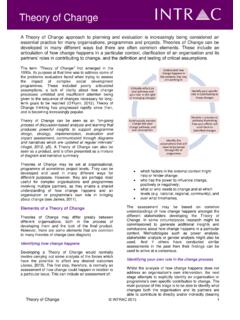
8 A fourth component is normally added, which covers the collection of information on unexpected or negative changes influenced by the development intervention being evaluated. This is illustrated using the theory of change in the diagram above. This very simple theory of change was developed by VBNK, a Cambodian organisation that works in the field of capacity development. A THEORY-BASED EVALUATION based on this theory of change would seek to assess change at different levels, including community, organisational and individual level. This might be achieved through a variety of methodologies such as participatory surveys in the community, organisational assessment tools for organisations, learning surveys for individuals, etc.
9 The EVALUATION would also seek to establish what kind of support had been provided by VBNK. The links between the different boxes could then be examined. For example, the EVALUATION could seek to assess whether support to individuals was genuinely supporting organisational development, or whether support provided to organisations had helped enhance individual capacity, and if so how. The EVALUATION might also seek to generate evidence that showed whether and/or how enhanced capacity at organisational and individual level had contributed to the empowerment of communities. If the theory of change was confirmed then a plausible argument with evidence could be developed and presented. If not, the assumptions would need to be further investigated to see why the theory had proved to be unreliable.
10 Challenges A THEORY-BASED EVALUATION can be carried out in most situations. The main challenge comes when a project or programme has no explicit theory of change or logic model, and it is difficult or impossible to develop one as part of the EVALUATION . This can only really happen when an intervention has been designed badly, or with no consideration of the desired changes. Another challenge may be where a project or programme has an explicit theory of change or logic model, but where the intervention has evolved since it was developed (White 2009). In these cases it should be possible to update or adapt the theory as part of the EVALUATION . As is always the case as well understood by physical scientists it is not possible to conclusively prove a theory, although it is sometimes possible to disprove it.