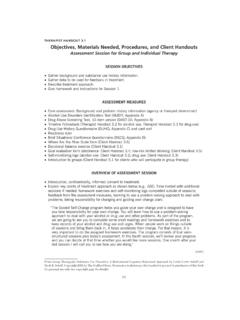
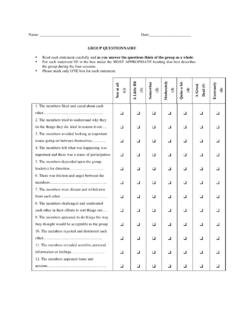
Transcription of THERAPIST HANDOUT 5.1 Objectives, Procedures, Client ...
1 164 From Group Therapy for Substance Use Disorders: A Motivational Cognitive-Behavioral Approach by Linda Carter Sobell and Mark B. Sobell. Copyright 2011 by The Guilford Press. Permission to photocopy this HANDOUT is granted to purchasers of this book for personal use only (see copyright page for details). THERAPIST HANDOUT , procedures , Client handouts , pregroup planning , and Sample Round-Robin DiscussionsGroup Session 1 INTRODUCTIONEach of the group THERAPIST handouts for group sessions is intended to help group leaders integrate cognitive-behavioral and motivational interviewing techniques and strategies into a group treatment format. Throughout each session, leaders should look for and acknowledge commonalities among members and encourage members to be supportive of other members the group leaders want to keep copies of the group members homework exercises and self-monitoring logs, they should develop a procedure that allows them to copy the information before or after the group, as members will need the forms during the each round-robin discussion, there is a list of suggested questions and topics.
2 Although several topics and questions are provided, group leaders need not ask all questions or address all topics; instead, questions and topics should be selected as they relate to what is happening in the OBJECTIVESR eview and discuss members goal evaluations; provide guidelines or information on ucontraindications for use if members self-monitoring logs with respect to their members with personalized feedback based on assessment and discuss members motivation to homework and instructions for Session PROCEDURESI ntroduce session, complete any remaining assessment and discuss members completed self-monitoring logs, copy or record members personalized feedback from assessment forms and and discuss members completed goal and discuss members completed decisional balance homework members the five-million-dollar question; affirm that changing is a choice people session: What stood out about today s session?
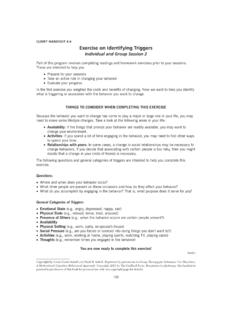
3 Remind members to do HANDOUTSR eading: Identifying Triggers ( Client HANDOUT )uExercise: Identifying Triggers ( Client HANDOUT )uCopies of Client HANDOUT for the group members when discussing the group rulesu (cont.) 165 objectives , procedures , Client handouts , pregroup planning , and Sample Round-Robin Discussions (page 2 of 9) pregroup PLANNINGP regroup planning is seen as critical for several reasons: Retention of group members contributes to members satisfaction, builds group cohesion, and results in positive group outcomes. Although pregroup planning only takes 15 to 20 minutes, it is important to do it prior to every group. pregroup planning for the first session is more extensive and may take slightly longer than planning for other sessions. It includes the assessment information on all something about each group member before the group starts, including their first 3fp r 5p cards to make brief notes about each member ( , age; first name; marital status; problem type, length, and consequences; medical problems; referral reason).
4 On a separate sheet of paper draw a circular diagram for the group and write in the first names of feach member as they sit down at the first session; this allows you to know who is sitting where and to be able to call on clients using their the chairs in a circle for the number of expected group members and the two leaders; for ubetter communication, the group leaders chairs should be positioned opposite one another (to save these chairs place a clipboard or other materials on them ahead of time).Have new homework available for members ( Client handouts and ).uPrior to this session prepare and highlight key points in each group member s Personalized uFeedback HANDOUT : Where Does Your Alcohol Use Fit In? ( Client HANDOUT ) or Where Does Your Drug Use Fit In? ( Client HANDOUT ).Note to Group Leaders: To prepare these handouts , use information collected from the TLFB and other measures administered at the assessment and discussed in Chapter 4 (go to for measures and forms).
5 Group leaders also need to decide who will take the lead for each of the major discussion topics in uthis session ( , introduction, self-monitoring, homework, ending group).FIRST ROUND-ROBIN DISCUSSIONI ntroduce group leaders and welcome members to members introduce begin, one of the group leaders can say, u Why don t we start by spending a few minutes talking about the benefits of group therapy and what groups are about? In addition to presenting basic information about the group, the leaders can also say, u Another thing that is important to think about is that each group member is an agent of change, and the goal is to learn from each other and to be supportive of change. Another way of thinking about this is that solutions come from group members, not from the therapists. After this initial discussion, group leaders can say, u Now that we have gone over the benefits of group and what is expected of group members, what other concerns do group members have?
6 After going over the basics, the group leader can start by sayingu, Let s go around and have each member tell us what you expect to get out of group. Normalize members feelings about groups by saying, Although it s natural for members to initially feel uncomfortable in groups, groups provide members an opportunity to learn from others with similar problems. There are benefits to having members provide advice and feedback to one another. (cont.) 166 objectives , procedures , Client handouts , pregroup planning , and Sample Round-Robin Discussions (page 3 of 9)Further Discussion Focus: Leaders can ease members into talking in groups with general questions such as, Let s go around and have everyone tell us [insert one of the following questions here; ask one question one at a time]. What brought each of you into treatment? u Tell us two or three words that best describe you. u Next ask, Now, thinking about those words, how do they relate to why you are here?
7 ROUND-ROBIN DISCUSSIONT opic: Group RulesBecause group rules are intended to shape appropriate group behaviors, promote positive group norms, and reduce clients anxieties, one of the most important discussions that group leaders can have with group members early in the first session relates to group rules. The group rules most commonly advocated and their rationales are listed in Table Although every group member should have received a HANDOUT describing the group ( Client HANDOUT ) at their assessment, each should be given another copy of this HANDOUT at the first group rule in Table needs to be reviewed. They include: maintaining confidentiality, not socializing outside of group, attending group on time and calling if you cannot come to a group, not using alcohol or illicit drugs before group, not discussing absent members in group, completing homework assignments and bringing them to group, participating regularly, and exhibiting appropriate behaviors in groups ( , no yelling, no profanity, no use of cell phone during groups, no talking over one another).
8 ROUND-ROBIN DISCUSSIONT opic: Group Treatment ProgramDiscussion Focus: Brief review of the GSC treatment program, including mention of the will be four 120-minute group sessions, typically with 6 to 10 exercises and readings will be will participate in self-monitoring and goal setting for alcohol or drug members will learn a general approach to problem solving that will help them guide their own uchange and motivate them to take responsibility for their own of the group leaders will call each group member 1 month after the last session to check on uhow everyone is doing and if more services are needed.(cont.) 167 objectives , procedures , Client handouts , pregroup planning , and Sample Round-Robin Discussions (page 4 of 9) TABLE Group Rules and Their RationalesConfidentiality. Group discussions are confidential: What is said in group, stays in group!Rationale: Confidentiality is the sine qua non group rule; without it, members are unlikely to share or even come to not socialize outside of groups.
9 Although some interactions will occur outside of the group ( , waiting room conversations, riding home on public transportation), it is best to avoid having clients socialize with one another while they are in the : Socializing outside of the group can undermine clients treatment by blurring boundary issues. Even if clients go out for coffee after a group, they form a relationship that others cannot share, and the stronger the relationship, the more likely it is to interfere with group groups on time. Members are expected to make groups a priority and attend all sessions, arrive on time, and remain for the entire session unless there is an emergency. Members who are unable to attend a session are expected to call : Attendance is important, as each meeting builds on the previous session and missed groups cannot be made not use alcohol or illicit drugs before : Coming to the group under the influence of alcohol or drugs can be disruptive to group interactions and tends to put the focus on the intoxicated member rather than the group as a not talk about group members who are not : Members who are not in the group any longer or unable to attend a session cannot speak for themselves.
10 Discussions about absent members can undermine trust in the homework assignments and bring them to : Because the completed assignments are discussed in the group, it is disruptive if some members have not completed their assignments. To enhance compliance, therapists need to give members an explanation about the rationale for and the importance of completing assignments (see Chapters 5 and 6).All members need to participate in all group : It is important for members to actively participate in the group ( , share their problems and feelings with others). Participation is very important, as each member is viewed as an agent of change, helping other members, being supportive, and providing feedback to appropriate behaviors in groups. (1) Take turns speaking and do not talk over one another; (2) respect the rights of others to express their opinions; (3) cell phones must be turned off during the group; (4) profanity, screaming, and yelling are not appropriate; strong emotions need to be communicated in a manner that is not disruptive and allows group members to help one : Members should be respectful of one another and of the leaders.