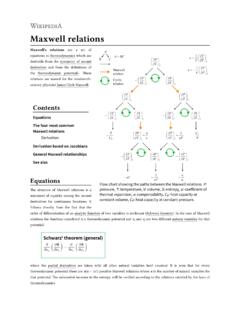
Transcription of Thermodynamic Potentials and Maxwell’s Relations
1 Thermodynamic Potentials and maxwell s RelationsStephen R. AddisonFebruary 25, 2003 IntroductionIn this lecture we introduce other Thermodynamic Potentials and maxwell energy and entropy representationsWe have noted that bothS(U,V,N)andU(S,V,N)contain complete Thermodynamic will use the fundamental Thermodynamic identitydU=TdS pdV+ dNas an aid to memorizing the of temperature, pressure, and chemical potential from the considerationof equilibrium conditions. by calculating the appropriate partial derivatives we have( U S)V,N=T,( U V)S,N= p,and( U N)S,N=.
2 We can also write the fundamental Thermodynamic identity in the entropy representation:dS=dUT+pTdV TdN1from which we find( S U)V,N=1T,( S V)U,N=pT,and( S N)U,N= calculating the second partial derivatives of these quantities we find the maxwell Relations can be used to relate partial derivatives that are easily measurable to those thatare not. Starting from( U S)V,N=T,and( U V)S,N= p,we can calculate 2U V S=( T V)S,N,and 2U S V= ( p S)V, since under appropriate conditions 2U V S= and 2U S Vthen( T V)S,N= ( p S)V, result is called a maxwell relation.
3 By considering the other second partial derivatives, we findtwo other maxwell Relations from the energy representation of the fundamental thermodynamicidentity. These are:( T N)S,V=( S)V,Nand ( p N)S,V=( V)S, , in the entropy representation, starting fromdS=dUT+pTdV TdNand the results( S U)V,N=1T,( S V)U,N=pT,and( S N)U,N= find the maxwell Relations : (1T) V U,N= (pT) U V,N, (1T) N U,V= ( T) U V,Nand (pT) N U,V= ( T) V U, H(S,p,N)We have already defined enthalpy asH=U+pV. We can calculate its differential and combineit with the fundamental Thermodynamic identity to show that the natural variables ofHareS,p0, +pVwe havedH= dU+ d(pV) = dU+pdV+Vdp,and so insertingdU=TdS pdV+ dNwe havedH=TdS pdV+ dN+pdV+Vdpresulting indH=TdS+Vdp+ , we can see that we can writeH=H(S,p,N), and as already notedS,p, andNare thenatural variables ofH.
4 We can continue as above to generate the definitions( H S)p,N=T,( H p)S,N=V,and( H N)S,p= .and the maxwell Relations ( T p)S,N=( V S)p,N,( T N)S,p=( S)p,Nand( V N)S,p=( p)S, the above, as we transformed fromUtoH, we changed independent variables, , wereplaced the variableVwith its conjugatep. (Variablesxandythat are related through the partialderivative of some function such that x=yare called conjugate variables.) This is an exampleof aLegendre transform. In a Legendre transform, to replace one independent variable with itsconjugate, a new function is defined by the addition or subtraction of the product of the conjugatesxandy.
5 In other words we define = xy. In the case of enthalpy we addedpV, as we shallsee, this was due to the presence of the term?pdVin the fundamental Thermodynamic identity. Toeliminate the variablesSandNin terms of their conjugates, it will be necessary to subtract theproducts of the conjugate variables, as we shall soon Free Enerygy F(T,V,N)This time we as we transform fromUtoF, we replace the independent variableSwith its conjugateT. In a Legendre transform, to replace one independent variable with its conjugate, a new function3is defined by the addition or subtraction of the product of the conjugates.
6 Thus in this case wedefine the new functionFby fromF(T,V,N) =U(S,V,N) TScalculating the differentialsdF= dU d(TS) = dU TdS SdT,then insertingdU=TdS pdV+ dNwe finddF=TdS pdV+ dN TdS SdTresulting indF= SdT pdV+ , we haveF=F(T,V,N)as desired. We continue as above to generate the definitions( F T)V,N= S,( F V)T,N= p,and( F N)T,V= .and the maxwell Relations ( S V)T,N=( p T)V,N,( S N)T,V= ( T)V,Nand( p N)T,V=( V)T, Free Energy G(T,p,N)This time we as we transform fromUtoG, we replace the independent variablesSandVwiththeir conjugatesTandp.
7 We can think of this as a double Legendre transform ofUor a singleLegendre transform of fromG(T,p,N) =U(S,V,N) TS+pVcalculating the differentialsdG= dU d(TS) + d(pV) = dU TdS SdT+pdV+Vdp,then insertingdU=TdS pdV+ dNwe finddG=TdS pdV+ dN TdS SdT+pdV+Vdp4resulting indG= SdT+Vdp+ , we haveG=G(T,p,N)as desired. We continue as above to generate the definitions( G T)p,N= S,( G p)T,N=V,and( G N)T,p= .and the maxwell Relations ( S p)T,N= ( V T)p,N,( S N)T,p= ( T)p,Nand( V N)T,p=( p)T, Grand Potential (T,V, )This time we as we transform fromUto , we replace the independent variablesVandNwiththeir conjugates,pand.
8 We can think of this as a double Legendre transform ofUor a singletransform ofF. The grand potential is far less common in elementary work than the other poten-tials. It is used in open systems, that is systems that can exchange particles with the will, however, make some use of from (T,V, ) =U(S,V,N) TS Ncalculating the differentialsd = dU d(TS) d( N) = dU SdT TVdS dN Nd ,then insertingdU=TdS pdV+ dNwe findd =TdS pdV+ dN TdS SdT dN Nd resulting ind = pdV SdT Nd .Thus, we have = (T,V, )as desired. We continue as above to generate the definitions( V)T, = p,( T)V, = S,and( )T,V= the maxwell Relations ( p T)V, =( S V)T, ,( p )T,V= ( N V)T, and( S )T,V=( N T)V.
9 5