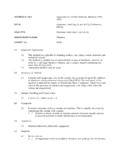
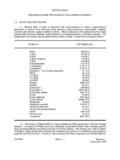
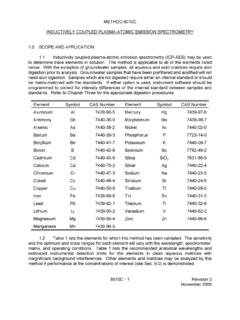
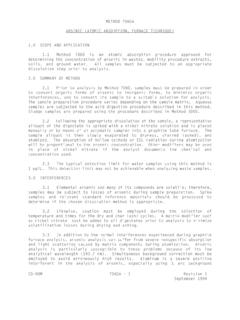
Transcription of TITLE ANALYTE: INSTRUMENTATION STORET No.
1 METHOD #: for NPDES (Issued 1971) TITLE :Residue, Non-Filterable (Gravimetric, Dried at103-105 C) ANALYTE: Residue ,Non-FilterableINSTRUMENTATION:Drying OvenSTORET and method is applicable to drinking, surface, and saline waters, domestic andindustrial practical range of the determination is 4 mg/L to 20,000 of well-mixed sample is filtered through a glass fiber filter, and the residueretained on the filter is dried to constant weight at 103-105 filtrate from this method may be used for Residue, , non-filterable.
2 Is defined as those solids which are retained by a glassfiber filter and dried to constant weight at 103-105 Handling and particulates such as leaves, sticks, fish, and lumps of fecalmatter should be excluded from the sample if it is determined that theirinclusion is not desired in the final result. of the sample is not practical; analysis should begin as soon aspossible. Refrigeration or icing to 4 C, to minimize microbiologicaldecomposition of solids, is apparatus, filter material, pre-washing, post-washing, and dryingtemperature are specified because these variables have been shown to affectthe high in Filterable Residue (dissolved solids), such as saline waters,brines and some wastes, may be subject to a positive interference.
3 Care mustbe taken in selecting the filtering apparatus so that washing of the filter andany dissolved solids in the filter ( ) minimizes this potential fiber filter discs, without organic binder, such as Millipore AP-40, ReevesAngel 934-AH, Gelman type A/E, or equivalent. NOTE: Because of the physical nature of glass fiber filters, the absolute poresize cannot be controlled or measured. Terms such as "pore size", collectionefficiencies and effective retention are used to define this property in glassfiber filters.
4 Values for these parameters vary for the filters listed support: filtering apparatus with reservoir and a coarse (40-60 microns)fritted disc as a filter : Many funnel designs are available in glass or porcelain. Some of themost common are Hirsch or Buchner funnels, membrane filter holders andGooch crucibles. All are available with coarse fritted oven, 103-105 balance, capable of weighing to of glass fiber filter disc: Place the glass fiber filter on themembrane filter apparatus or insert into bottom of a suitable Gooch cruciblewith wrinkled surface up.
5 While vacuum is applied, wash the disc with threesuccessive 20 mL volumes of distilled water. Remove all traces of water bycontinuing to apply vacuum after water has passed through. Remove filterfrom membrane filter apparatus or both crucible and filter if Gooch crucible isused, and dry in an oven at 103-105 C for one hour. Remove to desiccator andstore until needed. Repeat the drying cycle until a constant weight is obtained(weight loss is less than mg).
6 Weigh immediately before use. Afterweighing, handle the filter or crucible/filter with forceps or tongs of Sample VolumeFor a cm diameter filter, filter 100 mL of sample. If weight of capturedresidue is less than mg, the sample volume must be increased to provide atleast mg of other filter diameters are used, start with a samplevolume equal to 7 mL/cm of filter area and collect at least a weight of residue2proportional to the mg stated.
7 If during filtration of this initial volume the filtration rate dropsrapidly, or if filtration time exceeds 5 to 10 minutes, the following scheme isrecommended: Use an unweighed glass fiber filter of choice affixed in the filterassembly. Add a known volume of sample to the filter funnel and record thetime elapsed after selected volumes have passed through the filter. Twenty-fivemL increments for timing are suggested. Continue to record the time andvolume increments until filtration rate drops rapidly.
8 Add additional sample ifthe filter funnel volume is inadequate to reach a reduced rate. Plot theobserved time versus volume filtered. Select the proper filtration volume asthat just short of the time a significant change in filtration rate the filtering apparatus and begin suction. Wet the filter with a smallvolume of distilled water to seat it against the fritted the sample vigorously and quantitatively transfer the predeterminedsample volume selected in to the filter using a graduated cylinder.
9 Removeall traces of water by continuing to apply vacuum after sample has suction on, wash the graduated cylinder, filter, non-filterable residue andfilter funnel wall with three portions of distilled water allowing completedrainage between washing. Remove all traces of water by continuing to applyvacuum after water has passed through. NOTE: Total volume of wash water used should equal approximately 2 mLper cm . For a cm filter the total volume is 30 remove the filter from the filter support.
10 Alternatively, removecrucible and filter from crucible adapter. Dry at least one hour at 103-105 in a desiccator and weigh. Repeat the drying cycle until a constant weightis obtained (weight loss is less than mg). non-filterable residue as follows:where:A = weight of filter (or filter and crucible) + residue in mgB = weight of filter (or filter and crucible) in mgC = mL of sample and data are not available at this data on actual samples cannot be Technical Bulletin No.