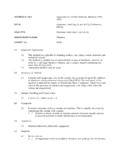
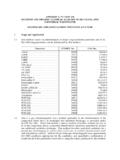
Transcription of TITLE: Sulfide (Colorimetric, Methylene Blue)
1 METHOD # for NPDES (Issued 1978) title : Sulfide ( colorimetric , Methylene Blue) ANALYTE:SulfideINSTRUMENTATION:Spec trophotometerSTORET 00745 Dissolved and method is applicable to the measurement of total and dissolved sulfidesin drinking, surface and saline waters, domestic and industrial insoluble sulfides are not measured by this method. Copper Sulfide is theonly common Sulfide in this method is suitable for the measurement of Sulfide in concentrations up to20 of reacts with dimethyl-p-phenylenediamine (p-aminodimethyl aniline) inthe presence of ferric chloride to produce Methylene blue , a dye which ismeasured at a wavelength maximum of 625 must be taken with a minimum of aeration.
2 Sulfide may be volatilizedby aeration and any oxygen inadvertently added to the sample may convertthe Sulfide to an unmeasurable form. Dissolved oxygen should not be presentin any water used to dilute analysis must be started and turbidity may interfere with observations of color or withphotometric test tubes, approximately 125 mm long and 15 mm , delivering 20 drops/mL. To obtain uniform drops, hold dropper invertical position and allow drops to form slowly. , use either or , for use at 625 nm with cells of 1 cm and 10 cm photometer, with filter providing transmittance near 625\ acid stock solution: Dissolve 27 g N,N-dimethyl-p-phenylenediamine oxalate (p-aminodimethylaniline) in a cold mixture of 50mL conc.
3 H SO and 20 mL distilled water in a 100 mL volumetric flask. Cool24 and dilute to the mark. If dark discard and purchase fresh reagent. Store indark glass acid reagent: Dissolve 25 mL amino-sulfuric acid stock solution( ) with 975 mL of 1 + 1 H SO ( ). Store in a dark glass bottle. This24solution should be chloride solution: Dissolve 100 g FeClC6H O in 40 mL distilled acid solution, H SO , 1 + hydrogen phosphate solution: Dissolve 400 g (NH ) HPO in 800424mL distilled blue solution I: Dissolve g of Methylene blue in distilled water ina 1 liter volumetric flask and dilute to the mark. Use grade or one certifiedby the Biological Stain Commission.
4 The dye content reported on the label shouldbe 84% or more. Standardize ( ) against Sulfide solutions of known strength andadjust concentration so that mL (1 drop) equals mg/L blue solution II: Dilute mL of adjusted Methylene blue solutionI ( ) to 100 mL with distilled water in a volumetric of Methylene blue I solution: several grams of clean, washed crystals of sodium sulfideNa SC9H O in a small somewhat less than enough water to cover the occasionally for a few minutes. Pour the solution into another reacts slowly with oxygen but the change is insignificant over a fewhours. Make the solution 1 liter of distilled water add 1 drop of solution and determine the Sulfide concentration by the Methylene blueprocedure (6) and by the titrimetric iodide procedure (Method , thismanual).
5 Using more than one drop of Sulfide solution or less water until atleast five tests have been made in the range of 1 to 8 mg/L the average percent error of the Methylene blue procedure (6)as compared to the titrimetric iodide procedure (Method ). by dilution or by adding more dye to Methylene blue solution I( ). mL of sample to each of two matched test tubes using aspecial wide tipped pipet or filling to a mark on the test tube A add mL amine-sulfuric acid reagent ( ) and mL (3drops) FeCl solution ( ). immediately by inverting the tube only tube B add mL 1 + 1 H SO ( ) and mL (3 drops) FeCl243solution ( ) and will develop in tube A in the presence of Sulfide .
6 Color developmentis usually complete in about 1 minute, but a longer time is often requiredfor the fading of the initial pink 3 to 5 mL (NH ) HPO solution ( ) to each 3 to 5 minutes and make color comparisons. If zinc acetate was usedwait at least 10 minutes before making Add Methylene blue solution 1 ( ) and/or II ( ) (depending onsulfide concentration and accuracy desired) dropwise to tube B( ) until the color matches that developed in the first If the concentration exceeds 20 mg/L, repeat using a portionof the sample diluted to one Use a 1 cm cell for to mg/L . Use a 10 cm cell for up to 20 Zero instrument with portion of sample from tube B ( ).
7 Prepare calibration curve from data obtained in Methylene bluestandardization ( ), plotting concentration obtained fromtitrimetric iodide procedure (Method ) versus absorbance. Astraight line relationship can be assumed from 0 to Read the Sulfide concentration from the calibration curve. comparison: With Methylene blue solution 1 ( ), adjusted so that mL(1 drop) = mg/L Sulfide and a mL samplemg/L Sulfide =number drops Methylene blue solution I ( ) + [number of drops Methylene blue solution II ( )]. : see and precision has not been determined. The accuracy is about 10%. Methods for the Examination of Water and Wastewater, 14th edition, p.
8 503,Method 428C (1975).