Transcription of TORNIER AEQUALIS ASCEND FLEX - wmtemedia.com
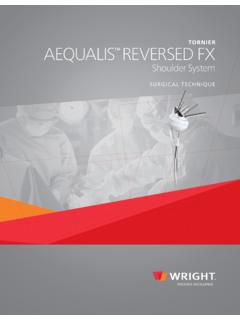
1 TORNIERAEQUALIS ASCEND FLEXC onvertible Shoulder SystemOne System. Two versatility of an anatomic and reversed shoulder in one system. AnatomicReversedContinuing the AEQUALIS LegacyTornier first introduced the key principles for anatomic shoulder reconstruction with the launch of the AEQUALIS shoulder system nearly two decades ago. The AEQUALIS system was born out of a landmark study of the proximal humerus performed by Gilles Walch, and Prof. Pascal Boileau, which detailed four anatomic variables: version, inclination, medial offset and posterior offset. Building upon this legacy and remaining true to its principles, the AEQUALIS ASCEND FLEX has given rise to the next generation of anatomic implant design.
2 Derived from an extensive 3 dimensional CT database of humeral specimens, the AEQUALIS ASCEND FLEX prosthesis design mimics the internal humeral geometry and is the first humeral stem that is truly anatomic from the inside out. The AEQUALIS ASCEND FLEX convertible prosthesis has been carefully built upon the TORNIER legacy and clinical understanding of the AEQUALIS anatomic and reversed systems. The evolved implant design and instrumentation has been developed and evaluated to make no compromises with surgical efficiency, implant accuracy, and overall system flexibility. GILLES WALCH, ASCEND FLEXThe AEQUALIS ASCEND FLEX convertible shoulder system provides anatomic and reversed options within a single system offering precise intra-operative implant-to-patient fit and easy conversion to reversed if Bet Shoulder Reconstruction Begins HereThe AEQUALIS ASCEND FLEX stem provides a platform for anatomic, reversed, and conversion procedures.
3 The universal female taper connection provides the simplicity of one stem and one technique for three different procedures. In addition, the short stem design eliminates canal-based constraints to allow for anatomic stem placement, preserves bone stock or future prosthetic intervention, and addresses the potential effects of stress shielding. This new system also offers the time-saving benefit of press-fit PreservationThe short stem design preserves bone stock for future prosthetic intervention both proximally and Preserving GeometryUnlike traditional stems, the curved stem design preserves the supraspinatus tendon insertion and preserves greater tuberosity bone Bone PreservationShort stem preserves distal canal for future surgical FixationThe AEQUALIS ASCEND FLEX system is available with a proximal PTC titanium plasma spray coating for press-fit application to save time in the OR.
4 It is also available in a highly polished surface finish for cemented use and long stem options in both press-fit and cemented designs to address clinical need and surgeon (Standard & Long)Cemented (Standard & Long)Simply ASCEND FLEXAEQUALIS ASCEND FLEX implants eliminate the unnecessary steps of stem removal, added trauma to the patient, and potential increase in complications during conversion from an anatomic to reversed prosthesis. Its unique, adaptable implants provide a means to relieve soft tissue tension, resulting in more predictable reduction and reduced operative time without the need for additional humeral ConversionUnique high and low offset reversed trays dial to a lateral position.
5 Moving the humerus medially and relieving capsular tension from the surrounding soft tissues to deliver a predictable trays provide up to mm of medial soft tissue reliefHumeral position using centered reversed trayReversed mm Low mm High OffsetLateral Stem Position & High Offset HeadCentral Stem Position & Low Offset mmEfficient, Accurate, Anatomic RestorationRegardless of stem position within the resected humeral surface, low and high eccentric heads infinitely dial to quickly and accurately create an anatomic AEQUALIS ASCEND FLEX Shoulder System achieves accurate and efficient restoration of natural shoulder biomechanics across a wide range of patients by addressing the variables associated with humeral inclination, stem orientation within the humerus, and head positioning on the resected Initial Pullout StrengthCompared to similar competitive glenoid design10%Glenoid Loosening2,390%Central Fin Bone Incorporation2.
6 3 Glenoid OptionsHumeral Resection AccuracyThe AEQUALIS ASCEND FLEX planers may be used to correct imperfections in resected humeral cut surfaces to ensure flush seating of the humeral head and a smooth transition between the head and Stem AlignmentThe anatomically curved short stem design more easily achieves anatomic alignment and reduces the extra steps commonly performed with traditional length canal-dependent straight stems to obtain proper head Glenoid FixationCORTILOC PeggedKeeledSimply AEQUALIS ASCEND FLEX reversed implants reduce scapular notching while maximizing abduction, adduction, and rotation, providing the ideal range of motion for activities of daily living.
7 Extensive reversed glenoid options provide optimal fixation and intra-operative flexibility for varying patient AbductionTraditional Centered MetaphysisInability to offset a centrally constrained metaphysis may lead to early acromial impingement with the greater ASCEND FLEX Offset Reversed Adapter Offset reversed trays increase abduction compared to traditional centered metaphysis designs by reducing acromial impingement with the greater & 25 mm baseplate diameters, as well as standard and long post options, maximize fixation for a wide variety of patient anatomies and conditions.
8 Options such as the lateralized sphere and BIO-RSA technique, provide surgeons with additional opportunities to increase range of motion and reduce scapular ASCEND FLEXGRAMMONTI mproved Adduction & Reduced NotchingThe 145 humeral inclination of AEQUALIS ASCEND FLEX increases adduction with reduced inferior scapular impingement when compared to the Grammont Glenoid CompatibilityLong Post BaseplateStandard Post Baseplate29 mm Baseplate25 mm BaseplateLateralized SphereBIO-RSAO ptimized RotationMedial-lateral reversed tray adjustability allows precise soft tissue tensioning for optimized internal and external the reversed tray lateralizes
9 The humerus to remove soft tissue laxity and improve rotation. Conversely, dialing the tray laterally can reduce excess tension for easier AEQUALIS ASCEND FLEX instrumentation provides a fast, bone conserving procedure that leverages the same humeral preparation for both anatomic and reversed procedures. Different than traditional instrumentation, the AEQUALIS ASCEND FLEX instrumentation focuses on bone compaction techniques that preserve bone and provide exceptional implant & Punch3 Compact4 LockBone-Preserving InstrumentationThe sounders and compactors eliminate bone removal associated with traditional canal reamers and alternatively compact cancellous bone to create a dense bony bed to support the Nesbitt Avenue SouthBloomington, MN 55437888 867 6437952 426 Cherry RoadMemphis.
10 TN 38117800 238 7117901 867 Trademarks and Registered marks of Wright Medical Group or its affiliates. 2016 Wright Medical Group or its affiliates. All Rights REV D ECN 160220 05-Feb-2016 References1 TORNIER test data on file2 Churchill RS. Trends in glenoid component design in unconstrained shoulder arthroplasty. J Shoulder Elbow Surg. 2011; 20: 41-46. Based on 2 yr minimum clinical and radiographic follow-u