Transcription of Touch Screens and Touch Surfaces are Enriched by …
1 THE TERM HAPTICS comes from theGreek word haptikos (from haptesthai, tograsp or Touch ). For Touch user interfaces, theterm typically refers to a tactile sensation orforce-feedback that users experience whentouching the surface. Conventional touchscreens do not provide the tactile sensation ofmechanical buttons and knobs, resulting in aless satisfying experience. Haptics technol-ogy can reproduce the same feel or tactile sensation as mechanical buttons and knobs or generate new sensations not previouslypossible. Tactile sensation can be more emotional and personal than sight or soundand can therefore enrich the user experienceand perception of the have been utilized in automotiveapplications for some time in rotary controlswith joystick types of motion.
2 Conventionalrotary knobs are limited with fixed detents( bumps ) and degrees of rotation (end-stops). BMW s iDrive, launched in 2001, wasthe first haptic interface that provided differ-ent feelings (feedback) for different functionswith one control. The device operated withrotary and four-axis joystick motions to con-trol the functions on the display. The concepthas evolved into the COMAND controller inthe Mercedes S-Class, the Multi Media Inter-face (MMI) in most Audi models, and the Remote Touch controller in several Lexus models. Some automotive OEMs believe that these types of rotary/joystick inputs are similar to computermouse controls and provide more intuitive andcomfortable operation than Touch was presented as a key enabler fortouch user interfaces in the article Tactile-Feedback Solutions for an Enhanced UserExperience in the October 2009 issue ofInformation article expands on the information in that piece and presents some new information on additional haptic tech-nologies and the use of haptic force-feedbackin automotive Touch - screen Screens and Touch SurfacesTouch Screens and Surfaces are increasinglyreplacing the conventional mechanical buttonsand knobs in automotive controls because oftheir ability to provide a reconfigurable userinterface (UI)
3 That blends with the vehicle stheme or styling while improving cost andreliability. Automotive UIs have been chang-ing to meet customer expectations for betterinteraction. The proliferation of portabledevices in vehicles is also driving the need toreduce driver distraction and keep attention onthe road. Touch Screens are enabling the customization and adaptability of the UI forimproved presentation of information and userinputs. The main disadvantages of touchscreens have been fingerprints on the screenand the lack of tactile feedback. Haptics are being utilized to provide uniqueinformation to automotive users. Slidingmotion inputs such as radio volume or fanspeed can be enhanced by increasing the rateand intensity of feedback as the finger movesacross the surface to correspond to the loud-ness of the radio or speed of the fan.
4 Usersare able to learn and identify features codedwith unique haptic effects. The muscle mem-ory of haptic effects can easily be recognizedand quickly understood even without confir-mation of sight and sound type and size of information displaysimpact the need for Touch Screens and OEMs initially began usingsmaller LCDs and OLED displays for cluster,radio and climate controls without Touch inter-action. Over time, the center-stack area hasevolved into a major control, navigation, andcommunication hub with display sizes contin-uing to increase, providing increased room foruser interaction. Eight-inch LCDs are becom-ing common in automobiles today. Adaptiveand reconfigurable UIs are required to providean increasing amount of information to thedriver and passengers.
5 Multiple Screens areTouch Screens and Touch Surfaces areEnriched by Haptic Force-FeedbackTactile feedback can enable more effective use of Touch Screens , particularly in automotive applications where driver distraction is a problem. The number of technologies used to produce haptic effects continues to increase, providing many options and opportunities for system Bruce BanterBruce Banteris Chief Engineer at has been active in developing HMI con-trols for more than 20 years and was previ-ously Chief Engineer at Methode Electronics,Lear, and TRW. He can be contacted at248/763-7838 or Display 3/100362-0972/03/2010-026$ + .00 SID 2010enabling technologybeing utilized to present different types ofinformation. Touch Screens , proximity sens-ing, and haptics are key parts of providingunique experiences for each trend of vehicle-interior styling istoward organic and flowing lines.
6 The center-stack area is being blended into the instrumentpanel and the center console, creating com-plex Surfaces that leave little room for flatglass panels. Molded Surfaces are the trendwith decorative finishes. Projected-capacitivetouch Screens (one of the few Touch technolo-gies that can be applied to a curved surface)are being developed for several applications tomatch the trend. Applying Touch , haptics, andmotion to a complex surface is challenging,and haptic design considerations must beincorporated during the initial stages of thevehicle-interior design. Adding HapticsOptimal UI experiences employ the senses ofsight, sound, and Touch . The move from mechanical buttons and knobs to Touch Screens and Surfaces can result in the loss of tactilefeedback.
7 Users have been programmed toexpect tactile confirmation of inputs withmechanical switches. Studies have shownincreased input speed, increased accuracy, and less frustration when haptic feedback ispart of the current automotiveapplications of Touch Screens and Surfaces utilize only sight and sound because they arethe easiest to implement. Several user clinicsand studies have been conducted by auto-motive OEMs to understand user preferences,and they indicate that users prefer the combi-nation of tactile force-feedback and type of haptic effect can vary in com-plexity from simple vibrations to multifacetedeffects driven by complex mathematical models (see Fig. 1). Simple rumble vibrationshave been used in mobile phones for severalyears, but they are evolving to more intricateeffects.
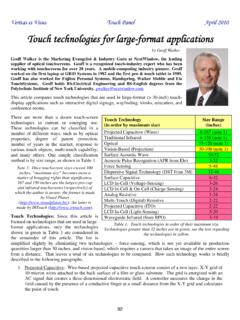
8 High-fidelity force-feedback has beenshown to produce a more authentic responseand engaging user experience. The new gesture-rich user interfaces that are beginningto appear in consumer products will undoubt-edly require high-fidelity Haptic EffectsMost haptic effects are produced by stimulat-ing the nerve receptors in the finger by motionof the Touch surface or vibration of the is generated by pushing or pullingthe surface with either a prime mover or mag-netic or electrostatic attractive forces. Controlof the movement is accomplished by varyingthe amplitude, frequency and duration of thedriving current or voltage. The seven meth-ods currently being utilized to produce hapticeffects are shown in Table 1. The following paragraphs discuss each ofthese seven methods.
9 (See the aforemen-tioned October article for additional details oninertial, piezo, and surface actuation).Inertial ActuationEccentric rotating mass (ERM) inertial actua-tors have been used as vibrators in mobile-phone applications for many years and theyare starting to be used to produce haptic touchscreens. Immersion Corp. has long been aleader in this technology, offering its TS2000software development kit (SDK) and associ-ated design ActuationPiezo actuation is generated by piezo-ceramicelements that deform with applied piezo elements are applied to the touchsurface, and haptic effects are created by theflexing motion of the elements against anothersurface. SMK is a leading supplier of resis-tive Touch Screens ; it has been including piezoforce-feedback as an option in its resistivetouch Screens for a number of years.
10 SMK sfirst automotive haptic Touch screen was intro-duced with PulseTouch in 2004 in Alpine s Information Display 3/1027 VibrationsVibrationsVibrationsTexturesTe xturesPulsesPulsesWeightHardnessDampingR umbleTactileForceHigh-FidelityForce FeedbackRepresentativeAuthenticDriven bycomplexmathematicalmodelsFig. 1: The spectrum of haptic feedback ranges from simple vibrations to complex multifacetedevents, with the latter being perceived as a more authentic representation of the original tactilefeedback it is designed to replicate. Source: Immersion 1: Inertial actuation and Capacitive Electrosensory Interface (CEI) are but two of the seven methods currently being used to produce MethodDescriptionInertial ActuationShaking the surface or the entire device with oscillatingrotary or linear-mass actuatorsPiezo ActuationFlexing the surface with piezo disks or stripsSurface ActuationMoving the surface with electrostatic attractionLateral ActuationMoving the surface laterally with electromagnetic actuatorsElectro-Active Polymer ActuationMoving the surface by contraction and expansion Bending WaveMoving the surface with piezoelectric sensors Capacitive ElectrosensoryGenerating electrostatic pressure and stimulation inInterface (CEI)