Example: confidence
Understanding Disasters - NIDM
Understanding Disasters ... environmental losses caused by hazards and to ensure that these losses are minimized when the disaster actually strikes. 2. During Disaster: ... economic and social vulnerability to threats and the underlying causes for this vulnerability.
Tags:
Information
Domain:
Source:
Link to this page:
Documents from same domain
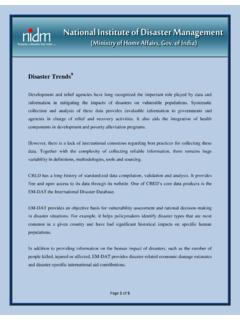
Disaster Trends9 - National Institute of Disaster …
nidm.gov.inPage 1 of 5 Disaster Trends9 Development and relief agencies have long recognized the important role played by data and information in mitigating the impacts of disasters on vulnerable populations.

S.No. Name Designation & Address City & State …
nidm.gov.inOfficials from the state of Tamil Nadu trained by NIDM during the year 209-10 to 2014-15 National Institute of Disaster Management (NIDM) Trainee Database is ...

CYCLONE RESISTANT BUILDING ARCHITECTURE - …
nidm.gov.inCYCLONE RESISTANT BUILDING ARCHITECTURE Prepared by:- Ankush Agarwal Technical Officer (Hazard Vulnerability Reduction) GoI – UNDP, Disaster Risk management Programme
CHEMICAL DISASTER MANAGEMENT
nidm.gov.inNATIONAL INSTITUTE OF DISASTER MANAGEMENT MINISTRY OF ENVIRONMENT & FORESTS NIDM Building, 5-B, IIPA Campus, IP Estate Mahatma Gandhi Road, New …

Training of Trainers Module for Teachers on …
nidm.gov.inTraining of Trainers Module for Teachers on Creation of Culture of Safety through Knowledge and Education SEEDS Technical Services-Knowledge Links ii

Disaster Management- Terminology8
nidm.gov.inPage 1 of 4 Disaster Management- Terminology8 Acceptable risk: The level of potential losses that a society or community considers acceptable given existing social, economic, political, cultural, technical and environmental conditions.
MANUAL FOR DROUGHT MANAGEMENT - NIDM : Home
nidm.gov.inii The Manual for Drought Management has been developed by the National Institute of Disaster Management (NIDM) through a consultative process involving the concerned Central Ministries, State Governments, scientific,
CYCLONE RESISTANT BUILDING ARCHITECTURE
nidm.gov.inThe key to safe construction of timber houses is the connection details. The inherent vulnerability of light-weight timber houses coupled with poor connections is a dangerous combination which has often led to disaster. 3.5 Reinforced Concrete Frames The design of reinforced concrete frames is usually controlled by the seismic hazard.
MANUAL FOR DROUGHT MANAGEMENT - NIDM
nidm.gov.inimplementing appropriate mitigation measures. This manual thus suggests a new approach to drought management, based on the following salient features: Abandon the use of famine codes and varied State management plans. During the colonial period, the Government wrote famine codes for dealing with situations of mass hunger and collective penury.
NATIONAL DISASTER MANAGEMENT GUIDELINES
nidm.gov.inAnnexure-G OIE List of Infectious Terrestrial Animal Diseases 143 Annexure-H Disposal of Animal Carcasses: A Prototype 146 Annexure-I List of National Standards on Phyto-sanitary Measures 148 Annexure-J Important Websites 149 Core Group for Management of Biological Disasters 150 Contact Us 156 CONTENTS
Related documents

Desk study: literature review and secondary data
documents.wfp.org• Geographic and historic information on the occurrence of hazards • Current exposure to sudden-onset natural disasters • Understanding/awareness of long-term threats to food and livelihood security (soil erosion, depletion of forest resources, water scarcity, etc.) • Issues involving migration, conflict, or large-scale exodus of refugees
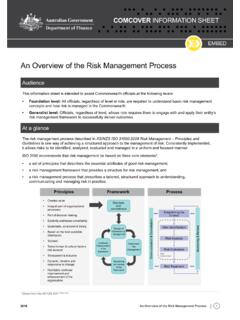
An Overview of the Risk Management Process
www.finance.gov.auAnother method is to begin thinking of the threats and opportunities the entity faces, and use ... including expected benefits and potential hazards • accountabilities for approving the plan and its implementation ... • obtaining further information to improve the understanding and management of already identified risks

Operational Risk Management Guide - USDA
www.fs.usda.govFeb 26, 2020 · achieved by the identification of opportunities and threats and the allocation and use of resources to increase the odds of success, avoid hazards, minimize consequences and provide for recovery. Risk management seeks to reduce risks to acceptable levels. In most endeavors, we will not be able to reduce risk to zero.