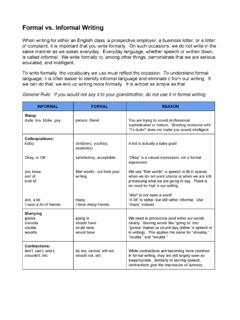
Transcription of Understanding Informal Communication in Multilingual …
1 Understanding Informal Communication in Multilingual Contexts Chien Wen Yuan1, Leslie D. Setlock1, Dan Cosley2, Susan R. Fussell1,2 Departments of Communication1 and Information Science2 Cornell University {cy294, lds87, drc44, ABSTRACT Informal Communication in organizations has many benefits, but people who are not native speakers of the organization s common language may find it hard to interact informally. In an interview study of nine native English-speaking and 33 non-native English-speaking students at a large university, we explore how native language shapes patterns of Informal interaction. We found that non-native speakers generally preferred interacting informally with fellow speakers of their own native language as opposed to native English speakers, which hinders Communication and collaboration between groups.}
2 Three factors led to this clustering effect: issues of common ground, feelings of social obligation to other speakers of one s native language , and desires to build social networks within a language group. Four factors led to greater motivation for cross- language interaction: a desire to build bridging capital, physical proximity, one-on-one or small-group interaction, and an established work relationship. The findings suggest ways that Communication tools might reduce barriers to Informal interaction between speakers of different native languages. Author Keywords Informal Communication ; cultural differences; Multilingual Communication ACM Classification Keywords Information interfaces and presentation ( , HCI): Miscellaneous.
3 INTRODUCTION Informal Communication in organizations has many benefits, including the development of new interpersonal relationships, awareness of others activities, and information exchange [22, 31]. For example, researchers might find new collaborators, or students may discover job possibilities. However, people may be fluent enough to work in a multicultural organization yet be limited in their comfort with colloquial, spontaneous conversation. In this case, they may choose instead to interact with fellow speakers of their own native language during breaks, meals, and social events. This splintering or clustering effect could create barriers to relationship development, awareness and information exchange between speakers of different native languages.
4 The goals of this paper are to understand how native language shapes patterns of Informal interaction in an English-speaking organization for both native and non-native speakers and to identify opportunities for designing new tools to facilitate Multilingual interaction in organizations. As global organizations increasingly bring together people from around the world to work on common problems [15, 32, 45], they face challenges due to linguistic diversity. Similarly, in educational contexts, students from around the world work together in labs, in departments, and on campus. In such contexts, problems have been shown to arise from differences in Communication styles [ , 3, 45], relationship norms [ , 23, 37], negotiation strategies [ ,1], methods of dealing with conflict [ , 37], preferred media [36], and technological proficiency [ , 18], which can result in misattribution of others intentions [14] and difficulty establishing trust [28].
5 Multilingual organizations can use a variety of strategies to support Communication among members, including human and machine translation, selection of a common language (lingua franca) such as English, and intensive language training for all employees [21]. Choosing English as a common language is frequently the strategy of choice for many reasons, including the role of English in higher education, colonization, political considerations, and cultural influence [ , 50]. Using a common language reduces the need for expensive human or machine translation, while effective language training means that, in principle, no members of the organization should be marginalized because of their native language .
6 However, there is evidence that speaking a common language can have negative consequences for non-native speakers. Non-native speakers may fear appearing incompetent if they seem to misunderstand conversational partners, and therefore may not request needed clarification [25, 39]. People may form within- language cliques [9, 35, 49] for the ease of conversational grounding, as in Figure 1. Non-native speakers may also lack culturally specific Permission to make digital or hard copies of all or part of this work for personal or classroom use is granted without fee provided that copies are not made or distributed for profit or commercial advantage and that copies bear this notice and the full citation on the first page.
7 To copy otherwise, or republish, to post on servers or to redistribute to lists, requires prior specific permission and/or a fee. CSCW 13, February 23 27, 2013, San Antonio, Texas, USA. Copyright 2013 ACM 978-1-4503-1331-5/13 $ Not Lost in Translation?February 23 27, 2013, San Antonio, TX, USA909 knowledge needed to engage in Informal Communication that is fundamental to maintaining awareness, developing relationships, and coordinating activities on the fly [35, 49]. At the same time, native speakers may be hesitant to engage in Informal Communication with non-native speakers because of concerns about the addressee s fluency, creating further clustering [ , 5, 25, 56]. In this paper, we explore the effects of using English as a lingua franca in a Multilingual academic environment on both native and non-native English speakers.
8 We first review what the literature on Informal Communication in organizations says about the effects of being a non-native speaker on such Communication . Then, we describe and report on themes from an in-depth interview study with interviewees from a variety of linguistic backgrounds. Non-native speakers formed the within- language cliques reported by other studies, and for some of the same reasons of language fluency and lack of cultural common ground. However, non-native interviewees also provided a number of novel insights about forces that both pushed them away from interaction with native English speakers, such as the large size and rapid conversational pace of many Informal group settings, and pulled them toward interaction with members of their own language community, such as feelings of social obligation.
9 For native English speakers, not knowing other cultures norms for appropriate interaction pushed them away from cross-cultural Communication . Interviewees also identified conditions that promoted greater Informal interaction between native and non-native speakers, including personal career motivations and proximate, structured opportunities for interaction. These forces affected participants choices around Informal multi-lingual interaction at multiple levels: individual-level forces that affected the development of relationships with specific people, group-level forces that shaped decisions about which group of people to interact with, and interaction-level forces that hindered Informal Communication in the moment.
10 Thus, we close by exploring ways to use and adapt existing technologies to reduce barriers at each of these levels, with the goal of giving both native and non-native speakers more flexibility in meeting their needs around cross-lingual and cross-cultural Communication in organizations. BACKGROUND Informal Communication In collocated organizations, Informal interactions in such places as cafeterias and hallways are essential for promoting awareness of others activities [ , 22, 31] and building valuable interpersonal ties [13]. The ability to converse socially is important for developing trust [28] and establishing shared identity and context [27]. However, studies suggest that Informal interaction may be challenging for less fluent individuals, whose language training may have focused on task-related terminology.







![Formal and Informal Essays[1] - OpenStudy](/cache/preview/5/2/f/9/6/a/b/d/thumb-52f96abd94d259826824a181c6312ef5.jpg)