Transcription of Unit Seven: Water
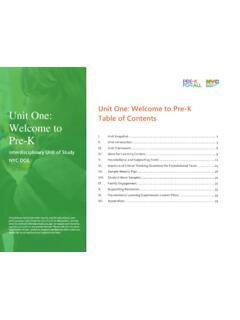
1 unit Seven: Water Table of Contents I. unit Snapshot .. 2 II. Introduction .. 4 III. unit Framework .. 6 IV. Ideas for Learning Centers .. 10 V. Foundational and Supporting Texts .. 27 VI. Inquiry and Critical Thinking Questions for Foundational Texts .. 29 VII. Sample Weekly 332 VIII. Student Work Samples .. 37 IX. Supporting Resources .. 40 X. Foundational Learning Experiences: lesson Plans ..41 XI. Appendices .. 57 unit Seven: Water Interdisciplinary unit of Study NYC DOE The enclosed curriculum units may be used for educational, non-profit purposes only. If you are not a Pre-K for All provider, send an email to to request permission to use this curriculum or any portion thereof. Please indicate the name and location of your school or program and describe which units you would like to use and how you intend to use them. unit SNAPSHOT 2 I. unit SnapshotUnit Topic Water Essential Question What does Water do? Focus Questions Where can we find Water ?
2 What happens to Water when it changes temperature? What happens when we put things in Water ? How does Water help us? Student Outcomes Enduring understandings that the student should have by the end of the unit : Water is all around us. Water changes depending on how warm or cold it is. Some things float in Water and some sink. Some things change when you put them in Water . All living things need Water . Connected Academic Vocabulary This list should be adapted to best fit the needs of individual programs and classrooms. absorb beach boat boil captain conclude condensation clean cloud deep dissolve diver drenched drink environment evaporate faucet ferry float fog form fountain freeze frost gas gurgle hail hydrate ice island lake liquid marsh melt meteorologist mist observe ocean perspiration pond precipitation predict puddle quench rain raincloud repel river sailor saturate sea shallow shore sink sleet slosh snow soak splash sponge solid state storm stream swamp sweat swim temperature thaw thirst umbrella vapor wash Water Water cycle watered waterproof weather unit SNAPSHOT 3 Focus StandardsFrom the New York State Prekindergarten Learning Standards (NYSPLS) Domain 1: Approaches to Learning: Demonstrates persistence Domain 2: Physical Health and Development: Uses sensory information to plan and carry out movements Demonstrates awareness and understanding of healthy habits.
3 Domain 3: Social and Emotional Development: Regulates responses to needs, feelings and events Domain 4: Communication, Language, and Literacy: Reading [ ] Participates in discussions about a text ( , during whole or small group interactive read-aloud discussions, during peer sharing, within play scenarios) Writing [ ] Uses a combination of drawing, dictating, oral expression, and/or emergent writing to narrate an event or events in a sequence Speaking and Listening [ ] Participates in collaborative conversations with diverse peers and adults in small and large groups and during play Language [ ] Demonstrates command of the conventions of academic English grammar and usage when writing or speaking. Domain 5: Cognition and Knowledge of the World: Mathematics [ ] Identifies first and last related to order or position Science [P-PS1-1.] Asks questions and uses observations to test the claim that different kinds of matter exist as either solid or liquid [P-LS1-1.]
4 ] Observes familiar plants and animals (including humans) and describes what they need to survive [P-ESS2-1.] Asks questions, makes observations, and collects and records data using simple instruments to recognize patterns about how local weather conditions change daily and seasonally Social Studies Demonstrates knowledge of the relationship between people, places, and regions The Arts [ ] Creates Dance INTRODUCTION 4 II. Introduction Welcome to unit 7: Water , Pre-K for All s seventh Interdisciplinary unit of Study. In unit 7: Water , children move from thinking critically about light, darkness and shadows to an exploration of the properties and uses of Water . This unit , like all Pre-K for All units, provides opportunities for children to observe objects and phenomena in their environment with increasing complexity. Activities throughout the unit prompt children to learn about Water through hands-on explorations and provide opportunities to observe Water in their immediate environment.
5 As you prepare to teach this unit , consider how Water is a part of your children s daily lives. Additionally, as the weather changes according to the season, use these changes to observe, draw, paint and discuss rain, snow, puddles, storms, etc. You may want to adjust your daily plan according to the weather, for example by reading Rain! by Linda Ashman on a rainy day. Through this type of flexibility and modification, you are engaging in responsive instruction as noted in the NYC DOE Division of Early Childhood Education Early Childhood Framework for Quality (EFQ) Element Three: High quality programs advance play-based learning and responsive instruction. All Interdisciplinary Units of Study are structured around four focus questions. Each focus question is designed to take about one week to explore. In the Water unit , children begin by considering where we can find Water . Children will have the opportunity to observe, discuss and explore Water in their classrooms and throughout their environment such as bodies of Water and weather related Water ( rain).
6 In the second week, children will focus on changes in Water temperature. They might explore and observe ice and Water at different temperatures and perform experiments with Water and ice. In the third week, children are invited to think about how objects respond when they are placed in Water . This may lead them to think critically about why some items float and some sink. There are also opportunities in this week to learn about substances that dissolve or expand in Water (like salt and sponges). In the final week of the unit , children will be invited to explore their understanding about how Water helps living things. Through these explorations, you are making science content and scientific thinking accessible and meaningful to children. Through these explorations, you are making science content and scientific thinking accessible and meaningful to children. You are building on their curiosity and excitement about science and laying the foundation for continued scientific inquiry in Kindergarten and beyond.
7 It may be necessary to do some research and learn more about Water on your own before implementing this unit . One place to find additional information on scientific thinking and exploration of Water is Section IX: Supporting Resources Your Water table will likely be a focal point in this unit . If a Water table is not available, or if you would like to provide additional opportunities for children to explore Water , you can use buckets or other containers of Water . You may also want to create a Water wall using recycled materials and containers to enhance children s exploration of Water . See Section XI: Appendices for more information and ideas on how to create a Water wall with recycled and/or easily attainable materials and Section VIII: Sample Student Work for some pictures of a Water wall. Throughout this unit , there are opportunities to develop children s literacy and language skills. Children may enjoy literature, engage in discussions around stories, and may want to retell and act out stories they have read.
8 Children will build on what they know about Water through informational texts. They might explore new vocabulary words such as hydrate and condensation to continue to develop their language skills as they engage in scientific explorations and thinking. In unit 6: Light, there were opportunities to focus on different kinds of lines and notice how they form shapes and letters. In this unit , we encourage you to help children not only recognize and explore the shapes of letters, but also learn about the sounds they make. As they are ready, children are encouraged to identify and match various letters and sounds through games such as Alphabet Soup. Begin with INTRODUCTION 5 letters that are familiar to the children, such as the letters in their names, and letters that arise throughout the unit , such as W. Remember, children will be in different stages of understanding and using letters and their sounds. Continue to use your authentic assessment data as you determine how best to support each student in your class.
9 Enjoy this study and the learning that unfolds! Please email with any questions or feedback. unit FRAMEWORK 6 III. unit Framework Essential Question This is a child-friendly question that connects the knowledge and skills that children should develop throughout the unit . Focus Questions These represent the major inquiries of the unit . They build over time and require children to make connections across all content areas. Each focus question is designed to take about one week to explore. These are key components of each Pre-K for All unit of Study. Foundational Learning Experiences These are experiences ( , whole group, small group lessons, field trips, observations, center activities) for each subtopic that provide ample opportunities to deepen children s understanding of the Focus Questions. Foundational Texts [ ] Interacts with a variety of genres ( , storybooks, poems, songs) These are a combination of literary and informational texts that can be read throughout the unit .
10 See Section XI for text-based critical thinking questions to support the read aloud experience. Engaging, informative and literary texts provide opportunities for exploring content, expressing ideas using one s imagination and critical thinking that are enhanced through multiple readings of the same book. Reading books multiple times helps all children build a deeper understanding of content, make meaningful connections between content and other concepts or experiences and builds their confidence as learners and as future readers. Key Vocabulary These are academic vocabulary words that help children understand the unit focus questions and access complex texts. These words can be supplemented by vocabulary in read alouds. Family and Community Engagement These are ideas for inviting families to share their experience and knowledge with the class, or for extending learning outside of the classroom. They are aligned to the NYC DOE Division of Early Childhood Education Early Childhood Framework for Quality (EFQ).

![Moon Phases | 5E Lesson Plan for Grades 3-5 [PDF]](/cache/preview/9/d/5/4/3/d/7/8/thumb-9d543d78d665d037f255dd1e746bbfdc.jpg)
![Sun & Stars | 5E Lesson Plan for Grades 3-5 [PDF]](/cache/preview/3/8/9/6/7/a/2/9/thumb-38967a29ac1fe92fba7fa7d775945b90.jpg)