Transcription of UNIVERSAL DESIGN FOR LEARNING IN BC
1 UNIVERSAL DESIGN FOR LEARNING IN BCLegacy of the projectUniversal DESIGN for LEARNING in BC 2010 UNIVERSAL DESIGN for LEARNING in BC is published by Special Education Technology - British Columbia, a provincial resource program of the BC Ministry of : SET-BC would like to thank the Ministry of Education for their support and funding for the BC UDL to this guide: Mallory Burton, Project Leader, Prince Rupert Julie Krall, Team Leader, Smithers Colleen Devlin, Team Member, Courtenay Megan Hannon, Team Leader, Nanaimo Karen James, Team Member, Nanaimo Kathy Rice, Team Leader, Prince George Tania Blak, Team Leader, Quesnel Anita Strang, Team Leader, CoquitlamPurpose of this GuideThe British Columbia UNIVERSAL DESIGN for LEARNING Project (BC UDL) was a three-year Ministry-funded project which operated from September 2007 to June 2010.
2 The purpose of this guide is to provide an overview of UNIVERSAL DESIGN for LEARNING (UDL), information about the BC UDL Project and other BC initiatives, and resources for LEARNING more about of Contents An Introduction to UNIVERSAL DESIGN for LEARNING (UDL) .. 2 The BC UDL Project .. 4 UDL is a Framework .. 6 UDL Addresses Diversity .. 7 UDL Engages Students (Actually UDL Engages Everyone!) .. 8 UDL Off ers Student Choice .. 9 UDL Scaff olds LEARNING .. 10 UDL Fosters Collaboration .. 11 Getting Started with UDL.. 12 General UDL References and Resources .. 14 UDL Resources and Initiatives in BC .. 15BC UDL Project Schools and Contacts by Geographical Region .. 16BC Contacts for UDL .. 171An Introduction to UNIVERSAL DESIGN for LEARNING (UDL)What s UNIVERSAL about UNIVERSAL DESIGN for LEARNING ?A UDL curriculum is designed from the outset to be accessible to the widest possible range of students.
3 Teachers who have adopted a UDL mindset expect that students will vary widely in LEARNING styles, abilities, and interests. They accept responsibility for teaching all of their students, and they build alternatives and scaff olds into curriculum to address diff erent LEARNING needs. UDL is not a one-size-fi ts-all approach; neither does it promote a classroom environment in which each student has an individual educational plan. The ultimate goal is to create a fl exible instructional environment that works for all students. Fair doesn t mean giving every child the same thing. Fair means giving every child what they need. Rick LavoieImplementing UNIVERSAL DESIGN typically occurs in 3 developmental stages: advocacy, accommodation, and accessibility (Schwanke, Smith & Edyburn, 2001). Advocacy raises awareness of diverse needs and motivates us to make changes.
4 At the accommodation stage, support is provided for individuals by request. However, there is sometimes a lag in providing accommodations or individuals must make a special eff ort or go to a diff erent place to use the accommodation. True accessibility is achieved when environments are engineered to ensure that supports are available to everyone at the time they are Can Educators Learn from Architects?The concept of UNIVERSAL DESIGN is borrowed from architecture. Architects DESIGN modern buildings with consideration for the needs of all potential users, planning accommodations such as ramps and elevators from the start. These accommodations, originally created for individuals with mobility challenges, often turn out to benefi t many other at Harvard s Center for Applied Special Technology (CAST) applied the concept of UNIVERSAL DESIGN to LEARNING .
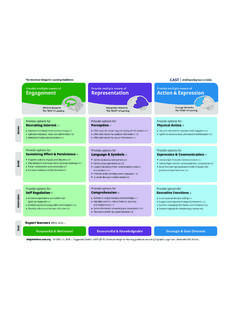
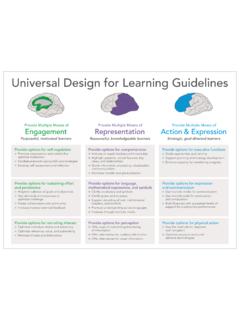
5 The UDL guidelines developed at CAST assist teachers in examining their curricula for potential barriers and putting supports in place for all learners. As in architecture, educational supports developed for those in the margins are often benefi cial for many DESIGN for LEARNING in BCWhat are the Cornerstone Beliefs of UDL?Research has confi rmed the existence of three brain networks involved in LEARNING (Rose & Meyer, 2002). Recognition networks help us acquire the what of LEARNING , strategic networks process the how of LEARNING and aff ective networks are responsible for the why of LEARNING . The team at CAST suggested that educators use multiple means of representation, expression, and engagement to provide support for these networks. The UDL approach uses multiple means of representation to support students recognition networks, addressing varying abilities and LEARNING styles.
6 Teachers present multiple examples to illustrate concepts, use a variety of media, highlight critical features, and support background knowledge. Teachers may also provide materials such as printed text in several formats and levels. Multiple means of expression support students strategic networks. Although students in a UDL classroom are expected to work toward the same LEARNING intentions, they may use a variety of ways to practice and demonstrate their knowledge. Teachers provide expert models and ongoing, relevant feedback. Students practice what they are LEARNING in a supported environment, using scaff olds the teacher has put in place to ensure their success. Multiple means of engagement support students aff ective networks, accommodating diff erent interests and motivating learners. Students are given a choice of content, tools, and LEARNING context.
7 Teachers use fl exible grouping and provide levels of challenge that are suited to students abilities and teachers involved in the BC UDL Project reported that using technology greatly increased their ability to engage students, provide fl exible and up-to-date materials, and support diverse LEARNING needs. However, a teacher can certainly diff erentiate many aspects of the curriculum without technology, and real experience is often preferable to the virtual. Valuable non-technological strategies such as project-based LEARNING and cooperative LEARNING fi t within the framework of UDL. Multiple Meansof ExpressionMultiple Meansof EngagementMultiple Meansof RepresentationWhere Can I Learn More about UDL?Links to the references on this page and general UDL resources including the CAST website, the Expanded UDL Guidelines and other UDL projects are presented in the section on General UDL References and of the BCUDL ProjectThe BC UDL ProjectFunding and ParticipantsThe BC UDL Project was a 3 year Ministry of Education funded initiative to assist pilot school districts in implementing UDL.
8 In each year of the project, 7 school-based teams representing diff erent geographical areas of the province were selected to participate. A full listing of the original schools and a list of individuals willing to provide more information about UDL are included in the sections BC UDL Project Schools and Contacts by Geographical Region and BC Contacts for Districts Participating07/08 Burnaby, Coquitlam, Prince Rupert, Quesnel, Surrey, Vernon, Victoria08/09 Revelstoke, Kelowna, Abbotsford, Vancouver, Prince George, Nanaimo-Ladysmith, Countenay-Comox09/10 Maple Ridge, Sunshine Coast, Bulkley Valley, Saanich, Cowichan Valley, North Okanagan-Shuswap, Vancouver Island WestTeams, Training and TechnologyDuring the project, 21 teams of 4 or more teachers at each site were trained in UNIVERSAL DESIGN . At almost every site, the teams grew much larger as more teachers in the school and in the district became interested in UDL.
9 In Surrey, UDL has become a cornerstone of a district-wide initiative to address diverse LEARNING teams received both onsite and online training in UDL principles. After completion of the onsite training in the fall, the team leaders met online weekly for the entire year. Many school districts provided funding for additional team members to attend the onsite and selected online also received grants to purchase a variety of hardware and software, developing a technology infrastructure to help implement UDL. Most districts also supplied computers for student use and purchased software and hardware for additional team members. One of my teachers told me that his involvement in the UDL project was the most signifi cant ProD he has experienced as a the principal I can see the diff erence in his students; they are more engaged as learners and demonstrate a higher degree of motivation.
10 His class has more than twice the number of Honour Role students as any other class. Brian Chappell, Principal of Harwin Elementary, Prince George4 UNIVERSAL DESIGN for LEARNING in BCDoes UDL Make a Diff erence?The Expanded UDL Guidelines are supported by an extensive review of the literature on eff ective teaching practices. In some respects, UDL can be seen as a long-overdue attempt to implement this research. Since UDL is in the beginning stages of implementation in BC, a large scale evaluation of student outcomes would be premature. However, teams were encouraged to conduct informal action research studies to determine whether UDL was making a diff erence at their school. For example, teams have compared student engagement before and after SMARTB oards, tracked Foundation Skills Assessment results, or looked at referrals to behaviour programs to see whether UDL is making it possible for more students to remain in their classrooms.