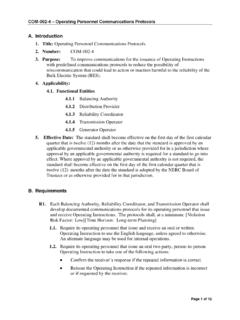
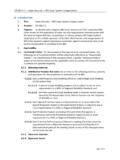
Transcription of Unofficial Comment Form - NPCC
1 Unofficial Comment form Project 2007-02 Operating Personnel Communications Protocols COM-002-4 Please DO NOT use this form . Please use the electronic Comment form to submit comments on the proposed draft com 002 4 (Operating Personnel Communications Protocols) standard. comments must be submitted by January 31, 2013. If you have questions please contact Stephen Eldridge by email or by telephone at 404 446 9686. Background Information: Effective communication is critical for Bulk Electric System (BES) operations. Failure to successfully communicate clearly can create misunderstandings resulting in improper operations increasing the potential for failure of the BES.
2 The eighth posting of Project 2007 02 is a continuation of the previous draft which combined com 002 3 and COM 003 1 into one standard titled com 002 4 that addresses communications protocols for operating personnel in Emergency, alert, and non emergency situations. The Standard Authorization Request (SAR) for this project was initiated on March 1, 2007 and approved by the Standards Committee on June 8, 2007. It established the scope of work for Project 2007 02 Operating Personnel Communications Protocols (OPCP). The scope described in the SAR is to establish essential elements of communications protocols and communications paths such that operators and users of the North American BES will efficiently convey information and ensure mutual understanding.
3 The August 2003 Blackout Report, Recommendation Number 26, calls for a tightening of communications protocols. Federal Energy Regulatory Commission (FERC) Order 693 paragraph 532 reiterates this need. This proposed standard s goal is to ensure that effective communication is practiced and delivered in clear and consistent language. The standard will be applicable to Transmission Operators, Balancing Authorities, Reliability Coordinators, Generator Operators, and Distribution Providers. These requirements ensure that communications include essential elements such that information is efficiently conveyed and mutually understood for communicating Operating Instructions.
4 The Purpose statement of com 002 4 states: To improve communications for the issuance of Operating Instructions with predefined communications protocols to reduce the possibility of miscommunication that could lead to action or inaction harmful to the reliability of the Bulk Electric System (BES). Unofficial Comment form Project 2007 02 OPCP com 002 4 | January 2013 2 1) New NERC Glossary term: The OPCP Standards Drafting Team (SDT) revised the definition of Operating Instruction from its previous drafts. The current definition reads A command by operating personnel responsible for the Real time operation of the interconnected Bulk Electric System to change or preserve the state, status, output, or input of an Element of the Bulk Electric System or Facility of the Bulk Electric System.
5 (A discussion of general information and of potential options or alternatives to resolve Bulk Electric System operating concerns is not a command and is not considered an Operating Instruction.) The Project 2007 02 SDT removed the term Reliability Directive in order to avoid complications that may result from the Notice of Proposed Rulemaking issued by the Federal Energy Regulatory Commission on November 21, 2013 proposing to remand the definition of Reliability Directive. com 002 4 uses the defined term Operating Instruction to define the circumstances when documented communications protocols must be used.
6 This term is proposed for addition to the North American Electric Reliability Corporation (NERC) Glossary to establish meaning and usage within the electricity industry. 2) Project 2007 02, Posting 8 continues to combine com 002 3 and COM 003 1 into com 002 4. The OPCP SDT combined com 002 3 and COM 003 1 in posting 7 into one standard in order to simplify communications protocols for operating personnel. This construct has been maintained in the posting 8 draft. The OPCP SDT determined that one communications protocols standard that addresses Emergency, alert, and non emergency situations will improve communications because system operators will not need to refer to a different set of protocols during an emergency situation.
7 The OPCP SDT believes this will improve consistency of communications and mitigate confusion during stressful emergency situations. The OPCP SDT decided to combine the standards under the title com 002 4 to further reduce confusion. The com 002 4 title keeps the numbering of COM standards consecutive ( , COM 001, com 002 ). 3) Project 2007 02, Posting 8 features 7 requirements. The The OPCP SDT developed the requirement structure and language in posting 8 to incorporate Emergency, alert, and non emergency communications protocols.
8 The language in com 002 4, Requirement R1 permits applicable entities flexibility to develop their communication protocols but requires a set of minimum elements in the communications protocols. Requirement R1 requires communications protocols to include the following elements: a. English Language: Requirement R1, Part Require the issuer and receiver of an oral or written Operating Instruction to use the English language, unless agreed to otherwise. An alternate language may be used for internal operations. b. Three part Communication for Oral Operating Instructions: Requirement R1, Parts and Require three part communication for issuers and receivers of oral two party, person to person Operating Instructions.
9 Unofficial Comment form Project 2007 02 OPCP com 002 4 | January 2013 3 c. One way Burst Message Receipt Confirmation and Clarification: Requirement R1, Part Requires the issuer of a written or oral single party to multiple party burst Operating Instruction to verbally or electronically confirm receipt by at least one receiver of the Operating Instruction. Time Identification: Requirement R1, Part Specify the instances that require time identification when issuing an oral or written Operating Instruction and the format for that time identification.
10 D. Transmission Interface Elements and Facilities Nomenclature: Requirement R1, Part Specify the nomenclature for Transmission interface Elements and Transmission interface Facilities when issuing an oral or written Operating Instruction. Requirements R2 and R3 require each Balancing Authority, Reliability Coordinator, Transmission Operator, Distribution Provider and Generator Operator to conduct initial training for operating personnel who can issue and/or receive Operating Instructions . These requirements mandate that before operating personnel can issue or receive an Operating Instruction, the operating personnel in question must receive the training listed in the respective requirement.







![Welcome [www.npcc.org]](/cache/preview/7/0/4/6/3/8/1/3/thumb-70463813e70cbd881cdccb4a4b4e1de9.jpg)