Transcription of UNPLUGGED Algorithms: Tangrams - Code.org
1 UUNPLUGGEDA lgorithms: TangramsLesson time: 20 Minutes Basic lesson time includes activity only. Introductory and Wrap-Up suggestions can be usedto delve deeper when time OVERVIEWThis lesson shows us something important about algorithms. If you keep an algorithm simple there are lots ofways to use it. If you want to make sure everyone ends up with the same thing, then your algorithm needs activity will show both SUMMARYG etting Started - 10 minutes1) Review 2) Vocabulary 3) Intro to Tangrams Activity: Algorithms with Tangrams - 20 minutes4) AlgorithmsWrap-up - 10 minutes5) Flash Chat: What did we learn?6) Vocab-ShmocabAssessment - 10 minutes7) Algorithm AssessmentLESSON OBJECTIVESS tudents will:Tackle the challenge of translating an image into actionable instructionsConvey instructions to teammates in order to reproduce an imageAnalyze the work of teammates to determine whether an outcome was successfulTEACHING GUIDEMATERIALS, RESOURCES AND PREPFor the StudentTangram Set & Algorithm Card Images PackScratch paper for writing algorithms or building imagesTangram Assessment WorksheetPens/PencilsScissorsFor the TeacherPrint one Algorithm Card Images Pack per groupPrint one tangram Set per studentPrint one tangram Assessment Worksheet per studentProvide student with scissors, paper, pens & pencilsGETTING STARTED (10 MIN)1) ReviewThis is a great time to review computer science experiences from the past.
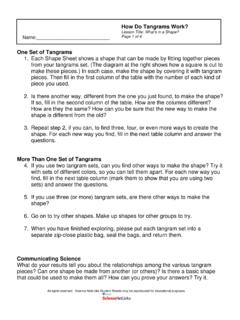
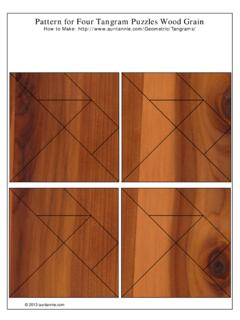
2 Where did everyone leave off?Here are some questions that you can ask in review:Do you remember what an algorithm is?What does an algorithm have to do with sequence?2) VocabularyThis lesson has one important word to review:Algorithm - Say it with me: Al-go-ri-thm A list of steps that you can follow to finish a task3) Intro to TangramsYour students may or may not have played with Tangrams before. If they have, you can skip this portion, and moveright to explaining the Algorithms , Tangrams are used to solve puzzles. You receive a set of seven Tans and must use them all (withoutoverlapping any) to recreate an image that has been given to you. Often, this is done as an individual activity, andthe player is allowed to see the image that they are trying to recreate. Many times, you can lay your pieces right onLESSON TIPF inishing the review by asking about the students' favorite things helps to leave a positive impressionof the previous exercise, increasing excitement for the activity that you are about to of the image silhouette to be sure that the solution is just : ALGORITHMS (20 MIN)4) AlgorithmsWe are going to use our Tangrams in a slightly different way than most.
3 Instead of looking at our puzzles and tryingto guess which shape goes where, we are going to get puzzles that already tell you where each shape might think that this will make it easier, but it won't, because students will also not get to actually look at theimage that we are trying to recreate! Instead, a teammate will be describing the image to keep it from getting too difficult, we will not use puzzles that require all seven :1. Divide into groups of Each player should cut out their own set of Have one member of each group select an Algorithm Card without showing it to anyone The person with the Algorithm Card will try to explain the image to everyone else without letting themactually see The other players will build their pictures off of the description given by the Card When the Card Holder is done, everyone will show their pictures and see if they all ended up with the If everyone ends up with the same drawing, the Card Holder can show the card and see if everyonematched the If any of the pictures in the group are different from each other, have the Card Holder try describing theimage again, using more Choose a new Card Holder and a new Algorithm Card and repeat until everyone has had a chance todescribe an image.
4 Play through this several times, with images of increasing TIPIf your class has never used tangram pieces, you can choose to do an example for them or evenhave an entire tangram lesson. There are several good ones on the Internet. Here is a lesson thatyou can do in the classroom and here is a game that you can play (10 MIN)5) Flash Chat: What did we learn?What did we learn today?Was it easier or harder than you thought it would be to describe an image to one another?Did any group end up having arrangements that all matched?Can you share some tricks that you came up with that helped your group match the Image Card exactly?6) Vocab ShmocabYou can choose to do these as a class, or have the students discuss with an elbow partner and you remember the definition of the word "algorithm"?"A list of steps that you can follow to finish a task""An algorithm that has been coded into something that can be run by a machine""Finding and fixing problems in your algorithm or program"ASSESSMENT (10 MIN)7) Algorithm Assessment EXTENDED LEARNINGUse these activities to enhance student learning.
5 They can be used as outside of class activities or Your WordMake up simple tangram Algorithms for your class, and have them figure out how many different images theycan create that follow that algorithm to the a couple of drawings to analyze against the curriculum is available under a Creative Commons License (CC BY-NC-SA ) If you are interested in licensing materials for commercial purposes, contact us: toward more specific algorithms that leave little room for DebuggingCreate an algorithm for an image, and provide the class with a tangram Arrangement that doesn't quite the class if the image matches the they figure out where it went wrong?Do you need to throw the whole arrangement out and start over or can you just start from where thealgorithm went wrong?LESSON TIPTry to focus on misplacements that allow the class to back up only a few steps to fix the algorithm.
6 Wewant to get it in the students' heads that they don't have to delete entire programs if something doesn'twork, they just need to find the error and fix that bit (and any bit that was relying on that instruction).