Example: dental hygienist
USER MANUAL - YSI
Nitrate, Chloride, and, in some cases, a pH/oRP combination sensor. **Cable 605790 will be referred to as a Quatro cable throughout this manual. All cables come in standard lengths of 1, 4, 10, 20, and 30-meters (3.28, 13,
Tags:
Information
Domain:
Source:
Link to this page:
Documents from same domain

EXO User Manual - YSI
www.ysi.com4.29 Total Suspended Solids Calculation 5. Maintenance 5.1 Sonde Storage 5.2 Sonde Maintenance 5.3 Replace EXO1 Sonde Bail 5.4 Replace EXO2 and EXO3 Sonde Bail 5.5 Depth and Level Sensor Maintenance and Storage 5.6 Standard Optical Sensors Maintenance and Storage 5.7 C/T Sensor Maintenance and Storage 5.8 Dissolved Oxygen Sensor Storage

The Basics of Chlorophyll Measurement
www.ysi.comIn the photosynthetic reaction below, carbon dioxide is reduced by water, and chlorophyll assists this transfer. Chlorophyll is present in many organisms including algae and some species of bacteria. Chlorophyll a is the most abundant form of chlorophyll within photosynthetic organisms and, for the most part, gives plants their green color.

Dissolved Oxygen Tables - YSI
www.ysi.comInches Hg mm Hg kPa Feet Meters Percent Saturation 30.23 768 102.3 –276 –84 101 29.92 760 101.3 0 0 100 29.61 752 100.3 278 85 99 29.33 745 99.3 558 170 98 29.02 737 98.3 841 256 97 28.74 730 97.3 1126 343 96 28.43 722 96.3 1413 431 95 28.11 714 95.2 1703 519 94 27.83 707 94.2 1995 608 93 27.52 699 93.2 2290 698 92 27.24 692 92.2 2587 789 91

Environmental Series - YSI
www.ysi.comUSEPA Method 8141B is often used to analyze organophosphorus (OPP) pesticides. The method specifies flame photometric detection (FPD) or nitrogen – phosphorus detection (NPD). Use of a pulsed flame photometric detector (PFPD) is an alternative to these …
Related documents
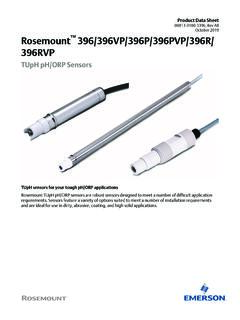
October 2019 Rosemount 396/396VP/396P/396PVP/396R/ …
www.emerson.com03 SMART preamplifier, 33-ft. (10 m) cable (standard preamp if used with ORP) 04 SMART preamplifier, 50-ft. (15.2 m) cable (standard preamp if used with ORP) 05 SMART preamplifier, 66-ft. (20 m) cable (standard preamp if used with ORP) 06 SMART preamplifier: 100-ft. (30.5 m) cable (standard preamp if used with ORP) Rosemount 396. October 2019

A. Data Definition Tables
www.hl7.orgFinal Standard. A.3 MESSAGE TYPES Message Description Chapter(s) ACK ent message General acknowledgm2.13.1 ... ORP . Pharmacy/treatment order acknowledgment message . 4.13.4 . ORR . General order response message response to any ORM . 4.4.2 . ORS . Stock requisition - Order acknowledgment message .

A general arene C–H functionalization strategy via ...
chemrxiv.orgon a 0.2 1mmol scale. Yields were determined by H-NMR spectroscopy using mesitylene as internal standard; isolated yields are reported in paren-theses. LED, light-emitting diode; 1,2-DCE, 1,2-dichloroethane. Scope of the C–H alkylation sequence. The one-pot procedure, set out in Figure 2c, was used to test the generality of the
Standard Methods for the Examination of Water and ...
beta-static.fishersci.comStandard Methods for the Examination of Water and Wastewater 22nd Edition TABLE OF CONTENTS Part 1000 INTRODUCTION 1010 INTRODUCTION ... (ORP) A. Introduction B. Oxidation–Reduction Potential Measurement in Clean Water …

OCTOBER 1, 2020
www.cfm.va.govPHYSICAL SECURITY & RESILIENCY DESIGN MANUAL October 1, 2020 Revised 09-01-2021. iii . Randall B. Dell, MSSI, CAAMA Acting Director, Office of Emergency Management

EPA 832-F-00-022 - September 2000
www3.epa.govcontrol methods employing oxidation reduction potential (ORP) as an effective stand-in for direct chlorine measurement (Bossard et al., 1995), other sources assert that ORP is an inappropriate technique for this purpose (WEF, 1996). For these reasons, control of dechlorination—particularly dechlorination to zero residual—has been problematic.

How to Conduct a Squad Ambush - Sites at Penn State
sites.psu.eduThe ORP should be located at least 100 meters away from the Ambush site and out of sight and sound of the enemy so that he cannot detect you. You set up the ORP so that your squad members have time to organize themselves and prepare for the mission while you conduct a reconnaissance on the Ambush site. The ORP is also the location that you return