Transcription of Using i.e. and e.g. correctly - Daniel B. Warnell School ...
1 Using and correctly I find that sometimes students are unsure about when to use the abbreviations and and the difference between the two. They are not interchangeable; each has its own meaning and usage. The abbreviation stands for id est, which is Latin for that is. The abbreviation stands for the Latin phrase exempli gratia, meaning for example.. Let's consider a sentence that uses : All employees will receive the standard discount; , 20 percent. Because id est means that is, management is Using , 20 percent.
2 To define the standard discount. And because , 20 percent forms an independent clause a complete sentence we technically have created a compound sentence: All employees will receive the standard discount; , 20 percent. So we use a semicolon to join the two independent clauses. Let's consider another one. One meal ( , breakfast) is included in the price of the room. Here, specifies that breakfast is the only meal included. Again, we have created an independent clause breakfast but this time, it falls in the interior of the sentence.
3 So technically, either parentheses or dashes should surround it. Now let's look at a sentence Using : Certain fur-bearing mammals, , nutria and otters, spend much of their lives in the water. Unlike which is used to specify a particular meaning simply means for example. Style manuals vary on punctuation that should used to enclose the phrase when it appears in the interior of a sentence. Some state that it should appear only inside parentheses; others state that commas may be used, provided that what follows as in our last example does not constitute an independent clause.
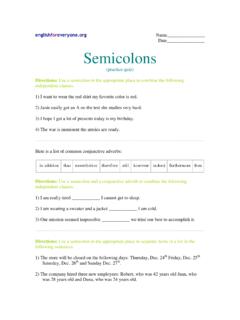
4 Here's another one: There are some herbs that belong in every kitchen garden ( , basil, rosemary, and oregano). Again, there may be other herbs that are equally useful; those are simply three examples. When the passage falls at the end of the sentence, you can either enclose it in parentheses or set it off with a comma before But as before, if . introduces an independent clause, use a semicolon because it's likely you've formed another compound sentence. The following would be an example: The beach closes when conditions warrant it; , a hurricane warning has been issued.
5 In modern American English, a comma should follow both and And because they have both become so commonplace, it is unnecessary to place the abbreviations in italics, even though they are abbreviated Latin phrases.