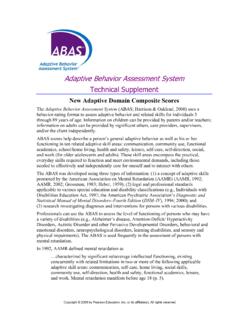
Transcription of Using the BAdER Reading and Language Inventory
1 # 108376 Cust: PH/OH/CHET Au: BAdER Pg. No. 1 Title: BAdER Reading and Language Inventory 6/e Server: K Short / Normal / LongDESIGN SERVICES OFS4carliSlePublishing Services1 PART ONEU sing the BAdER Reading and Language 109/04/12 8:50 PM# 108376 Cust: PH/OH/CHET Au: BAdER Pg. No. 2 Title: BAdER Reading and Language Inventory 6/e Server: K Short / Normal / LongDESIGN SERVICES OFS4carliSlePublishing 209/04/12 8:50 PM# 108376 Cust: PH/OH/CHET Au: BAdER Pg. No. 3 Title: BAdER Reading and Language Inventory 6/e Server: K Short / Normal / LongDESIGN SERVICES OFS4carliSlePublishing Services3 BAdER Reading and Language inventoryIntroductIonThe BAdER Reading and Language Inventory was constructed for use by teachers of K 12 and adult students and by literacy specialists and resource teachers, including teachers of English Language Learners.
2 The design of the Inventory offers examiners the flexibility to obtain infor-mation for several purposes: to determine literacy levels, to plan instruction, and to make referrals to appropriate specialists. Additional reasons for administering the Inventory include measuring a student s progress, assessing the effectiveness of specific Reading approaches, and diagnosing specific literacy needs. Because students experiencing difficulty in learning to read may have problems in other areas, several informal tests are provided so that their needs and abilities can be assessed.
3 Portions of the Inventory can be used for quick screening or initial placement of tests have long been recommended by professional authorities for those students who fail group-administered tests. The Inventory provides valid, reliable procedures for individual assessment , as well as subtests and checklists to discover inhibiting conditions that can be im-proved with appropriate of children, adolescents, and adults have instructional decisions to make. They also make referrals to specialists in vision, hearing, and Language development when appropriate. Yet, most teachers have teaching responsibilities that make individual, in-depth evaluation difficult.
4 Reading and learning specialists have demands on their time, too. This Inventory was developed to meet the needs of teachers and specialists for a diagnostic battery, efficient in administration and interpretation, that encompasses vital areas of evaluation based on research. To the extent that students strengths and needs are understood, they can be helped to ModelA thorough assessment includes personal interviews and reflections, observations, informal and formal tests, and diagnostic teaching. Experienced teachers learn to look for patterns of behavior as they observe learner strengths and needs.
5 The Inventory provides several tools and guides for this model. However, the quest for pertinent information should be balanced against the need not to distress the student or take time from instruction by of the InventoryStudent Priorities and Interests Several inventories and checklists are provided to assess the interests and priorities of children, teens, and adults. Interests and priorities of non-English-speaking learners should be obtained from their English-speaking Language Learning The English Language Learning test can be used for initial screen-ing.
6 The test begins with a list of questions requiring either one-word or concrete replies. Upper-level items require longer replies and give information about student concerns. Gottlieb (2006) supports honing in on more diagnostic information by focusing on the student s individual and classroom needs. An English Language Learning (ELL) Checklist helps the instructor monitor 309/04/12 8:50 PM4 PART ONE Using ThE BAdER Reading ANd Language Inventory # 108376 Cust: PH/OH/CHET Au: BAdER Pg. No. 4 Title: BAdER Reading and Language Inventory 6/e Server: K Short / Normal / LongDESIGN SERVICES OFS4carliSlePublishing ServicesGraded Word Recognition Lists Word recognition lists include a Graded Word List, Experiential Word Lists, and Thematic Word Lists.
7 The Graded Word List is a series of 10 words at each level from preprimer (PP) through eighth grade, plus a list designated as high school. Our research, plus reports from test users, have found the Reading level estimate of the word list to be highly accurate so that it may be used alone for screening or initial placement. This test provides an estimate of the reader s level of literacy so the examiner can select an entry level to the graded paragraphs. In addition, the graded list can serve as a quick check of the student s word recognition and word analysis abilities. Finally, by contrasting the reader s ability to read words in context with word recognition in isolation, the examiner can obtain some information about the reader s ability to use context as an aid to word Experiential Word Lists are provided: Instructional Directions List, Experience List I, Experience List II, and Functional Literacy List.
8 The first list contains 15 words frequently used in instructional materials and tests. The experience lists contain either 15 or 16 words that beginning readers may have learned in daily life. The functional list contains 14 words that may be encoun-tered in completing forms and managing personal affairs in daily adult Thematic Word Lists provide vocabulary on basic and intermediate levels. The themes are health and safety, office, and Reader s Passages The Graded Reader s Passages range from preprimer through 12th-grade level in difficulty. The passages have been designed to enable the examiner to assess word recognition, fluency, and comprehension abilities so that a reader s independent and instruc-tional Reading levels might be are two sets of passages: elementary and secondary.
9 The elementary set of pas-sages has been written so the content is appropriate for readers in the elementary school grades. The elementary set of passages has two forms, A and B. The elementary passages go from the preprimer through the eighth-grade level. The preprimer through third-grade level passages were constructed to be age and grade appropriate. The passages at the intermediate grade lev-els, grades 4 through 8, were constructed to be content and age appropriate for students in the intermediate grades. The elementary set of passages ends at the eighth-grade level.
10 If additional testing beyond the eighth-grade level is desired, the examiner can use the passages in the sec-ondary set of passages. The secondary/adult graded passages were constructed to be appropriate for adolescents in the secondary grades and/or adults. The preprimer through third-grade level passages are intended for adolescents and adults at the beginning Reading levels. In the interme-diate levels (fourth through eighth grade), the passages are designed to assess functional literacy. Beyond the eighth-grade level, the secondary/adult passages assess Reading in history, science, and citizenship.