Transcription of UV-Visible Spectroscopy (UV-Vis) สเปกโทรสโคปี …
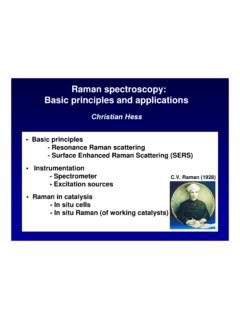
1 26/08/571UV-Visible Spectroscopy (UV-Vis)By SupapornSangsrichanCH210 Analytical ChemistryMaejoUniversity1. 2. (UV-VIS Spectroscopy )3. (UV-VIS Spectrophotometer)4. (Application) ( Spectroscopy )23 (Emission) (Absorption) (Scattering) P0 Incident radiationReflection (Pr)Absorbed radiationtransmitted radiationPtScattering (Ps)4 (magnetic field) (electric field) electromagnetic spectrum 5 (Electromagnetic spectrum)6 (E) (frequency, ( nu))
2 E = h = hc/ (wavelength; (lambda)E = 1 Jh = (Planck s constant) = x 10-34 J s= x 10-34 m2kg s-1= x 10-27 - (erg-s)c = speed of light = 3 x 10⁸m s-181. (Hz) 5 cm ( = 6 103 MHz )2. 104 cm-1 (Hz) (nm) ( = 1014 Hz l= 320 nm )3. J 300 nm(E = 10-19J) 4. (J) (Hz) 30 ( = 1017 Hz E = 10-17 J) ) 9 190-800 nm (Organic compound), (Complex compound), (Inorganic compound) ( IR, NMR Spectroscopy ) 10 (Electronictransition) (valenceelectron) (bondingelectron) (non-bondingelectron)
3 = hc/ 11 EnergyAnti bondingNon bondingBonding n *n Energy diagramp-p*(pi to pi* transition)n-p*(n to pi star transition)s -s*(sigma to sigma star transition)n-s* (n to sigma star transition) ~bacher/UV- (nm)Intensity/ transition with lowest energyCH4122intenses-s* (C-H)CH3CH3130intenses-s* (C-C)CH3OH183200n-s* (C-O)CH3SH235180n-s* (C-S)CH3NH2210800n-s* (C-N)CH3Cl173200n-s* (C-Cl)CH3I258380n-s* (C-I)CH2=CH216516000p-p* (C=C)CH3 COCH3187950p-p* (C=O)27314n-p* (C=O)CH3 CSCH3460weakn-p* (C=S)CH3N=NCH334715n-p* (N=N)Common functional groups26/08/57313 14 (VisibleandUltravioletregion).
4 3x10¹⁴ 3x10¹⁶Hz 1 m 10 mm 100 kJmol-11516 Wavelength (nm)Absorbed colorComplementary color<380 Ultraviolet-380 435 VioletYellow-green435 480 BlueYellow490 500 Blue-greenOrange500 560 GreenPurple560 580 Yellow-greenViolet580 595 YellowBlue595 650 OrangeGreen-blue650 780 RedBlue-green>780 Near-infrared-Perceiving Color1. (Chromophore) (Unsaturated functional group) - 3 multiple bond 2 C=C multiple bond 2 C=O benzene ring benzene, phenol17 2.
5 (auxochrome) absorption spectrum Bathochromic shift (red shift) spectrum (lmax ) Hypsochromicshift (blue shift) spectrum (l max ) Hyperchromiceffect max ) Hypochromic effect max )1826/08/5743. (Solvent effect) (C=O) solvent shift4. (Steric effect) lmax max 19 20 (Beer-Lambert s law).
6 A = bc (Lambert slaw) (Beer s law) 21A = bc(Beer s and lambert s law) A = (Absorbance) = Molar absorptivity (L mole-1cm-1)b = (cm)C= (mole L-1)Beer Lambert s LawTransmittance,T = P / P0% Transmittance,%T = 100 TAbsorbance,A=log10P0/PA=log101/TA=log10 100/%TA=2-log10%TA = abca = absorptivity g/L22 bc= -logT= A%T= % T= = -log T= -log ( )= -log ( )= -( )23 UV-Vis (%T) %T (Absorbance) = = 24 1.
7 40 200 nm 400 gmol-1 mg 25cm3 1 cm molarabsorptivity ( = x104 Lmol-1cm-1)2. absorbance %T ( ) : Transmission 10 Absorbance molar absorptivity 26/08/57525 5 1. (Light source)2. (Monochromator)3. (Cell compartment)4. (Detector)5. (Readout system) UV-VIS spectrometer (Po) (P) (Po)26P0P27 (monochromatic radiation) slit (stray light) 28 (Lightsource) (radiation) (Po )1.
8 (Light source)deuterium lamptungsten lamp (deuteriumlamp)185-375nm 320-2500nm 365 nm 250-600 nm29 (entrance slit) (mirror and lens) 2. (monochromator) 25 nm (Prism) Comparisonofthespectraobtainedfromadiffr actiongratingbydiffraction(1),andaprismb yrefraction(2).
9 Longerwavelengths(red)arediffractedmore, butrefractedlessthanshorterwavelengths(v iolet). UV-Vis300-2000 (grating) (Exit slit) (A)broad band illumination source (B)entrance slit(C) curved mirror (thecollimator), (D) Grating; collimated light isdiffracted(E) mirror which refocuses the light, (F) exit slit33 (samplecell) cuvette (quartz) (silica) 3. 33 4.
10 (Radiation detector) (Photovoltaic cells) 550 nm 10% 350 750 nm ( selenium) (Phototube) 26/08 (Photomultipliertube:PMT) 190-900 nm PMT Dynodes9 90 9 900 depletion layer depletion layer ~dunnivfm/FAASICPMS_Ebook/CH2 - 401.