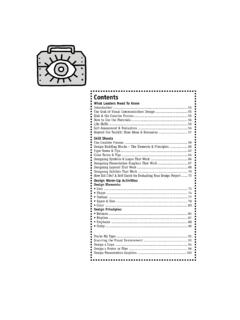
Transcription of Visual Vocabulary Quick Reference - Jesse James Garrett
1 Pagefilepage stackfile Vocabulary Quick ReferencePages are the fundamental unit of presentation on the Web, not(necessarily) a unit of implementation -- one page in your diagram maycorrespond to multiple HTML files (as in a frameset interface) or multipleunits of code (as in a server-side include or database-drivenimplementation).Files are parcels of data without navigational properties. They aredelivered to the user for use outside a Web browser environment (suchas audio or video files, stand-alone documents like PDFs, orexecutables).A page stack indicates a group of functionally identical pages whosenavigational properties are immaterial to the macrostructure of the file stack represents a group of files that receive identical navigationaltreatment and can be classified as a single entity (such as a collection ofdownloadable games or a library of PDF instruction manuals).
2 Continuation points allow us to separate our diagrams into easilydigestible sections, we use continuation points to bridge the gapsbetween sections. A single continuation point may list one or moresources or destinations as needed. The choice of orientation is a matterof the architect's aesthetic between elements are depicted with simple use arrows to convey directionality, indicating how the userwill move through the system. We use a crossbar on the opposite end ofthe arrow to prohibit upstream conditional connector is used when a path may or may not bepresented to the user depending upon whether one or more conditionsare met. Conditional connectors use arrows to convey directionality,indicating how the user will move through the system.
3 We use a crossbaron the opposite end of the arrow to prohibit upstream area is used to identify a group of pages that share one or morecommon attributes (such as appearing in a pop-up window, or havingsome unique design treatment). Use labels to identify these attributes or(as with connectors), refer to notes elsewhere in the document if youhave a lot to areas are used to represent architectures that involve repeatingthe same basic structure as it is applied to a number of functionallyidentical information elements. For example, you may have a productcatalog in which each product has a number of pages associated with conditional area is used when one or more conditions applies to agroup of pages. Conditional areas are applied most commonly insituations involving access permissions, such as when a valid login orencrypted (SSL) connection is required.
4 Conditional areas are associatedwith a result generated in the event that the condition(s) are not concurrent set is used in cases where a user action generates multiple,simultaneous results (such as spawning a pop-up window at the sametime a page is loaded in the main window, or displaying a page while afile is being downloaded). Upstream elements connect to the curved side;downstream elements connect to the flat decision point is used to model when one user action may generateone of a number of results, and the system must make a decision aboutwhich result is to be presented. Note that arrows must be used inconjunction with decision points to clarify whether associated elementsare upstream or downstream from the decision conditional branch is when the system (not based on user action) mustselect one path among a number of mutually exclusive options to bepresented to the user.
5 Upstream elements connect to one point of thetriangle; downstream elements connect to the opposite selectors function much like the conditional branch, with oneimportant difference: with the selector, the various downstream paths arenot mutually exclusive. Any number of the paths that fulfill thecondition(s) may be presented to the user ( search results.)A cluster is used when a system can present more than one path basedupon certain conditions. The cluster can appear downstream from eithera conditional branch or a conditional selector. For example if the attributebeing evaluated has value x, the user sees a path to page B; but if theattribute has value y, the user sees paths to both page C and page flow Reference serves as a sort of "placeholder" for a flow in everycontext in which it is repeated.
6 Both the flow area and flow referenceelements have the same basic shape, a rectangle with the cornersclipped flow area encloses a sequence of steps (like a login procedure, forinstance) that will appear repeatedly in different contexts throughout thedesign, analogous to a programming procedure. Flow areas require theuse of two special types of continuation points: entry points and exitpoints.