Transcription of WHO | Philippines
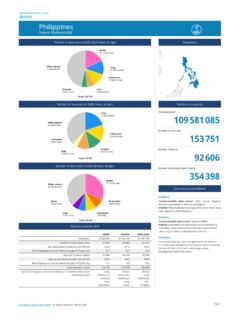
1 COUNTRY PROFILES WESTERN PACIFIC REGION WHO Global Status Report on Alcohol 2004 1 World Health Organization 2004 Philippines (THE) Recorded adult per capita consumption (age 15+) Sources: FAO (Food and Agriculture Organization of the United Nations), World Drink Trends 2003 Lifetime abstainers Total 52% Male Estimates from key alcohol experts show that the proportion of adult males and females who had been abstaining (last year before the survey) was 10% (males) and 70% (females). Data is for after year Heavy and hazardous drinkers Total Male 0 1 2 3 4 5 1961 19651969 1973 197719811985198919931997 2001 YearLitres of pure alcohol TotalBeerSpiritsWineData from the 2003 World Health Survey.
2 Total sample size n = 10 034; males n = 4639 and females n = 5395. Sample population aged 18 years and Data from the 2003 World Health Survey. Total sample size n = 10 034; males n = 4639 and females n = 5395. Sample population aged 18 years and above. Definition used: average consumption of 40 g or more of pure alcohol a day for men and 20 g or more of pure alcohol a day for COUNTRY PROFILES WESTERN PACIFIC REGION WHO Global Status Report on Alcohol 2004 2 World Health Organization 2004 A 2001 survey of subjects aged between 15 and 74 years (total sample size n = 10 240) found that the rate of regular drinking was (total), 13% (males) and (females).
3 Regular drinking was defined as drinking on four days or more per According to the 2003 World Health Survey (total sample size n = 4951; males n = 3430 and females n = 1521), the mean value (in grams) of pure alcohol consumed per day among drinkers was (total), (males) and (females).1 Heavy episodic drinkers Total 7% Male A 2001 survey (subsample size of drinkers n = 3529; age group 15 to 74 years old) found that among drinkers were heavy drinkers. of male drinkers and of female drinkers were heavy drinkers. Heavy drinking was defined as having more than 12 drinks on an average drinking Youth drinking (lifetime abstainers) Total Male Youth drinking (current drinkers) Total Male Data from the 2003 World Health Survey.
4 Total sample size n = 10 034; males n = 4639 and females n = 5395. Sample population aged 18 years and above. Definition used: at least once a week consumption of five or more standard drinks in one Data from the 2003 World Health Survey. Total sample size n = 1692; males n = 849 and females n = 843. Sample population aged 18 to 24 years 2002 national survey conducted among 20 000 Filipinos aged 15 to 27 years old. The same survey conducted in 1994 (sample size unknown) found that of the total respondents, of males and 16% of females were currently drinking alcohol at the time of the COUNTRY PROFILES WESTERN PACIFIC REGION WHO Global Status Report on Alcohol 2004 3 World Health Organization 2004 A 2001 survey (total sample size n = 1105; age group 15 to 19 years old) found that of the total population sampled were current drinkers.
5 Of males and of females were reported to be currently drinking Youth survey interviewed a national sample of 5266 men and 5612 women aged 15 to 24 in 1994. Data for age group 15 to 19 years old show that the rate of current drinkers among males was 47% and 12% among According to a cross-sectional, three-stage stratified cluster sampling representing 16 health regions of the country (total sample size n = 4198; aged 15 29 years old), the prevalence of alcohol use among Filipino youth is 39%; males ( ) are twice more likely than females ( ) to drink alcohol. Seven out of ten youth drinkers are light drinkers (70%), three out of ten are moderate drinkers, and only 4% are heavy Youth drinking (heavy episodic drinkers) Total Male Note: These are preliminary, early-release, unpublished data from WHO's World Health Survey made available exclusively for this report.
6 Some estimates may change in the final analyses of these data. A 2001 survey (total sample size n = 1105; age group 15 to 19 years old) found that of the total population sampled were heavy drinkers. Heavy drinking was defined as having more than 12 drinks on an average drinking Traditional alcoholic beverages Basi (sugar-cane wine) is made in the Philippines . It is made by fermenting boiled, freshly extracted sugar-cane juice. A dried powdered starter is used to start the fermentation. The mixture is left for up to three months to ferment and up to one year to age. The final product is light brown in colour and has a sweet and sour Unrecorded alcohol consumption The unrecorded alcohol consumption in the Philippines is estimated to be litres pure alcohol per capita for population older than 15 for the years after 1995 (estimated by a group of key alcohol experts).
7 2 Mortality rates from selected death causes where alcohol is one of the underlying risk factors The data represent all the deaths occurring in a country irrespective of whether alcohol was a direct or indirect contributor. Data from the 2003 World Health Survey. Total sample size n = 1692 ; males n = 849 and females n = 843. Sample population aged 18 to 24 years old. Definition used: at least once a week consumption of five or more standard drinks in one COUNTRY PROFILES WESTERN PACIFIC REGION WHO Global Status Report on Alcohol 2004 4 World Health Organization 2004 Chronic mortality 0 1963 1967 1971 197519811995 YearSDR per 1000 use disordersCirrhosis of the liverMouth and oropharynxcancers Ischaemic heart disease Note.
8 Chronic mortality time-series measured on two axes, ischaemic heart disease on right axis and the other causes on the left. Caution should be exercised when interpreting the results as death registration level is incomplete. Source: WHO Mortality Database Morbidity, health and social problems from alcohol use There is little data available on the extent of alcoholism or alcohol abuse in the Philippines . However, while there may be no official statistics available, the consequences of alcoholism are very obvious in the community or inside homes. There are many undocumented cases of alcoholic persons who collapsed in the street because of drunkenness.
9 Alcoholism is a growing concern in the culture and social life of this country. In recent years, only a few alcohol-related cases have been recorded by the philippine General Hospital. This could be due to the fact that alcoholism is not considered a medical problem by most Filipinos. Most Filipinos with an alcohol problem do not submit to medical treatment even if their condition is chronic. Alcohol rehabilitation centres have low admission rates compared to similar institutions for illicit drug dependency. The philippine General Hospital alcohol support group centre offers treatment and counselling for its indigent patients. For anonymity, patients from rich families go to private rehabilitation centres.
10 There are also some non-governmental organizations which provide similar services and carry out advocacy work. However, more effort is still needed in the Philippines in order to address the problems of alcohol Country background information Total population 2003 79 999 000 Life expectancy at birth (2002) Male Adult (15+) 51 199 360 Female % under 15 36 Probability of dying under age 5 per 1000 (2002) Male 39 Population distribution 2001 (%) Female 33 Urban 59 Gross National Income per capita 2002 US$ 1020 Rural 41 Sources.