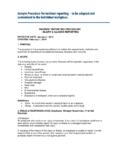
Transcription of Work at Height Rescue Plan2 - worksafenb.ca
1 Company Logo Company NameWorking at Height Rescue Plan Risk Assessment - Method Address:.. Rescue Plan Ref. No:..Location/area:..JOB TASK:Reference No.:..Work at Height Dates: From:..To:..What is task to be done:..Operators:Names of operators who are involved in the work at Height :1)..2)..3)..4)..5)..6)..Signature of Person Responsible For Working at Height Rescue (WAH)..Date:.. Rescue :Communication:What communication systems will be used between the suspended worker and supervisor / Rescue team?
2 (3 as appropriate)1)Direct voice communication 2)Whistle 22)Mobile Phone 3)Two-way Radios / Headsets Emergency Contact:In the event of an emergency / fall from Height the WAH supervisor should immediately alert:The Rescue team and first aid assistance: Rescue Team Name:.. Name:..TEL :.. TEL: ..First Aider(s) Name:.. Name:..TEL :.. TEL: ..If the site Rescue team is unable to affect a Rescue within 5 minutes the Fire & Rescue Service are to be calledon TEL - 999 and the Ambulance Service should be called Accident & Emergency Hospital TEL.
3 In all instances inform the Control Room of the situation, TEL - ..Note: Once the Rescue team is in attendance and if required, a nominated person is to go to the site entrance tomeet, and direct the emergency services, and provide the following information:Which Floor / how high up the casualty is:..Operators condition after fall:..Safety of Rescuers: (3as appropriate)Are Operators trained competent & in date in use of Rescue equipment?Yes No Are Rescue training records in date?Yes No Are there a sufficient number of rescuers available?
4 Yes No Is Rescue equipment selected appropriate for nature of work?Yes No What obstructions are in the way of reaching the suspended Operator? (Detail):..Have assessments been made of anchor points, & are they in date for test?Yes No Has consideration been made to method of attaching casualty?Yes No (Detail):.. will rescuers get to casualty?(3 as appropriate) (3 as appropriate) Rescue Remote Rescue Keys to building & Pull casualty in through window / Pull casualty up through floor / slab / Climb / abseil down building / Suspended access Aerial equipment from Crane man What equipment is needed to ensure Rescue within 5 minutes in order to minimize suspension trauma?
5 (3 as appropriate) (3 as appropriate) Rescue Aerial ladder Rescue Kit - Suspended access Rescue Kit - Climbing / rope Rescue Low Height Rescue Crane man Descent Rescue First Aid If Operative is injured (3 as appropriate)Can casualty still be rescued within 5 minutes?Yes No Is a qualified first aider who under stands suspension trauma present?Yes No Who and how will the emergency services and hospital be alerted? (Detail):..How will others be protected?
6 (3 as appropriate) (3 as appropriate)Assign someone to direct Set up How will Accident scene be protected?(3 as appropriate) (3 as appropriate)Prevent further injury or Set up 4 Preserve Report Incident / Event in normal Other Considerations:Lone working precautions (Detail):..Unusual features of building / structure (Detail):..Weather Conditions (Detail):..Proximity to emergency services / hospital (Detail):..Language barriers (agency / contract staff) (De-tail).
7 WORK AT Height Rescue PLAN PRODUCED BY:Rescuer In Charge:Name (print):.. Position:..Signature:.. Date:..APPROVAL OF WORK AT Height Rescue PLAN:Work At Height Supervisor:Name (print):.. Position:..Signature:.. Date:..Authorising Manager:Name (print):.. Position:..Signature:.. Date:..5 Rescue Plan Supplementary NotesIntroductionWhen operatives are suspended in mid-air after a fall, their lives hang in the balance - even if they have survivedthe fall without a scratch. Every second counts. The intention of this guidance is to help you fully understand theimplications of an operative falling, being arrested and then suspended by a harness, which initially saves them,but minutes later may kill them due to suspension than just helping to understand why this happens, this guidance will show what action should be taken toprevent a fallen operative dying from suspension trauma.
8 It will also clearly outline the current law with whichmust be complied with to discharge our legal Soon to Death or Serious Injury?Harnesses can become deadly whenever an operative is suspended for durations of over five minutes in an up-right posture with the legs relaxed straight beneath the body. After five minutes they are highly likely to be uncon-scious - but operatives attending the scene may not realise the seriousness of the situation and, 15 minutes latera dead body could be hauled up. The cause of this problem is called 'suspension trauma'.
9 In March 2004, OSHA (US equivalent of the UK Health and Safety Executive) issued a health and safety bulletinoutlining the dangers of prolonged, upright suspension. The bulletin warned of the risk of "orthostatic intolerance"and "suspension trauma" and refers to some of the potential health hazards - death being the chief one - experi-enced by operatives who are suspended upright by fall arrest equipment after a Trauma Orthostatic IntoleranceUnless the operative is rescued promptly using established safe procedures, suspension trauma caused byorthostatic intolerance could occur and result in serious or fatal injury as the brain.
10 Kidneys and other organs aredeprived of oxygen. Most users of fall protection equipment are unaware of the hazard of suspension pooling - The need to faint and fall overDeath from suspension trauma is caused by orthostatic intolerance and is the result of venous pooling. This canoccur any time a person is required to stand still for prolonged periods and may be worsened by heat and dehy-dration. Major blood vessels pass through the muscles in the legs. The movement of these muscles assists cir-culation by squeezing the blood back up towards the heart.



![SAFETY TALK [hearing protection] - WorkSafeNB – …](/cache/preview/3/4/b/8/d/f/0/4/thumb-34b8df04d33dcf40e26b345789106441.jpg)