Transcription of Working Your Way through ADAs T2D Treatment Algorithm …
1 Working Your Way through ADA s T2D Treatment AlgorithmConnor Scheidt, PharmDPharmacistBanner Health I have no disclosures. Presenter Disclosure InformationLearning ObjectivesRecognize drug-specific and patient factors of antihyperglycemic agents to support patient-provider shared decision makingDemonstrate when and how to intensify therapyIdentify opportunities to refer patients to Diabetes Self-Management EducationStandards of Medical Care in Diabetes - 2020 American Diabetes Pharmacologic approaches to glycemic Treatment : Standards of Medical Care in Diabetes 2020. Diabetes Care 2020;43(Suppl.)
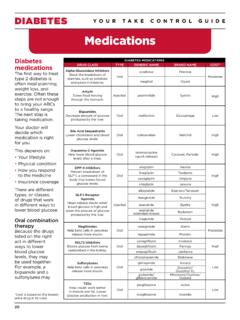
2 1):S98 S110 Figure -Glucose-lowering medication in type 2 diabetes: overall approachTable -Drug-specific and patient factors to consider when selecting antihyperglycemic Treatment in adults with type 2 diabetesAmerican Diabetes Association. 2. Pharmacologic approaches to glycemic Treatment : Standards of Medical Care in Diabetes 2020. Diabetes Care 2020;43(Suppl. 1):S98 S110 Patient case: Mary History of the present illness 52-year-old overweight woman New diagnosis of type 2 diabetes based on an A1C of Had prediabetes for 5 years. Also has hypertensionand dyslipidemia, which are both well controlled with losartan 100mg once daily and atorvastatin 40mg once daily.
3 Patient case: Mary Social History Divorced with 2 teenage children. Works as an administrative assistant. Tried losing weight in the past but has not been successful long term. Tries to walk 2-3 times per week, but lacks motivation. She has tried to cut back on sweets, she stopped drinking soda, but still eats fast food routinely and self-identifies problems with portion control and junk food. Patient case: Mary Vital signs: BP: 128/78 mmHg HR: 76 bpm Wt: 168 lb Ht: 5 4 BMI: kg/m2 Patient case: Mary Labs: A1C: eGFR: 68 mL/ UACR: 22 mg/g Tchol: 167 mg/dL LDL: 73 mg/dL HDL: 58 mg/dL TG: 178 mg/dL What is your Treatment plan for Mary s type 2 diabetes?
4 Figure -Glucose-lowering medication in type 2 diabetes: overall approachAmerican Diabetes Pharmacologic approaches to glycemic Treatment : Standards of Medical Care in Diabetes 2020. Diabetes Care 2020;43(Suppl. 1):S98 S110 First-Line TherapyFIRST-LINE Therapy is Metformin and Comprehensive Lifestyle (including weight management and physical activity) At diagnosis, recommended first-line therapy includes:Comprehensive lifestyle interventionMetforminAmerican Diabetes Association. 2. Pharmacologic approaches to glycemic Treatment : Standards of Medical Care in Diabetes 2020. Diabetes Care 2020;43(Suppl.)
5 1):S98 S110 Metformin Preferred initial pharmacologic agent. Continue as long as it is tolerated and not contraindicated; Other agents, including insulin, should be added to metformin. Consider periodic measurement of vitamin B12 Diabetes Association. 2. Pharmacologic approaches to glycemic Treatment : Standards of Medical Care in Diabetes 2020. Diabetes Care 2020;43(Suppl. 1):S98 S110 Metformin: Pros & ConsPros: High efficacy May aid in weight maintenance (possibly weight loss) Indirect lowering of insulin levels Low hypoglycemia risk Oral administrationCons: GI intolerance is common Potential for B12 deficiency Contraindicated with eGFR < 30 mL/ m2-Potential for metformin-associated lactic acidosis (MALA)American Diabetes Association.
6 2. Pharmacologic approaches to glycemic Treatment : Standards of Medical Care in Diabetes 2020. Diabetes Care 2020;43(Suppl. 1):S98 S110 Describe 3 scenarios in which metformin monotherapy may not be the preferred first-line Therapy for Type 2 Diabetes Early combination therapy can be considered in some patients at Treatment initiation to extend the time to Treatment failure. A The early introduction of insulin should be considered if there is evidence of ongoing catabolism (weight loss), if symptoms of hyperglycemia are present, or when A1C levels (>10% [86 mmol/mol]) or blood glucose levels ( 300 mg/dL [ mmol/L]) are very high.
7 E A patient-centered approach should be used to guide the choice of pharmacologic agents. Considerations include cardiovascular comorbidities, hypoglycemia risk, impact on weight, cost, risk for side effects, and patient preferences (Table and Figure ). EAmerican Diabetes Association. 2. Pharmacologic approaches to glycemic Treatment : Standards of Medical Care in Diabetes 2020. Diabetes Care 2020;43(Suppl. 1):S98 S110 Patient case: Robert History of the present illness 66-year-old man 3-year history of type 2 diabetes Also has: Hypertension Dyslipidemia Osteoarthritis Sleep apnea Depression Had a myocardial infarction 5 years ago Patient case: RobertSocial History: Married and lives with his wife.
8 He recently retired. Robert and his wife travel frequently. They both eat out at restaurants often. He does not case: RobertMedications: Metformin 1000mg twice daily Lisinopril 20mg once daily Metoprolol XL 100mg once daily Rosuvastatin 20mg once daily Aspirin 81mg once daily Paroxetine 10mg once dailyPatient case: RobertPatient case: RobertVital signs: BP: 136/84 mmHg HR: 64 bpm Ht: 5 11 Wt: 224 lb, BMI: kg/m2 Labs: A1C: eGFR: 58 mL/ , UACR: 366 mg/g, Tchol: 154 mg/dL, LDL: 69 mg/dL, HDL: 48 mg/dL TG: 184 mg/dLHow would you modify Robert s type 2 diabetes Treatment regimen?
9 Davies MJ, D Alessio DA, Fradkin J, et al. Diabetes Care 2018;41(12):2669-2701 Decision Cycle for Patient-Centered Glycemic ManagementASSESS KEY PATIENT CHARACTERISTICS Current lifestyle Comorbidities ASCVD, CKD, HF Clinical characteristics age, HbA1c, weight Issues such as motivation and depression Cultural and socio-economic contextFigure -Glucose-lowering medication in type 2 diabetes: overall approachAmerican Diabetes Pharmacologic approaches to glycemic Treatment : Standards of Medical Care in Diabetes 2020. Diabetes Care 2020;43(Suppl. 1):S98 S110 Pharmacologic Therapy for Type 2 Diabetes A patient-centered approach should be used to guide the choice of pharmacologic agents.
10 Considerations include comorbidities (atherosclerotic cardiovascular disease, heart failure, chronic kidney disease), hypoglycemia risk, impact on weight, cost, risk for side effects, and patient preferences. E Among patients with type 2 diabetes who have established atherosclerotic cardiovascular disease or indicators of high risk, established kidney disease, or heart failure, a SGLT-2 inhibitor or GLP-1 receptor agonist with demonstrated cardiovascular disease benefit is recommended as part of the glucose-lowering regimen independent of A1C and in consideration of patient-specific factors. AAmerican Diabetes Association.