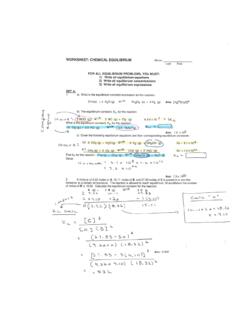
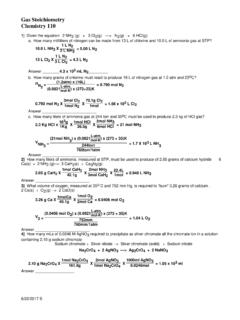
Transcription of WORKSHEET:SOLUTIONS AND COLLIGATIVE PROPERTIES …
1 WORKSHEET:SOLUTIONS AND COLLIGATIVE PROPERTIES SET A: 1. Find the molarity of all ions in a solution that contains moles of aluminum chloride in 820. ml solution. Answer: [Al 3+]= M , (Cl-] = 2. Find the molarity of each ion present after mixing 27 ml of M HNO3 with 36 ml of M Ca(NO3)2 (Note: There is no reaction taking place.) Answer: [H+]= M, [NO3-]= , [Ca2+]= M . 3. Find the molarity of each ion present after mixing 35 ml of M K2SO4 with 27 ml of K3PO4. Answer: [K +] = M, [SO42-]= M, [PO4 3-]= M. 4. Calculate the concentration of each ion and the mass of any precipitate when a mole of aluminum hydroxide is added to ml of M nitric acid solution ( Assume that there is no volume change upon the addition of the aluminum hydroxide to the solution). Hint: Write a balanced equation for the reaction taking place.)
2 Answer: 20 g Al(OH)3 left over, [Al3+]= M, [NO3-]= 5. A solution consists of g benzene,C6H6 , and g toluene ,C6H5CH3. The vapor pressure of pure benzene at 20. C is 75 mm Hg and that of toluene at C is 22 mm Hg. Assume that Raoult s law holds for each component of the solution, calculate the mole fraction of benzene in the vapor. ( molar mass of benzene= g/mole and toluene = g/mole.) Answer= 6. The freezing point of a glucose solution ( C6H12O6;molar mass= g/mole) is - C . The density of the solution is g/ml. What is the molarity of the glucose solution? ( Kf for water is ) Answer: mole/L 7. What is the normal boiling point of a M solution of KBr that has a density of g/ml?( KB for H2O is C .kg/mole) Answer=: C 8. ml of M potassium carbonate solution is mixed with ml of M cobalt(III) chloride a.
3 Write a balanced equation for the reaction. b. Write the total-ionic and net-ionic equations for the above reaction. Total ionic: Net-ionic: c. Give the name and mass of any precipitate(s)that may have formed. Answer: g of Co2(CO3)3 precipitate. Calculate the molar concentration of each ion remaining in solution after the reaction is complete. Answer:concentration of potassium ions= M, concentration of cobalt (III) ions= M concentration of carbonate ions= 0 M concentration of chloride ions= M SET B: 1. A solution that contains g of a nonvolatile nondissociating solute in 400. g of benzene freezes at C . The normal freezing point of benzene is C. What is the molar mass of the solute? ( KF for benzene= C .kg/mole) Answer: 82 g/mole 2. Chloroform and methanol form an ideal solution. The solution boils at 22 C and atm.
4 At 22 C , the vapor pressure of pure methanol is atm and the vapor pressure of pure chloroform is atm. What is the mole fraction of chloroform in the solution? Answer: 3. What is the normal boiling point of M solution of CaI2 that has a density of g/ml? ( KB for H2O = C .kg/mole) Answer: C 4. Calculate the freezing point of a % by mass Na3PO4 solution. ( Kf for H2O = C .kg/mole) Answer: C 5. ml of M aluminum nitrate is mixed with ml of M sodium carbonate and allowed to react. a. Write a balanced equation for the reaction. b. Write total-ionic and net-ionic equations for the above reaction. Total-ionic: Net-ionic: c. Give the name and mass of any precipitate that may have formed. Answer: g of Al2(CO3)3 precipitate d. Calculate the molar concentration of each ion remaining in solution after reaction is complete.
5 Answer: Concentration of carbonate ions= 0 M Concentration of aluminum ions = M Concentration of nitrate ions= M Concentration of sodium ions = M SET C: 1. What is the molarity of an aqueous solution of C6H12O6 that has a normal boiling point of C and density of g/ml? KB for water is C .kg/mole. ( C6H12O6 is a nonvolatile nondissociating solute.) Answer: mole/L 2. Calculate the normal freezing point of a M aqueous solution of C12H22O11 that has a density of g/ml. ( C12H22O11 is a nonvolatile nondissociating solute.) The molal freezing point depression constant of water is C .kg/mole. Answer: Freezing point= C 3. Heptane, C7H16, and octane,C8H18, form an ideal solution. At 40. C , the vapor pressure of pure heptane is atm , and the vapor pressure of pure octane is atm. A solution is made of g heptane and g octane.
6 Calculate the mole fraction of octane in the vapor at the above temperature. Answer: 4. What is the molar mass and molecular formula of a nondissociating compound whose empirical formula is C4H2N , if g of the compound in 500. g benzene give a freezing point depression of C? ( The molal freezing point depression constant for benzene is C .kg/mole.) Answer: 128 g/mole; C8H4N2 5. Liquids A and B form an ideal solution. The vapor pressure of pure A is atm at the normal boiling point of a solution prepared from mole of B and mole of A. What is the vapor pressure of pure B at this temperature? Answer: atm 6. A L aqueous solution contains g of a protein. The osmotic pressure of the solution is torr at 25 C. What is the molar mass of the protein? Answer: x 104 g/mole 7. Acetone and methanol form ideal solution.
7 At 25 C, the vapor pressures of pure acetone and pure methanol are atm and atm respectively. Calculate the mole fraction of methanol in a solution that boils at 25 C and atm. Answer: X= -2.