Transcription of ZABEP 20 - Medicines
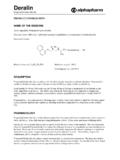
1 ZABEP 20. PRODUCT INFORMATION. Name of the medicine Rabeprazole sodium. The chemical name is ( ) 2-[{4-(3-methoxypropoxy)-3-methylpyridin -2-yl}- methylsulphinyl]-1H-benzimidazole Rabeprazole has one chiral centre and is a racemic mixture of two enantiomers. Its structural formula is: C18H20N3 NaO3S Molecular weight: CAS No.: 117976-09-6. Description Rabeprazole sodium is a substituted benzimidazole and belongs to the class of proton pump inhibitors. Its solubility in water is pH dependent, being very soluble in water at ph 9 to 11, and only slightly soluble in water at pH 8.
2 It is very soluble in methanol, freely soluble in dichloromethane and practically insoluble in hexane. Rabeprazole sodium is a BCS Class III drug. ZABEP 20 enteric coated tablets contain 20 mg of rabeprazole sodium. The tablets also contain povidone, hydroxypropyl cellulose, magnesium oxide, mannitol, magnesium stearate, ethylcellulose, methacrylic acid - ethyl acrylate copolymer (1:1), polysorbate 80, sodium lauryl sulfate, propylene glycol, iron oxide yellow, titanium dioxide and purified talc. The tablets are gluten free. Pharmacology Rabeprazole sodium suppresses gastric acid secretion by the specific inhibition of the H+/K+- ATPase enzyme (proton pump) at the secretory surface of the gastric parietal cell thereby blocking the final step of acid production.
3 This effect is dose-related and leads to inhibition of both basal and stimulated acid secretion irrespective of the stimulus. Animal studies indicate that after administration, rabeprazole rapidly disappears from both the plasma and gastric mucosa. Pharmacodynamics Anti-secretory activity Oral administration of a 20 mg dose of rabeprazole sodium provides rapid and effective reduction of gastric acid secretion. The onset of the anti-secretory effect occurs within one hour with the maximum effect occurring within two to four hours. Inhibition of basal and food-stimulated acid ZABEP 20/PI/221214 v4.
4 ZABEP 20 Product information Page 2 of 12. secretion 23 hours after the first dose of rabeprazole sodium is 69% and 82% respectively, and the duration of inhibition lasts up to 48 hours. The duration of pharmacodynamic action is much longer than the pharmacokinetic half-life (approximately one hour) would predict. This effect is probably due to the prolonged binding of rabeprazole to the parietal H+/K+-ATPase enzyme. The inhibitory effect of rabeprazole sodium on acid secretion increases slightly with repeated once daily dosing, achieving steady state inhibition after three days.
5 When the drug is discontinued, secretory activity normalises over 2 to 3 days. Helicobacter pylori Is associated with duodenal and gastric ulcer disease in approximately 95% and 70% of patients respectively. H. pylori is implicated as a major contributing factor in the development of gastritis and ulcers in such patients. Recent evidence also suggests a causative link between H. pylori and gastric carcinoma. H. pylori eradication therapy is appropriate in most patients with duodenal and gastric ulcer where the latter is not caused by nonsteroidal anti-inflammatory drug (NSAID) ingestion (see Dosage and administration).
6 Serum gastrin effects In clinical studies, patients were treated once daily with 10 or 20 mg rabeprazole sodium for up to 12 months duration. Serum gastrin levels increased during the first 2 to 8 weeks reflecting the inhibitory effects on acid secretion. Gastrin values returned to pre-treatment levels, usually within 1 to 2 weeks after discontinuation of therapy. In a maintenance study, which was subsequently extended up to 5 years duration, serum gastrin levels were only modestly raised in most patients. Enterochromaffin-like (ECL) cell effects Increased serum gastrin secondary to antisecretory agents stimulates proliferation of gastric ECL.
7 Cells which, over time, may result in ECL cell hyperplasia in rats and mice and gastric carcinoids in rats, especially females (see Carcinogenicity). In over 400 patients treated with rabeprazole sodium(10 or 20 mg/day) for up to one year, the incidence of ECL cell hyperplasia increased with time and dose, which is consistent with the pharmacological action of the proton pump inhibitor. No patient developed the adenomatoid, dysplastic or neoplastic changes of ECL cells in the gastric mucosa. No patient developed the carcinoid tumours observed in rats. Pharmacokinetics Absorption Rabeprazole sodium tablets are enteric coated to allow rabeprazole, which is acid labile, to pass through the stomach intact.
8 Absorption is rapid, with peak plasma levels of rabeprazole occurring approximately hours after a 20 mg dose. Peak plasma concentrations (Cmax) of rabeprazole and AUC are linear over the dose range of 10 mg to 40 mg. Absolute bioavailability of an oral 20 mg dose (compared to intravenous administration) is about 52%, largely due to pre-systemic metabolism. Additionally, the bioavailability does not appear to increase with repeat administration. In healthy subjects, the plasma half-life is approximately one hour (range to hours) and the total body clearance is estimated to be 283 98 mL/min.
9 Distribution Rabeprazole is approximately 97% bound to human plasma proteins. After intravenous administration the volume of distribution is L/kg. Metabolism Rabeprazole is metabolised through the cytochrome P450 (CYP450) hepatic drug metabolism system (see Interactions with other Medicines ). In humans, the thioether (M1) and carboxylic acid (M6) are the main plasma metabolites with the sulphone (M2), desmethyl thioether (M4) and mercapturic acid conjugate (M5) minor metabolites observed at lower levels. Only the desmethyl ZABEP 20/PI/221214 v4. ZABEP 20 Product information Page 3 of 12.
10 Metabolite (M3) has a small amount of anti-secretory activity, but its presence in plasma is minimal. Elimination and excretion Following a single 20 mg 14C-labelled oral dose of rabeprazole sodium, no unchanged drug was excreted in the urine. Approximately 90% of the dose was eliminated in urine mainly as the two metabolites: a mercapturic acid conjugate (M5) and a carboxylic acid (M6), plus two unknown metabolites also found in the species used in the toxicology studies. The remainder of the dose was recovered in faeces. Total recovery was This suggests low biliary excretion of the metabolites; with bio-transformation and urinary excretion of water soluble metabolites as the primary route of elimination.