1 Why is multiple testing a problem?
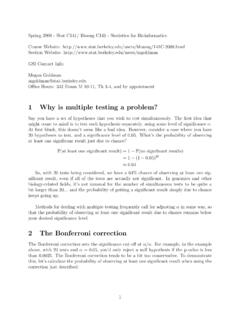
1 Why is multiple testing a problem? Say you have a set of hypotheses that you wish to test simultaneously. The rst idea that might come to mind is to test each hypothesis separately, using some level of signi cance . At rst blush, this doesn’t seem like a bad idea. However, consider a case where you have
Download 1 Why is multiple testing a problem?

Information
Domain:
Source:
Link to this page:
Documents from same domain
One Hundred Solved Exercises for the subject: …
www.stat.berkeley.eduOne Hundred1 Solved2 Exercises3 for the subject: Stochastic Processes I4 ... If the probability of rain is p, what is the probability that I get wet? 2.

International Relations Theory and the End of the …
www.stat.berkeley.eduInternational Relations Theory and the End of the Cold War Author(s): John Lewis Gaddis ... out of efforts to construct theories of international relations. There is a very simple reason for this: visions of any future have to proceed from the awareness of some kind of past; otherwise there can be no ...
Sampling - Department of Statistics
www.stat.berkeley.edusample” consists of the people willing to be interviewed on certain days at certain shopping centers. This too is a convenience sample. The reason This too is a convenience sample. The reason
Computing in the Statistics Curricula
www.stat.berkeley.educomputational problems and vocabulary into traditional statistics courses. 1.2 Our Backgrounds We have been thinking about and working on making changes in these directions for several years.
Brownian Motion and An Introduction to Stochastic Integration
www.stat.berkeley.eduBrownian Motion and An Introduction to Stochastic Integration Arturo Fernandez University of California, Berkeley Statistics 157: Topics In Stochastic Processes Seminar
Introduction to Time Series Analysis. Lecture 1.
www.stat.berkeley.eduIntroduction to Time Series Analysis. Lecture 1. Peter Bartlett 1. Organizational issues. 2. Objectives of time series analysis. ... Time Series Analysis and its Applications. With R Examples, Shumway and Stoffer. 2nd Edition. 2006. 2. ... Forecasting. Example: Predict unemployment. 4. Control. Example: Impact of …
Lecture Notes for Introductory Probability
www.stat.berkeley.eduLecture Notes for Introductory Probability Janko Gravner Mathematics Department University of California Davis, CA 95616 ... The theory of probability has always been associated with gambling and many most accessible ... The probability of this is 4 times the probability …

Conservative statistical post-election audits - Berkeley
www.stat.berkeley.eduthat requires post-election audits of randomly selected precincts, “to ensure with at least 99% statistical power that for each federal, gubernatorial or other Statewide election held in the State, a 100% manual recount of the voter-verifiable paper

Introduction to SQL - Department of Statistics
www.stat.berkeley.eduIntroduction to SQL What is SQL? I Structured Query Language I Usually “talk” to a database server I Used as front end to many databases (mysql, postgresql, oracle, sybase) I Three Subsystems: data description, data access and privileges I Optimized for certain data arrangements I The language is case-sensitive, but I use upper case for keywords.

Reversible Markov Chains and Random Walks on Graphs
www.stat.berkeley.eduReversible Markov Chains and Random Walks on Graphs David Aldous and James Allen Fill Un nished monograph, 2002 (this is recompiled version, 2014)
Related documents
Linked List Problems - Stanford University
cslibrary.stanford.eduproblem #18). It's easy to find linked list algorithms that are complex, and pointer intensive. • Pointer Intensive Linked list problems are really about pointers. The linked list structure itself is obviously pointer intensive. Furthermore, linked list algorithms often break and re-weave the pointers in a linked list as they go.

Strategies for Teaching Science Content Reading
files.eric.ed.govan answer to a problem, but rather one must be able to explain how the answer was determined. One engages in metacognition when one can describe the steps that were undertaken to solve the problem. Another example of metacognition is using criteria to make a choice. Metacognition, then, is the process of thinking about one’s own thoughts.

First Four Steps: Problem Definition - Virginia Tech
courses.cs.vt.eduCS@VT Intro Problem Solving in Computer Science ©2012 McQuain SA Example: Really Bad Day 24 Problem Timing (H,M,L) Trend (H,M,L) Impact (H,M,L) Next Process 1. Get dog off leg H H H DA 2. Repaircar 3. Put out fire. 4. Protect contents of briefcase 5. Preparefor tornado 1. Get dog off leg: Timing: Must do this NOW ---high! Trend: Wounds are ...

The Trolley Problem - University of Colorado Boulder
rintintin.colorado.eduThe Trolley Problem 1. The Trolley Problem: Consider the following pair of cases: Switch There is a runaway trolley barreling down the railway tracks. Ahead, on the tracks, there are five people. The trolley is headed straight for them. You are standing some distance off in the train yard, next to a lever. If you pull this lever,

CONFLICT RESOLUTION - Winona State University
www.winona.eduFeb 28, 2017 · Breathe. Calm Down. Now, you are ready to accurately look at the problem at hand. 2. Think! Ask yourself: • What exactly is the problem? • Is this really a problem? Why? • It is my problem? • Does it need immediate attention? • What do I want? What is my goal? • What might I be assuming?
CHAPTER 16 -- MAGNETIC FIELDS QUESTION & PROBLEM …
faculty.polytechnic.orgQUESTION & PROBLEM SOLUTIONS 16.1) What is the symbol for a magnetic field? What are its units? Also, what are magnetic fields, really? Solution: As a vector, the symbol for a magnetic field is B. Its units are teslas. In reality, magnetic forces are relativistic effects produced by charge in relative motion.