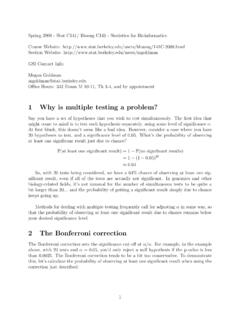
1 Why is multiple testing a problem?
The Bonferroni correction sets the signi cance cut-o at =n. For example, in the example above, with 20 tests and = 0:05, you’d only reject a null hypothesis if the p-value is less than 0.0025. The Bonferroni correction tends to be a bit too conservative. To demonstrate
Download 1 Why is multiple testing a problem?

Information
Domain:
Source:
Link to this page:
Documents from same domain
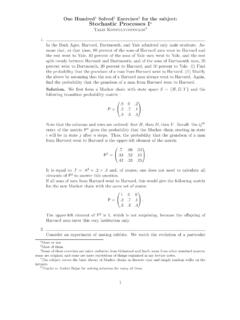
One Hundred Solved Exercises for the subject: …
www.stat.berkeley.eduOne Hundred1 Solved2 Exercises3 for the subject: Stochastic Processes I4 ... If the probability of rain is p, what is the probability that I get wet? 2.
International Relations Theory and the End of the …
www.stat.berkeley.eduInternational Relations Theory and the End of the Cold War Author(s): John Lewis Gaddis ... out of efforts to construct theories of international relations. There is a very simple reason for this: visions of any future have to proceed from the awareness of some kind of past; otherwise there can be no ...
Sampling - Department of Statistics
www.stat.berkeley.edusample” consists of the people willing to be interviewed on certain days at certain shopping centers. This too is a convenience sample. The reason This too is a convenience sample. The reason
Computing in the Statistics Curricula
www.stat.berkeley.educomputational problems and vocabulary into traditional statistics courses. 1.2 Our Backgrounds We have been thinking about and working on making changes in these directions for several years.
Brownian Motion and An Introduction to Stochastic Integration
www.stat.berkeley.eduBrownian Motion and An Introduction to Stochastic Integration Arturo Fernandez University of California, Berkeley Statistics 157: Topics In Stochastic Processes Seminar
Introduction to Time Series Analysis. Lecture 1.
www.stat.berkeley.eduIntroduction to Time Series Analysis. Lecture 1. Peter Bartlett 1. Organizational issues. 2. Objectives of time series analysis. ... Time Series Analysis and its Applications. With R Examples, Shumway and Stoffer. 2nd Edition. 2006. 2. ... Forecasting. Example: Predict unemployment. 4. Control. Example: Impact of …
Lecture Notes for Introductory Probability
www.stat.berkeley.eduLecture Notes for Introductory Probability Janko Gravner Mathematics Department University of California Davis, CA 95616 ... The theory of probability has always been associated with gambling and many most accessible ... The probability of this is 4 times the probability …

Conservative statistical post-election audits - Berkeley
www.stat.berkeley.eduthat requires post-election audits of randomly selected precincts, “to ensure with at least 99% statistical power that for each federal, gubernatorial or other Statewide election held in the State, a 100% manual recount of the voter-verifiable paper
Introduction to SQL - Department of Statistics
www.stat.berkeley.eduIntroduction to SQL What is SQL? I Structured Query Language I Usually “talk” to a database server I Used as front end to many databases (mysql, postgresql, oracle, sybase) I Three Subsystems: data description, data access and privileges I Optimized for certain data arrangements I The language is case-sensitive, but I use upper case for keywords.

Reversible Markov Chains and Random Walks on Graphs
www.stat.berkeley.eduReversible Markov Chains and Random Walks on Graphs David Aldous and James Allen Fill Un nished monograph, 2002 (this is recompiled version, 2014)
Related documents

Lecture 10: Multiple Testing - University of Washington
www.gs.washington.eduPhilosophical Objections to Bonferroni Corrections “Bonferroni adjustments are, at best, unnecessary and, at worst, deleterious to sound statistical inference” Perneger (1998) •Counter-intuitive: interpretation of finding depends on the number of other tests performed •The general null hypothesis (that all the null hypotheses are
Correlation Between Continuous & Categorical Variables
www.ce.memphis.eduBonferroni correction Observed Male Female Total Married 456 516 972 Widowed 58 123 181 Divorced 142 172 314 Separated 29 50 79 Never married 188 207 395 Total 873 1068 1941 Expected Male Female Married 437.1747 534.8253 Widowed 81.40804 99.59196 Divorced 141.2272 172.7728 Separated 35.53168 43.46832 Never married 177.6584 217.3416 Adjusted ...

Data Mining - Stanford University
infolab.stanford.eduof statistics, known as the Bonferroni correction gives a statistically sound way to avoid most of these bogus positive responses to a search through the data. Without going into the statistical details, we offer an informal version, Bon-ferroni’s principle, that helps us avoid treating random occurrences as if they were real.

Interaction Effects in ANOVA - University of Oregon
pages.uoregon.eduthis procedure for alpha adjustment is an application of Bonferroni’s procedure). Method 4. Planned Comparisons. Another alternative to the procedures above is the use of planned comparisons instead of the omnibus F test for the interaction. These procedures can also be implemented using the oneway procedures described above.

Model Selection: General Techniques - Stanford University
statweb.stanford.eduBonferroni correction Simultaneous inference for Model selection: goals Model selection: general Model selection: strategies Possible criteria Mallow’s Cp AIC & BIC Maximum likelihood estimation AIC for a linear model Search strategies Implementations in R Caveats - p. 3/16 Crude outlier detection test