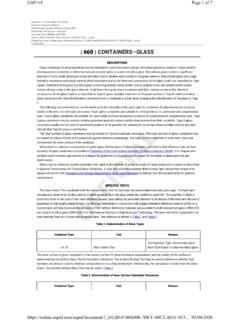
660 〉〉 CONTAINERS—GLASS
glass containers will raise the hydrolytic resistance from a moderate to a high level, changing the classification of the glass to Type II. The following recommendations can be made as to the suitability of the glass type for containers for pharmaceutical products,
Download 660 〉〉 CONTAINERS—GLASS

Information
Domain:
Source:
Link to this page:
Documents from same domain

USP <51> Antimicrobial Effectiveness Testing
latam-edu.usp.orgIf the diluted product exhibits antimicrobial properties, specific neutralizers may need to be incorporated into the diluents or the recovery media. The ability of the procedure to measure preservative efficacy may be compromised if the method suitability requires significant dilution (10 −2 or 10 −3) as this will affect the measured recovery
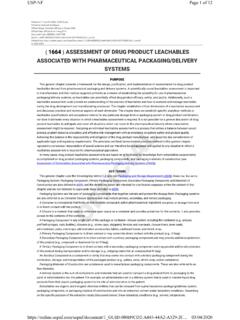
1664 〉〉〉〉 ASSESSMENT OF DRUG PRODUCT …
latam-edu.usp.orgadministration ports, overwraps, adminstration accessories, labels, cardboard boxes, and shrink wrap. A Primary Packaging Component is in direct contact or may come into direct contact with the product (e.g., IV bag). A Secondary Packaging Component is in direct contact with a primary packaging component and may provide additional protection

659 PACKAGING AND STORAGE REQUIREMENTS
latam-edu.usp.orgAncillary component:A component or entity that may come into contact with a Tertiary packaging component during the distribution, storage, and/or transportation of the packaged article (e.g., pallets, skids, and shrink wrap).
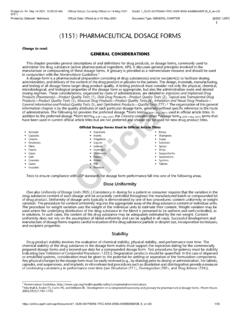
1151 PHARMACEUTICAL DOSAGE FORMS
latam-edu.usp.orgBioavailability (See also In Vitro and In Vivo Evaluation of Dosage Forms á1088ñ and Assessment of Solid Oral Drug Product Performance and Interchangeability, Bioavailability, Bioequivalence, and Dissolution á1090ñ.)Bioavailability is influenced by factors such as the

Module 08 USP 1115 Bioburden Control of Non-Sterile …
latam-edu.usp.orgUnlike aseptic processing for which facility requirements are generally uniform in specification and performance, nonsterile product manufacturing environments typically involve diverse products and microbial contamination control requirements. In general, liquid, cream, or ointment products require a greater level of

USP <71> Sterility Tests - United States Pharmacopeia
latam-edu.usp.orgThe view from USP <1211> Sterilization and Sterility Assurance of Compendial Articles : 6 ... For products containing a mercurial preservative that cannot be tested by the ... Used for sterility testing of viscous products and for devices having tubes with small lumen.

1117 MICROBIOLOGICAL BEST LABORATORY PRACTICES
latam-edu.usp.orgWhenever possible, sampling equipment should be loaded with its microbiological recovery media in the environment that is to be sampled. All testing in laboratories used for critical testing procedures, such as sterility testing of final dosage forms, bulk product, seed

71 〉〉〉〉 STERILITY TESTS
latam-edu.usp.orgof the test. Modify the conditions in order to eliminate the antimicrobial activity, and repeat the Method Suitability Test. This method suitability is performed (a) when the test for sterility has to be carried out on a new product; and (b) whenever there is a change in the experimental conditions of the test.
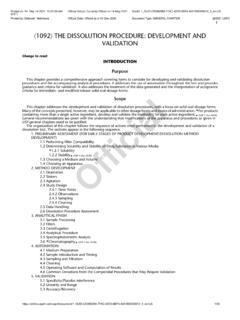
1092 THE DISSOLUTION PROCEDURE: DEVELOPMENT AND …
latam-edu.usp.org5.4 Precision 5.4.1 Repeatability of Analysis 5.4.2 Intermediate Precision/Ruggedness 5.4.3 Reproducibility 5.5 Robustness 5.6 Stability of Standard and Sample Solutions ... (such as dynamic solubility, potentiometric titration, or turbidity measurement methods). (USP …

STERILIZATION OF COMPENDIAL ARTICLES
latam-edu.usp.orgFor steam and dry heat, the D-value is a function of temperature. In gas sterilization (ethylene oxide, ClO , or O ), D-values are a function of the chemical concentration, relative humidity, and temperature. Similarly, for liquid chemical sterilization the D-value is a function of the temperature and sterilant concentration.
Related documents

ISO 1496-1: Series 1 Freight Containers--Specification and ...
law.resource.orgInternal dimensions of containers shall be as large as pessible, but, in any case: - closed containers type 00 shall comply with the requirements for minimum internar length, width and height given in . 4.3; - containers type . 02, having partial opening(s) in the side(s), shall comply with the requirements for minimum

CMA CGM CONTAINERS
www.cma-cgm.comcontainers’ for the transport of garments on hangers. our containers are suitable for multi-modal transport and can be seamlessly transferred from ship to rail, to barge, to truck. all of our containers meet iso standards 668, 1496/1 and 6346, C. s.C. criteria (Convention for safe Contai-
Type I Glass for Pharmaceutical Containers: Technical ...
www.dcvmn.orgcontainers EtchingTest ArsenicTest Spectral Transmission Applied to glass containers for aqueous parenteral preparations. Limit Value ≤ 0,1 ppm of As For coloured glass containers UV-VIS sprectrometer with an integrating sphere Glass Containers for Pharmaceutical Use Glass Containers According to the European Pharmacopoeia (EP)
Holding Times and Containers - Eurofins Scientific
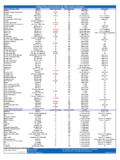
www.eurofinsus.comHolding Times and Containers for Water/Aqueous Samples General Chemistry / Metals Method Holding Time (days) Min Volume (mls) Container Preservation Alkalinity SM 2320 B
Containers and Amounts - Teach-This.com
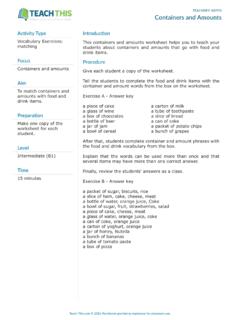
www.teach-this.comContainers and Amounts Introduction This containers and amounts worksheet helps you to teach your students about containers and amounts that go with food and drink items. Procedure Give each student a copy of the worksheet. Tell the students to complete the food and drink items with the container and amount words from the box on the worksheet.
BRIEFING 660 Containers Glass, - U.S. Pharmacopeia
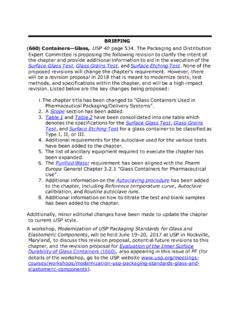
www.usp.orgcontainers, and factors that influence inner surface durability of glass containers is provided in 1660 . This chapter also contains recommended approaches to evaluate the potential of a drug product to cause the formation of glass particles and delamination.