
A Simple Feature Augmentation for Domain Generalization
2.3. Domain Randomization Domain randomization has been widely used in differ-ent tasks [34,43,31,31,42,26] in computer vision. [34] firstly proposed to apply diverse random rendering styles to synthetic data, such that the test data was likely to lie within the training distribution, thus improving generaliza-tion.
Download A Simple Feature Augmentation for Domain Generalization

Information
Domain:
Source:
Link to this page:
Documents from same domain
What Have We Learned From Deep Representations for …
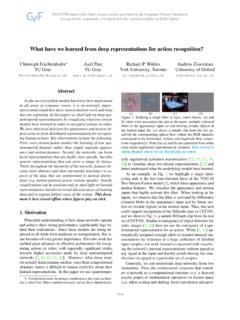
openaccess.thecvf.comwhat these powerful models actually have learned. In this paper we shed light on deep spatiotemporal net-works by visualizing what excites the learned models us-ing activation maximization by backpropagating on the in-put. We are the first to visualize the hierarchical features
Finding Tiny Faces in the Wild With Generative Adversarial ...
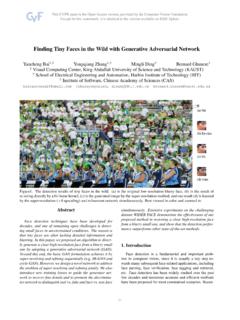
openaccess.thecvf.comfaces, which are unfriendly for the face classifier. Toward-s this end, we design a refinement sub-network to recover some detailed information. In the discriminator network, the basic GAN [17, 12, 8] is trained to distinguish the real and fake high resolution images. To classify faces or non-
Squeeze-and-Excitation Networks - openaccess.thecvf.com
openaccess.thecvf.comSqueeze-and-Excitation Networks Jie Hu1∗ Li Shen2∗ Gang Sun1 hujie@momenta.ai lishen@robots.ox.ac.uk sungang@momenta.ai 1 Momenta 2 Department of Engineering Science, University of Oxford Abstract Convolutional neural networks are built upon the con-
RegularFace: Deep Face Recognition via Exclusive ...
openaccess.thecvf.comRegularFace: Deep Face Recognition via Exclusive Regularization Kai Zhao Jingyi Xu Ming-Ming Cheng ∗ TKLNDST, CS, Nankai University kaiz.xyz@gmail.com cmm@nankai.edu.cn
Protecting World Leaders Against Deep Fakes
openaccess.thecvf.comProtecting World Leaders Against Deep Fakes Shruti Agarwal and Hany Farid University of California, Berkeley Berkeley CA, USA {shrutiagarwal, hfarid}@berkeley.edu
Auto-DeepLab: Hierarchical Neural Architecture Search for ...
openaccess.thecvf.comAuto-DeepLab: Hierarchical Neural Architecture Search for Semantic Image Segmentation Chenxi Liu1∗, Liang-Chieh Chen 2, Florian Schroff2, Hartwig Adam2, Wei Hua2, Alan Yuille1, Li Fei-Fei3 1Johns Hopkins University 2Google 3Stanford University Abstract Recently, NeuralArchitectureSearch(NAS)hassuccess-
PointNet: Deep Learning on Point Sets ... - CVF Open Access
openaccess.thecvf.comPointNet: Deep Learning on Point Sets for 3D Classification and Segmentation Charles R. Qi* Hao Su* Kaichun Mo Leonidas J. Guibas Stanford University
Frustum PointNets for 3D Object Detection From RGB-D Data
openaccess.thecvf.comFrustum PointNets for 3D Object Detection from RGB-D Data Charles R. Qi1∗ Wei Liu2 Chenxia Wu2 Hao Su3 Leonidas J. Guibas1 1Stanford University 2Nuro, Inc. 3UC San Diego Abstract In this work, we study 3D object detection from RGB-D data in both indoor and outdoor scenes.
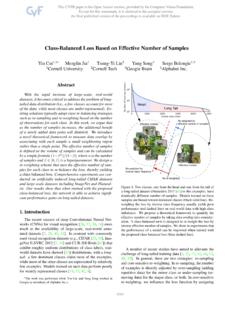
Class-Balanced Loss Based on Effective Number of Samples
openaccess.thecvf.comand large-scale datasets including ImageNet and iNatural-ist. Our results show that when trained with the proposed class-balanced loss, the network is able to achieve signifi-cant performance gains on long-tailed datasets. 1. Introduction The recent success of deep Convolutional Neural Net-works (CNNs) for visual recognition [26, 37, 38, 16] owes
ESRGAN: Enhanced Super-Resolution Generative Adversarial ...
openaccess.thecvf.comESRGAN: EnhancedSuper-Resolution Generative Adversarial Networks Xintao Wang 1, Ke Yu , Shixiang Wu2, Jinjin Gu3, Yihao Liu4, Chao Dong 2, Yu Qiao , and Chen Change Loy5 1 CUHK-SenseTime Joint Lab, The Chinese University of Hong Kong 2 Shenzhen Institutes of Advanced Technology, Chinese Academy of Sciences 3 The Chinese University of Hong Kong, …
Related documents
Pointer Authentication on ARMv8 - Qualcomm
www.qualcomm.comRandomization is a good generic defense that makes it harder to reliably exploit systems. Countermeasures in this category range from randomized stack/heap, which makes it harder to find a pointer to corrupt, to full Address Space ... including generating good quality random numbers, is the responsibility of the software.
Chapter 208 Paired T-Test - Statistical Software
ncss-wpengine.netdna-ssl.comtest, and non-parametric tests including the randomization test, the quantile (sign) test, and the Wilcoxon Signed-Rank test. Tests of assumptions and distribution plots are also available in this procedure. Research Questions For the paired-sample situation, the prime concern in research is examining a measure of central tendency

Cognitive Behavioral Therapy for Suicide Prevention
www.mirecc.va.govApr 23, 2021 · If the patient has difficulty generating a list of specific CBT coping strategies, then they may ... Randomization (N = 95) Cognitive Therapy . 16 Sessions (N = 46) Case Management . 16 Telephone Sessions (N = 49) Follow-up Assessments . 1, 3, 6, 9, 12 months (N = 34 completed 12M)

Social and Economic Networks 1 - Stanford University
web.stanford.eduCONTENTS 5 4.2.6 Giant Components in the Con–guration Model . . . . . . . . . . 141 4.2.7 Diameter Estimation . . . . . . . . . . . . . . . . . . . . . . . . 145

Econometrics Machine Learning and - Stanford University
web.stanford.eduData generating process is different. Observed data generated by a “more crime -> more police” rule but now want to know what happens to crime when you add more ... Randomization: solves selection bias, so observed difference is average effect of …
Statistical Methods in Psychology Journals
www.apa.orgabsence of randomization, we should do our best to inves-tigate sensitivity to various untestable assumptions. Measurement Variables. Explicitly define the variables in the study, show how they are related to the goals of the study, and explain how they are measured. The units of measure-ment of all variables, causal and outcome, should fit the