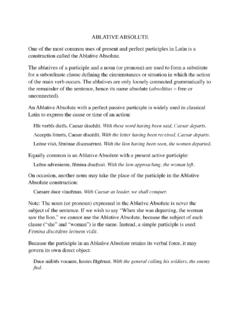
ABLATIVE ABSOLUTE
ABLATIVE ABSOLUTE One of the most common uses of present and perfect participles in Latin is a construction called the Ablative Absolute. The ablatives of a participle and a noun (or pronoun) are used to form a substitute
Download ABLATIVE ABSOLUTE

Information
Domain:
Source:
Link to this page:
Documents from same domain
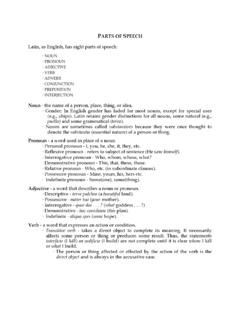
Parts of Speech - The Latin Library
www.thelatinlibrary.comPARTS OF SPEECH Latin, as English, has eight parts of speech: · NOUN · PRONOUN · ADJECTIVE · VERB · ADVERB · CONJUNCTION · PREPOSITION · INTERJECTION Noun - the name of a person, place, thing, or idea.
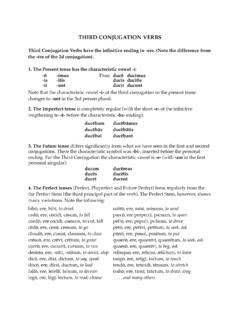
Third Conjugation Verbs - The Latin Library
www.thelatinlibrary.comTHIRD CONJUGATION VERBS Third Conjugation Verbs have the infinitive ending in -ere. (Note the difference from the -ēre of the 2d conjugation).
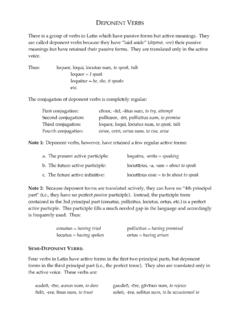
DEPONENT VERBS - The Latin Library
www.thelatinlibrary.comDEPONENT VERBS There is a group of verbs in Latin which have passive forms but active meanings. They are called deponent verbs because they have “laid aside” (dëpönö, -ere) their passive
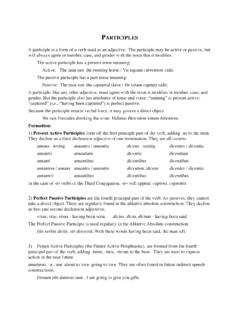
PARTICIPLES - The Latin Library
www.thelatinlibrary.comPARTICIPLES A participle is a form of a verb used as an adjective. The participle may be active or passive, but will always agree in number, case, and gender with the noun that it …
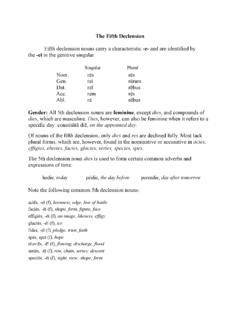
The Fifth Declension
www.thelatinlibrary.comThe Fifth Declension Fifth declension nouns carry a characteristic -e- and are identified by the -eī in the genitive singular. Singular Plural Nom. rēs rēs ...
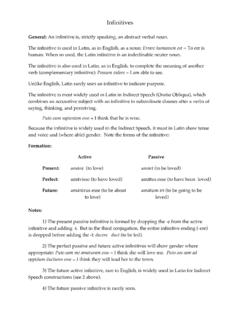
Infinitives - The Latin Library
www.thelatinlibrary.comInfinitives General: An infinitive is, strictly speaking, an abstract verbal noun. The infinitive is used in Latin, as in English, as a noun: Errare humanum est = To err is ...
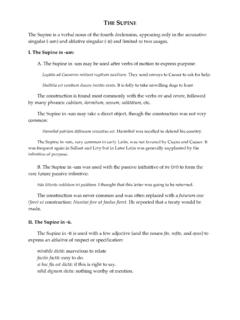
T SUPINE - The Latin Library
www.thelatinlibrary.comTHE SUPINE The Supine is a verbal noun of the fourth declension, appearing only in the accusative singular (-um) and ablative singular (-ü) and limited to two usages.
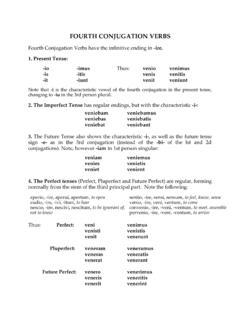
FOURTH CONJUGATION VERBS - The Latin Library
www.thelatinlibrary.comFOURTH CONJUGATION VERBS Fourth Conjugation Verbs have the infinitive ending in -ire. 1. Present Tense:-io-is-it-imus-itis-iunt Thus: venio venis venit venimus
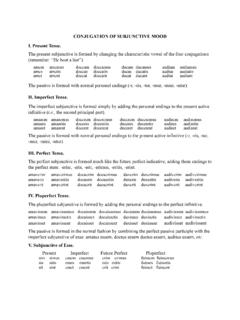
CONJUGATION OF SUBJUNCTIVE MOOD I. Present …
www.thelatinlibrary.comCONJUGATION OF SUBJUNCTIVE MOOD I. Present Tense. The present subjunctive is formed by changing the characteristic vowel of the four conjugations
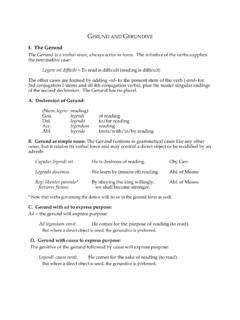
I. The Gerund - The Latin Library
www.thelatinlibrary.comGERUND AND GERUNDIVE I. The Gerund The Gerund is a verbal noun, always active in force. The infintive of the verbs supplies the nominative case: Legere est difficile = To read is difficult (reading is difficult)
Related documents
The Essential Handbook For Business Writing
essentialbusinessenglish.comThe Essential Handbook For Business Writing Desmond A. Gilling communication excellence in English, the language of business worldwide
PARTICIPLES - The Latin Library
www.thelatinlibrary.comPARTICIPLES A participle is a form of a verb used as an adjective. The participle may be active or passive, but will always agree in number, case, and gender with the noun that it modifies.

sExercExerciisee 2288 - English for Everyone
englishforeveryone.orgRR eaaddThheoorryy..OOrrgg © 2 01 E n glishFF o rEv ey .O © 22000088 Name_____ Date_____ sExercExerciisee 2288 Past Tense Fill in the spaces with the correct form ...

sExercExerciisee 2299 - EnglishForEveryone.org
englishforeveryone.orgRR eaaddThheoorryy..OOrrgg © 2 01 E n glishFF o rEv ey .O © 22000088 Name_____ Date_____ sExercExerciisee 2299 Present Tense Fill in the spaces with the correct ...
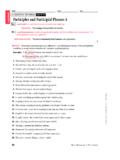
The crying child asked for his mother. PARTICIPLE EXERCISE ...
www.mrshatzi.comThe crying child asked for his mother. PARTICIPLE The record broken by José Canseco was impressive. PARTICIPIAL PHRASE 15, Closely written, the words filled every space on the diary pages.

Perfect-English-Grammar.com Irregular Past Participles ...
www.perfect-english-grammar.comTitle: Microsoft Word - 50 Irregular Verbs Past Participle Part 2.doc Author: Seonaid Bell Created Date: 11/23/2007 12:00:00 AM
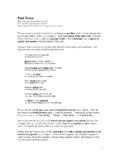
Past Tense - David's Homepage
cokdybysme.net2 Given their need to be in grammatical agreement, l-participles for the pronoun vy cover a whole range of possibilities depending on the number and gender of the vy subject: Byl jste někdy v Praze? The addressee is one male. Byla jste někdy v Praze? The addressee is one female. Byli jste někdy v Praze? The addressee is plural and contains at least one male.

participles and participial phrases a answer key - Bing
pdfsebooks.comparticiples and participial phrases a answer key.pdf FREE PDF DOWNLOAD NOW!!! Source #2: participles and participial phrases a answer key.pdf FREE PDF DOWNLOAD
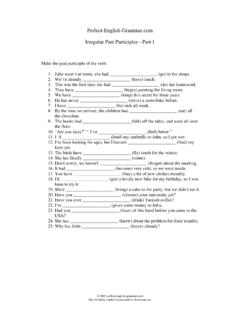
Perfect-English-Grammar.com Irregular Past Participles ...
www.perfect-english-grammar.com© 2007 perfect-english-grammar.com May be freely copied for personal or classroom use. Perfect-English-Grammar.com Irregular Past Participles - Part 1