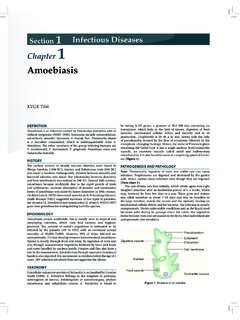
Amoebiasis - API
Amoebiasis is an infection caused by Entamoeba histolytica with or without symptoms (WHO 1969). Synonyms include entamoebiasis, amoebiosis, amoebic dysentery or bloody flux. Entamoeba dispar ... Amebiasis (Amebic Dysentery): Investigation Guideline. [online]. Available from
Download Amoebiasis - API

Information
Domain:
Source:
Link to this page:
Documents from same domain
Section 12 Toxicology Chapter 92 - The Association …
www.apiindia.orgVENOM ALLERGENS Bees release large amount of venom, 50–140 mcg/sting.2 Allergens constituting the venom include vasoactive amines, small …
CLINICAL APPROACH TO DILATED BILE DUCT
www.apiindia.org7 : 4 Dilated bile duct is commonly seen in clinical practice and usually represents an obstructive lesion limiting the flow of bile. The evaluation of dilated bile duct is aimed to diagnose and treat the

Isolated systolIc hypertensIon - API
www.apiindia.org111 Isolated systolIc hypertensIon Raminder Singh, Mumbai Until the 1980’s the diastolic blood pressure (DBP) was assumed to be the most relevant hemodynamic
Chapter 113
www.apiindia.org515 Chapter 113Section 16 Clinical Approach to a Patient with Headache done if patients have visual symptoms, jaw or tongue claudication, temporal artery signs or other findings suggesting giant cell
ManageMent of Liver abscess - API
www.apiindia.org471 Management of Liver Abscess • Drain the pus, • Institute appropriate antibiotics, and • Deal with any underlying source of infection, if present.
Clinical Approach to Isolated Splenomegaly 441
www.apiindia.orgClinical Approach to Isolated Splenomegaly 443 tation in addition to the age of the patient, clinical features, associated hepatomegaly and lymphadeno-
Colonization Versus Infection - API
www.apiindia.orgColonization Versus Infection 331 the other hand, an organism isolated from a non sterile specimen like sputum or a wound swab may be a colonizer. However it …
Chapter 13
www.apiindia.orgChapter 13 INTRODUCTION Atypical mycobacteria are also called nontuberculous mycobacteria (NTM) or mycobacteria other than tuberculosis (MOTT). Nontuberculous mycobacteria are widely distributed in the ... Clinical and Microbiological Criteria for Diagnosis of NTM Clinical (both required):
Chapter 137
www.apiindia.org628 Metabolic Disorders Section 18 with treatment can exceed the growth acceleration, resulting in a compromised adult height.15 The deficit in adult stature correlates with the duration of hypothyroidism before initiation of treatment.

RATIONAL USE OF DIURETICS AND PATHOPHYSIOLOGY …
www.apiindia.org601 RATIONAL USE OF DIURETICS AND PATHOPHYSIOLOGY OF EDEMA OP Kalra, Amitesh Aggarwal, Delhi IntroductIon The use of diuretics for therapeutic purposes is not new.
Related documents
Amoebiasis in the Tropics: Epidemiology and Pathogenesis
cdn.intechopen.comEntamoeba histolytica is a protozoan parasite that causes amebic dysentery and liver abscess. ... In developed countries amebiasis tends to be more common in older patients and occurs mostly among men who have sex with men or in institutions. However, in tropical regions, the epidemiology of amoebiasis is completely ...
Progress towards Development of a Vaccine for Amebiasis
cmr.asm.orgagainst amebiasis in humans remain unknown, and whether a vaccine to prevent amebiasis must stimulate cell-mediated im- mune responses for protective efficacy is unclear.
Amebiasis - Entamoeba histolytica - Piedmont HealthCare
piedmonthealthcare.comAmebiasis is a worldwide disease, however developing countries have significantly higher prevalence rates because of poorer socioeconomic conditions and sanitation levels. Areas that have high rates of …
AMEBIASIS - Department of Public Health
publichealth.lacounty.govAcute Communicable Disease Control Manual (B-73) REVISION—March 2016 PART IV: Acute Communicable Diseases AMEBIASIS — page 1 AMEBIASIS 1. Agent: Entamoeba histolytica, a protozoan parasite that exists as a trophozoite and cyst.
1. What is amebiasis? 2. How do you get amebiasis?
publichealth.lacounty.gov1. What is amebiasis? Amebiasis (am-e-BY-a-sis) is an infection of the intestine caused by a parasite (an organism living in or on another organism). 2. How do you get amebiasis? You can get amebiasis by: • Eating contaminated food • Drinking ...
Amebiasis - UMass Amherst
www.bio.umass.eduAmebiasis is defined as infection with Entamoeba histolytica, regardless of associated symptomatology. In resource-rich na-tions, this parasitic protozoan is seen primarily in travelers to and emigrants from endemic areas. Infections range from asympto-
Amebiasis
www.calhouncountymi.govAmebiasis is a disease caused by a one-celled parasite called Entamoeba histolytica. Who gets amebiasis? Although anyone can have this disease, it is more common in people who live in tropical areas with poor sanitary conditions. In the United States, amebiasis is most often found in

Clinical Notification of Reportable Diseases and Conditions
www.gov.mb.caintestinal amebiasis is often gradual with patients reporting several weeks of symptoms (4, 6). Patients with amoebic colitis present with bloody diarrhea and abdominal pain and tenderness (6). Disease is more severe in those who are malnourished, pregnant women and at the extremes of age (4).
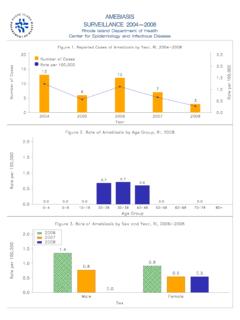
AMEBIASIS SURVEILLANCE 2004-2008 - health.ri.gov
www.health.ri.gov€€€€Population. (Rates for 2003-2005 use 2000 Census data. Rates for 2006-2008 use 2006 Census data.) 3. Rate is calculated per 100,000 population.
Amebiasis - E.Histolytica A Catalyst Of The Beginning Of ...
www.ijiras.comschistosomiasis, amebiasis is the most hidden and poorly understood infectious disease which affects rapidly a large number of people without a certain incubation period. It causes a lot of complications which may occur in any period of patient’s life.