Analog Integrated Circuit Design
valence electrons are bound in covalent bounds and are not free to move. (silicon is an electrical insulator in this condition). • However, in room temperatures (300K), a small fraction of the electrons gain sufficient thermal energy to break loose from the covalent bonds. These free electrons can easily move through the crystal.
Download Analog Integrated Circuit Design

Information
Domain:
Source:
Link to this page:
Documents from same domain
What is Restorative Justice -- revised2
www.d.umn.edurestorative justice briefing paper - 2 centre for justice & reconciliation at prison fellowship international may 2005 po box 17434, washington, dc 20041♦phone 703.481.0000♦fax 703.481.0003♦email dvanness@pfi.
Motivation In Sport - University of Minnesota Duluth
www.d.umn.eduWhat do coaches want from the study of motivation? Higher task achievement from their athletes High task persistency from their athletes Higher effort from their athletes
ECE 1315 Digital Logic Design Laboratory Manual
www.d.umn.eduECE 1315 Digital Logic Design Laboratory Manual ... equipment that you will use in the lab to build and test ... display digital inputs and outputs from your ...
ANTICOAGULANT, THROMBOLYTIC, and ANTI …
www.d.umn.eduMed 6541 Hematopoiesis and Host Defences Spring 2006 Dr. Janet Fitzakerley 307 Med jfitzake@d.umn.edu Anticoagulants www.d.umn.edu/~jfitzake Page 1 of 21
Experiential Learning Theory - University of …
www.d.umn.eduExperiential Learning Theory: Previous Research and New Directions David A. Kolb Richard E. Boyatzis Charalampos Mainemelis Department of Organizational Behavior
Analog Integrated Circuit Design 2nd Edition
www.d.umn.eduto the design of a comparator. Random circuit noise can cause the output to change from one logic level to the other, even when the comparator input is held constant. Hence, in order to measure the input offset
Analog Integrated Circuit Design
www.d.umn.edu• Good analog circuit designers are scarce (very well compensated, gain lots of respect, regarded as “artists” because of the “creative” circuit design they do…
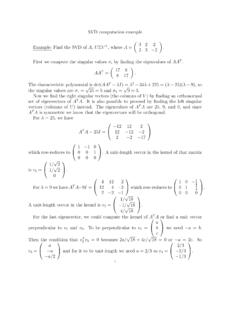
SVD computation example A U V T A 3 2 2 AA
www.d.umn.eduSVD computation example Example: Find the SVD of A, UΣVT, where A = 3 2 2 2 3 −2 . First we compute the singular values σ i by finding the eigenvalues of AAT. AAT = …
PER UNIT IDENTITIES - University of Minnesota Duluth
www.d.umn.eduECE 4501 POWER SYSTEMS UMD PER UNIT IDENTITIES DISCUSSION: Per Unit (pu) systems are used by engineers to quantify equipment parameters in terms of their Nameplate
Lab 8 Reflection and Refraction
www.d.umn.edu1" " Reflection and Refraction Goal: To study the reflection of light by a flat surface and to study the refraction of light through straight and curved surfaces. Lab Preparation When light travelling through air encounters a different material, part of the light
Related documents
Chemical Bonding - Colorado State University
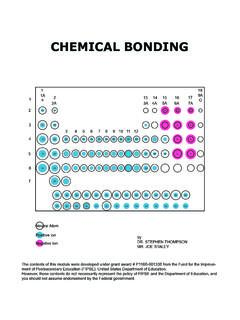
www.smallscalechemistry.colostate.eduIonic and covalent bonds are two ideal types. Many bonds share characteristics of both ionic and covalent bonding. They are called polar covalent bonds and they tend to occur between atoms of mod-erately different electronegativities. In polar covalent bonds the electrons belong predomi-nantly to one type of atom while they are still partially

Sugar or Salt? Ionic and Covalent Bonds - UU
www.uu.eduthe other hand, is composed of carbon, oxygen, and hydrogen and has covalent bonds. D Introduction A salt molecule is made up of one sodium atom and one chlorine atom. For salt to be made, the sodium atom must lose an electron and become a sodium ion. When sodium loses an electron it becomes a Na+ and is called a cation. Na → Na+ + e-

CERAMICS: Properties 1 (Physical, Chemical, Mechanical)
www-personal.umich.edu[CLICK] THERMAL PROPERTIES of ceramics are governed by the type of bonding (covalent to ionic) and number of bonds present . [CLICK] Generally for all materials, the expansion from absolute zero to the melting temperature is about 15%, so materials with higher Tm values have lower LCTE values. This is apparent in the table.

Chapter 11 Substance Mass (amu) Moment (D) Acetonitrile ...
alpha.chem.umb.educovalent-network A)supercritical B)covalent-network C)molecular D)ionic E)metallic 26) 7. ... London disperson forces, and/or hydrogen bonds. A)Molecular B)Covalent-network C)Metallic and covalent-network D)Metallic E)Ionic 27) 8. Answer Key
LEWIS STRUCTURES General Rules for Drawing Lewis Structures
clas.sa.ucsb.eduoctet and shares one electron in single bonds in covalent compounds. Fluorine generally does not make double bonds. Fluorine is not willing to share more than one electron and with a double bond the formal charge on fluorine would be +1. A +1 formal charge on the most electronegative atom is generally not observed.

List the four major differences between ionic and covalent ...
homework.sdmesa.eduIonic bonds result from transfer of electrons, whereas covalent bonds are formed by sharing. 2. Ionic bonds are electrostatic in nature, resulting from that attraction of positive and negative ions that result from the electron transfer process; charge …

CHEMICAL BONDING
nios.ac.inIonic or electrovalent bond Covalent bond Co-ordinate covalent bond In addition to these we have a special kind of bond called hydrogen bond. Let us discuss about different types of bonds, their formation and the properties of the compounds so formed. 5.2 Ionic or Electovalent Bond According to Kossel’s theory, in the process of formation of ...

Common Polyatomic Ions - West Virginia University
pltl.wvu.eduCOVALENT bonds ♦ Octet Rule - An atoms tends to gain, lose or share such that it achieves eight valence electrons. There are some exceptions to the “Octet” Rule! Formation of Ionic Compounds: ♦ All compounds are electrically neutral ⇒ possess no net charge. ♦ Number of positives = number of negatives Compounds Ionic—held together ...

Intermolecular and Ionic Forces
web.gccaz.edugeneral, intermolecular forces are much weaker than the ionic and covalent bonds that hold together the atoms and ions in a compound. For example, about 40 kJ of energy are required to vaporize 18 grams of water molecules—i.e., completely convert …

9.2 Network Covalent, Ionic, and Metallic Solids
www.mi.mun.ca9.2 Network Covalent, Ionic, and Metallic Solids YOU ARE EXPECTED TO BE ABLE TO: • Classify non-molecular solids as either network covalent solids, ionic solids, or metallic solids. • Relate the physical properties of non-molecular solids to the forces holding them together.