Example: confidence
Intermolecular and Ionic Forces
general, intermolecular forces are much weaker than the ionic and covalent bonds that hold together the atoms and ions in a compound. For example, about 40 kJ of energy are required to vaporize 18 grams of water molecules—i.e., completely convert …
Tags:
Information
Domain:
Source:
Link to this page:
Documents from same domain

Intermolecular and Ionic Forces - web.gccaz.edu
web.gccaz.eduIntermolecular and Ionic Forces ... general, intermolecular forces are much weaker than the ionic and covalent bonds that hold together the atoms and ions in a compound. ... compared in this lab. The alkane used in this activity is pentane, CH 3 CH 2 CH 2 CH 2 CH 3. Alcohols are
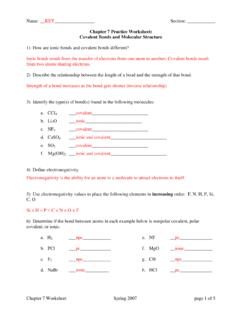
Chapter 7 Practice Worksheet: Covalent Bonds and Molecular ...
web.gccaz.eduChapter 7 Worksheet Spring 2007 page 1 of 5 Chapter 7 Practice Worksheet: Covalent Bonds and Molecular Structure 1) How are ionic bonds and covalent bonds different? ... f. Mg(OH) 2 ___ ionic and covalent _____ 4) Define electronegativity. Electronegativity is the ability for an atom in a molecule to attract electrons to itself. ...

CHM 130 Predicting Products Worksheet
web.gccaz.eduCHM 130 Predicting Products Worksheet Circle the appropriate reaction type for each, complete the reaction with products (remember to check charges for ionic compounds), include states, and finally balance each reaction.

Chapter 14. CHEMICAL EQUILIBRIUM
web.gccaz.eduChapter 14. CHEMICAL EQUILIBRIUM 14.1 THE CONCEPT OF EQUILIBRIUM AND THE EQUILIBRIUM CONSTANT Many chemical reactions do not go to completion but instead attain a ...
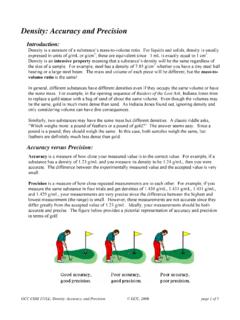
Density: Accuracy and Precision
web.gccaz.eduGCC CHM 151LL: Density: Accuracy, and Precision © GCC, 2008 page 4 of 5 glassware. ... 1. Obtain a set of 4 brass slugs and 1 aluminum slug. 2.

Balancing Equations Worksheet KEY
web.gccaz.eduBalancing Equations Worksheet KEY 1. Zn (s) + 2 AgNO 3 (aq) ⇒ Zn(NO 3) 2 (aq) + 2 Ag (s) 2. N 2 (g) + 3 H 2 (g) ⇒ 2 NH 3 (g) 3. NaCl (aq) + AgC 2H 3O 2 (aq) ⇒ NaC 2H 3O 2 (aq) + AgCl (s) 4. 3 Mg(OH) 2 (aq) + 2 H 3PO 4 (aq) ⇒ 6 H 2O (l) + Mg 3(PO 4 ) 2 (aq) 5. 2 HNO 3 (aq) + Ni (s) ⇒ Ni(NO 3) 2 (aq) + H 2 (g) 6. Ba(HCO 3) 2 (s) ⇒ BaCO 3 (s) + H 2O (g) + CO
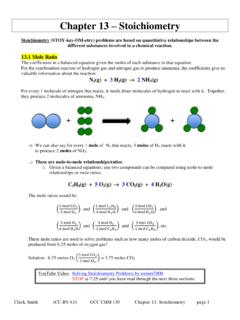
Chapter 13 Stoichiometry - Glendale Community College
web.gccaz.eduChapter 13 – Stoichiometry Stoichiometry (STOY-key-OM-etry) problems are based on quantitative relationships between the different substances involved in a chemical reaction.

Marine Biology: Study Guide - web.gccaz.edu
web.gccaz.eduBIO145: Marine Biology 3 Study Guide Chapter 10 An Introduction to Ecology Ecology is the scientific study of the interactions between organisms and their environment that determine the distribution and abundance of organisms.

CHM 130LL: Electrolytes - Welcome to web.gccaz.edu
web.gccaz.edumainly in body fluids outside the cells. Human body fluids have almost the ... CHM 130LL: Electrolytes Lab . GCC CHM 130LL Spring 2016 page 2 of 7 Understanding ... This makes it possible to identify which substance is in which well (ex: A3 or C2). In your data table (on the next page), ...
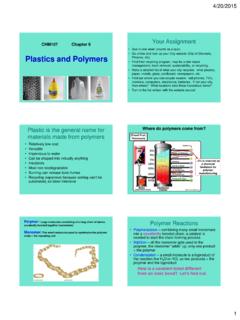
Polymers and Plastics - web.gccaz.edu
web.gccaz.edua chemical feedstock for polymer manufacturing Polymer: ... • Now back to polymers and plastics Given these monomers predict the structure of the polymer Ethylene Vinyl chloride ... recycle numbers are these plastics? • Plastic comes from oil – so less recycling means
Related documents
Chemical Bonding - Colorado State University
www.smallscalechemistry.colostate.eduIonic and covalent bonds are two ideal types. Many bonds share characteristics of both ionic and covalent bonding. They are called polar covalent bonds and they tend to occur between atoms of mod-erately different electronegativities. In polar covalent bonds the electrons belong predomi-nantly to one type of atom while they are still partially

Sugar or Salt? Ionic and Covalent Bonds - UU
www.uu.eduthe other hand, is composed of carbon, oxygen, and hydrogen and has covalent bonds. D Introduction A salt molecule is made up of one sodium atom and one chlorine atom. For salt to be made, the sodium atom must lose an electron and become a sodium ion. When sodium loses an electron it becomes a Na+ and is called a cation. Na → Na+ + e-

List the four major differences between ionic and covalent ...
homework.sdmesa.eduIonic bonds result from transfer of electrons, whereas covalent bonds are formed by sharing. 2. Ionic bonds are electrostatic in nature, resulting from that attraction of positive and negative ions that result from the electron transfer process; charge …

Chapter 11 Substance Mass (amu) Moment (D) Acetonitrile ...
alpha.chem.umb.educovalent-network A)supercritical B)covalent-network C)molecular D)ionic E)metallic 26) 7. ... London disperson forces, and/or hydrogen bonds. A)Molecular B)Covalent-network C)Metallic and covalent-network D)Metallic E)Ionic 27) 8. Answer Key

CHEMICAL BONDING
nios.ac.inIonic or electrovalent bond Covalent bond Co-ordinate covalent bond In addition to these we have a special kind of bond called hydrogen bond. Let us discuss about different types of bonds, their formation and the properties of the compounds so formed. 5.2 Ionic or Electovalent Bond According to Kossel’s theory, in the process of formation of ...

Common Polyatomic Ions - West Virginia University
pltl.wvu.eduCOVALENT bonds ♦ Octet Rule - An atoms tends to gain, lose or share such that it achieves eight valence electrons. There are some exceptions to the “Octet” Rule! Formation of Ionic Compounds: ♦ All compounds are electrically neutral ⇒ possess no net charge. ♦ Number of positives = number of negatives Compounds Ionic—held together ...

CERAMICS: Properties 1 (Physical, Chemical, Mechanical)
www-personal.umich.edu[CLICK] THERMAL PROPERTIES of ceramics are governed by the type of bonding (covalent to ionic) and number of bonds present . [CLICK] Generally for all materials, the expansion from absolute zero to the melting temperature is about 15%, so materials with higher Tm values have lower LCTE values. This is apparent in the table.

9.2 Network Covalent, Ionic, and Metallic Solids
www.mi.mun.ca9.2 Network Covalent, Ionic, and Metallic Solids YOU ARE EXPECTED TO BE ABLE TO: • Classify non-molecular solids as either network covalent solids, ionic solids, or metallic solids. • Relate the physical properties of non-molecular solids to the forces holding them together.
LEWIS STRUCTURES General Rules for Drawing Lewis Structures
clas.sa.ucsb.eduoctet and shares one electron in single bonds in covalent compounds. Fluorine generally does not make double bonds. Fluorine is not willing to share more than one electron and with a double bond the formal charge on fluorine would be +1. A +1 formal charge on the most electronegative atom is generally not observed.

Analog Integrated Circuit Design
www.d.umn.eduvalence electrons are bound in covalent bounds and are not free to move. (silicon is an electrical insulator in this condition). • However, in room temperatures (300K), a small fraction of the electrons gain sufficient thermal energy to break loose from the covalent bonds. These free electrons can easily move through the crystal.