Applications Engineering Manual - Trane
leaving chilled-water temperature rises, so do the refrigerant temperature and pressure. When the l eaving chilled-water temper ature changes, the work a compressor must do also changes. The effect of leaving chilled-water temperature change on power consumption can be 1.0 to 2.2 percent per degree Fahrenheit [1.8 to 4.0 percent per degree ...
Download Applications Engineering Manual - Trane

Information
Domain:
Source:
Link to this page:
Documents from same domain

One of the Systems Series - Trane Belgium
www.tranebelgium.comFebruary 2012 TRG-TRC018-EN Air Conditioning Clinic Introduction to HVAC Systems One of the Systems Series
Applications Engineering Manual - Trane
www.tranebelgium.comApplications Engineering Manual Chiller System Design and Control. Chiller System Design and Control Susanna Hanson, applications engineer ... For the purposes of this manual, the term water can be understood to be any such acceptable fluid, with recognition of the
Chilled-Water Systems One of the Systems Series / Air ...
www.tranebelgium.comrefrigerant condensing temperature (and pressure) in a water-cooled chiller can be lower than in an air-cooled chiller. For example, at an outdoor design condition of 95°F [35°C] dry-bulb temperature, 78°F [25.6°C] wet-bulb temperature, a cooling tower delivers 85°F [29.4°C] water to the water-cooled condenser.

One of the Fundamental Series - Trane - Accueil
www.tranebelgium.comof oil, prevent the compressed refrigerant vapor from escaping through the mating surfaces. Similarly, other types of compressors also rely on oil for lubrication and for providing a seal when compressing the refrigerant vapor. Characteristically, some of this lubricating oil is pumped along with the refrigerant throughout the rest of the system.

Cooling and Heating Load Estimation
www.tranebelgium.comcooling and heating loads and is limited to introducing the components that make up the load on a building, the variables that affect each of these components, and simple meth ods used to estimate thes e load components.

Absorption Water Chillers
www.tranebelgium.comWater chillers using the vapor-compression refrigeration cycle vary by the type of compressor used. The compressor works to draw in refrigerant vapor and increase its pressure and temperature to create the cooling effect. Reciprocating, scroll, helical-rotary (or screw), or centrifugal compressors are

Centrifugal Water Chillers
www.tranebelgium.comchillers. As mentioned earlier, this particular clinic discusses centrifugal water chillers. Centrifugal water chillers can also be divided into two types based on the method used to reject heat to the atmo sphere: water-cooled or air-cooled. Since most centrifugal chillers are water-cool ed, they are the primary focus of this clinic.
Maintenance manual Centrifugal chillers
www.tranebelgium.com(1) Tube testing required if aggressive water conditions exist. Applies to condensers only on water cooled units. Seasonal start up and shut down are mainly recommended for Comfort Air Conditioning and annual and preventive maintenance are mainly recommended for Process Application. Year Commissioning Inspection visit Seasonal shut-down ...
Related documents

Plan Symbols
o.b5z.netCondenser water supply CWS Condenser water return CWR Chilled water supply CHWS Chilled water return CHWR Make up water MU Humidification line H Drain D Brine supply B Brine return BR Refrigerant discharge RD Refrigerant liquid RL AIR CONDITIONING PIPING 09 …
Fundamentals of HVAC Controls Course Content ... - People
people.eecs.berkeley.eduleaves the cooling coil and goes through the chilled water return (CHWR) pipe to the chiller's evaporator. Here it gives up the heat into the refrigeration system. The newly "chilled" water leaves the evaporator and is pumped through the chilled water supply (CHWS) piping into the cooling coil continuously and the water cycle repeats.
Fundamentals of HVAC Controls Course Content ... - People
people.eecs.berkeley.eduleaves the cooling coil and goes through the chilled water return (CHWR) pipe to the chiller's evaporator. Here it gives up the heat into the refrigeration system. The newly "chilled" water leaves the evaporator and is pumped through the chilled water supply (CHWS) piping into the cooling coil continuously and the water cycle repeats.

Sequence of Operation
www.uc.eduK. Supply Air Temperature (SAT) Control, AHU. 1. SAT setpoint established by DDC controller (usually 55°F). or 1. SAT reset based on requirements of individual terminal box with the most cooling requirement (i.e. zone temperature with most deviation to high side of setpoint). or 1. SAT is reset down until all zone temperatures are satisfied.
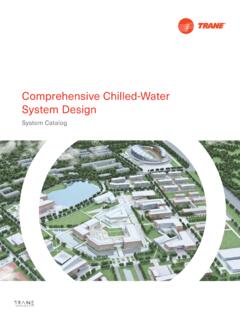
Comprehensive Chilled-Water System Design
www.trane.comHigh performing Water-cooled heat rejection is more effective than air-cooled. Centralized equipment uses more efficient, larger ... modulated to maintain the chilled-water temperature at setpoint. Load terminals such as cooling coils in central ... supply fan cooling tower pump indoor air outdoor air control valves. 5
HEAT RECOVERY FROM CHILLED WATER SYSTEMS
www.shareddocs.comproduces hot water and the additional benefit of chilled, cold water. So, the COP equation to measure efficiency of producing chilled water can be expressed as shown in Equation 3. But with heat recovery systems, the benefit of hot and cold water can be realized. So, the equation that quantifies the combined benefit of hot and cold water
Expansion Tank (CHW)-FINAL - Engineering Pro Guides
www.engproguides.comThe chilled water supply temperature range is constrained by the following two requirements. The chilled water supply temperature must be cold enough to dehumidify the air, but not too cold that the chiller freezes. The typical chilled water temperatures are shown below. Supply Chilled Water: 42 F to 48 F/5.56 C to 7.78 C Return Chilled Water ...
Chilled-Water System Decisions - Trane
www.trane.comline occurs. This warm, deficit water flow increases the system supply-water temperature and at some point an additional chiller and primary pump are enabled. A chiller and pump are disabled when excess flow rate in the bypass line is high enough to still have excess flow after a primary pump is turned off. Therefore the maximum flow rate the

Jacketed Heating - Chemical Processing
www.chemicalprocessing.comjacket inlet temperature to protect the lining. The heating/ cooling supply can have various split-range (TY) configu-rations such as control valves to hot/cold headers (which we’ll call Case 1), control valves to steam and chilled-water heat exchangers (Case 2) and control valve on the chilled Improve Batch Reactor Temperature Control

DEHUMIDIFICATION STRATEGIES AND THEIR APPLICABILITY …
www.ashrae.orgair over a chilled coil (water, glycol, or refrigerant) and cooling it below its dew point temperature so the air releases moisture by condensing on the coil surface. This is an energy intensive process (cooling 1 lb of water by 1°F requires about 1 Btu of energy, while condensing 1 lb of water vapor to water requires about 1,000 Btu). This