ARCHIMEDES’ PRINCIPLE
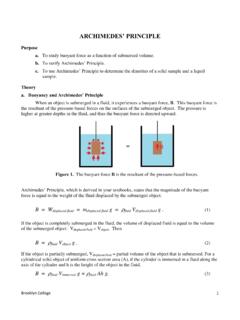
Jun 19, 2019 · ARCHIMEDES’ PRINCIPLE Purpose a. To study buoyant force as a function of submersed volume. b. To verify Archimedes’ Principle. c. To use Archimedes’ Principle to determine the densities of a solid sample and a liquid sample. Theory a. Buoyancy and Archimedes’ Principle When an object is submerged in a fluid, it experiences a buoyant ...
Download ARCHIMEDES’ PRINCIPLE

Information
Domain:
Source:
Link to this page:
Documents from same domain
Reflection and Image Formation by Mirrors
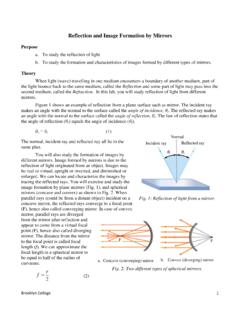
depthome.brooklyn.cuny.eduthe light bounce back to the same medium, called the Reflection and some part of light may pass into the second medium, called the Refraction. In this lab, you will study reflection of light from different mirrors. Figure 1 shows an example of reflection from a plane surface such as mirror. The incident ray
STANDING WAVES ON A STRING
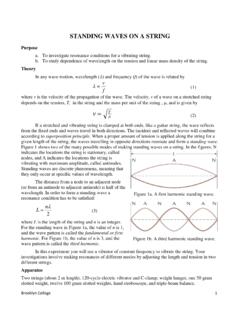
depthome.brooklyn.cuny.eduSTANDING WAVES ON A STRING Purpose a. To investigate resonance conditions for a vibrating string. b. To study dependence of wavelength on the tension and linear mass density of the string. Theory In any wave motion, wavelength ( ) and frequency (f) of the wave is related by f v (1) where v is the velocity of the propagation of the wave.

CENTRIPETAL FORCE - City University of New York
depthome.brooklyn.cuny.eduthe centripetal force. F sp mg, ( 5 ) where m is the total mass of the load including the hanger. This force is equal to the centripetal force for holding the bob at the same radius when it is rotating. Figure 3. Free-body diagrams for (a) dynamic and (b) static measurements. Figure 2. Centripetal force apparatus. Shaft Sliding arm Counter
Double slit interference and single slit diffraction ...
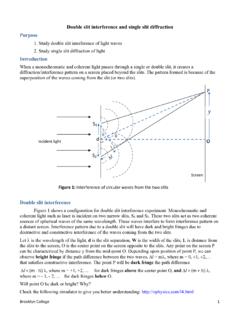
depthome.brooklyn.cuny.eduInterference pattern due to a double slit will have dark and bright fringes due to destructive and constructive interference of the waves coming from the two slits. Let l is the wavelength of the light, d is the slit separation, W is the width of the slits, L is distance from
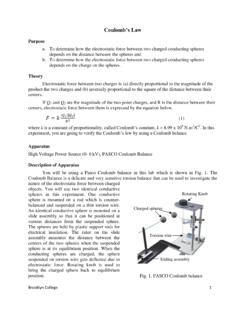
Lab-1: Coulomb’s Law - City University of New York
depthome.brooklyn.cuny.eduElectrostatic force between two charges is (a) directly proportional to the magnitude of the ... fully discharged by grounding momentarily (a grounding probe is provided). Always touch the probe to the suspended sphere very gently from below. Set the torsion dial
Related documents
Mechanical Engineering Principles - Weebly
vinukumar.weebly.com21.4 Archimedes’ principle 233 21.5 Measurement of pressure 235 21.6 Barometers 235 21.7 Absolute and gauge pressure 237 21.8 The manometer 237 21.9 The Bourdon pressure gauge 238 21.10 Vacuum gauges 239 21.11 Hydrostatic pressure on submerged surfaces 240 21.12 Hydrostatic thrust on curved surfaces 241 21.13 Buoyancy 241
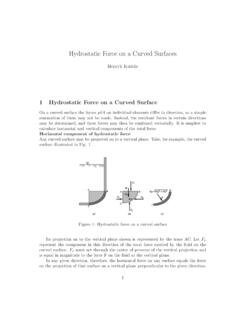
Lecture6 Hydrostatic Force on curved Surfaces
fluid.itcmp.pwr.wroc.plas the buoyancy. This buoyancy force can be computed using the same principles used to compute hydrostatic forces on surfaces. The results are the two laws of buoyancy discovered by Archimedes in the third century B.C.: 1. a body immersed in a fluid experiences a vertical buoyant force equal to the weight of the fluid it displaces.

Force on a Curved Surface due to Hydrostatic Pressure
site.iugaza.edu.psBuoyancy When a body is submerged or floating in a static fluid, the resultant force exerted on it by the fluid is called the buoyancy force. Buoyancy Force= ! ! and this force will act vertically upward through the centroid of the volume of fluid displaced, known as the center of buoyancy. Archimedes’ principle

COURSE OBJECTIVES CHAPTER 2 2. HULL FORM AND …
www.usna.edu4. Learn Archimedes’ Principle in qualitative and mathematical form . 5. Calculate problems using Archimedes’ Principle . 6. Read, interpret, and relate the Body Plan, Half-Breadth Plan, and Sheer Plan and identify the lines for each plan . 7. Relate the information in a ship's lines plan to a Table of Offsets . 8.

ME 101: Engineering Mechanics - IIT Guwahati
www.iitg.ac.inArchimedes (287-212 BC): Principles of Lever and Buoyancy! Mechanics is a branch of the physical sciences that is concerned with the state of rest or motion of bodies subjected to the action of forces. Rigid-body Mechanics ME101 Statics Dynamics Deformable-Body Mechanics, and Fluid Mechanics

NTSE-FEBRUARY, 2021 (STAGE – 1 – AP) MENTAL ABILITY TEST
ntse.fiitjee.comSTAGE – I – AP - NTSE 2021 NT (E) VIZAGFIITJEE Centre, # 49-52-5, Santhipuram, Sankaramatam Road, Visakhapatnam. Ph:0891-2555501,02,03 2 PAPER - I MENTAL ABILITY TEST (Q.Nos. 1 to 100) Max. marks : 100 Note: SHADE the …

Real-life applications - Density and Volume
tonkadensity.weebly.comintriguing is the concept of buoyancy expressed in Archimedes's principle. More than twenty-two centuries ago, the Greek mathematician, physicist, and inventor Archimedes (c. 287-212 B.C. ) received orders from the king of his hometown—Syracuse, a Greek colony in Sicily—to weigh the gold in the royal crown. According to legend, it was while ...
LECTURES IN ELEMENTARY FLUID DYNAMICS
web.engr.uky.eduLECTURES IN ELEMENTARY FLUID DYNAMICS: Physics, Mathematics and Applications J. M. McDonough Departments of Mechanical Engineering and Mathematics