Asynchronous Methods for Deep Reinforcement Learning
3. Reinforcement Learning Background We consider the standard reinforcement learning setting where an agent interacts with an environment Eover a number of discrete time steps. At each time step t, the agent receives a state s tand selects an action a tfrom some set of possible actions Aaccording to its policy ˇ, where ˇis a mapping from states s
Download Asynchronous Methods for Deep Reinforcement Learning

Information
Domain:
Source:
Link to this page:
Documents from same domain

TPOT: A Tree-based Pipeline Optimization Tool for ...
proceedings.mlr.pressJMLR: Workshop and Conference Proceedings 64:66{74, 2016 ICML 2016 AutoML Workshop TPOT: A Tree-based Pipeline Optimization Tool for Automating Machine …
Ensembles for Time Series Forecasting
proceedings.mlr.pressEnsembles for Time Series Forecasting set of real world time series. Our results clearly indicate that this is a promising research direction. In Section2we provide a brief description of the tasks being tackled in this paper.
Show, Attend and Tell: Neural Image CaptionGeneration …
proceedings.mlr.pressShow, Attend and Tell: Neural Image Caption Generation with Visual Attention Kelvin Xu? KELVIN.XU@UMONTREAL.CA Jimmy Lei Bay JIMMY@PSI.UTORONTO.CA Ryan Kirosy RKIROS@CS.TORONTO.EDU Kyunghyun Cho?
Wasserstein Generative Adversarial Networks
proceedings.mlr.pressWasserstein Generative Adversarial Networks Figure 1: These plots show ˆ(P ;P 0) as a function of when ˆis the EM distance (left plot) or the JS divergence (right plot).The EM plot is continuous and provides a usable gradient everywhere.
Self-Attention Generative Adversarial Networks
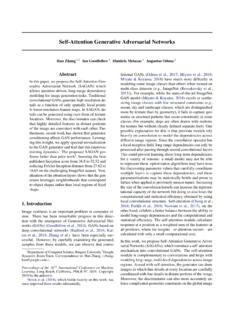
proceedings.mlr.pressSelf-Attention Generative Adversarial Networks Figure 1. The proposed SAGAN generates images by leveraging complementary features in distant portions of the image rather than local regions of fixed shape to generate consistent objects/scenarios. In each row, the first image shows five representative query locations with color coded dots.
Generative Adversarial Text to Image Synthesis
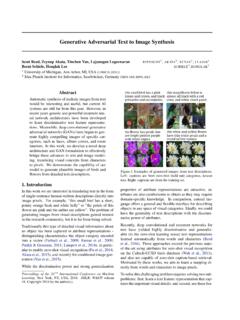
proceedings.mlr.pressdeep convolutional decoder networks to generate realistic images.Dosovitskiy et al.(2015) trained a deconvolutional network (several layers of convolution and upsampling) to generate 3D chair renderings conditioned on a set of graph-ics codes indicating shape, position and lighting.Yang et al. (2015) added an encoder network as well as actions ...

On the di culty of training recurrent neural networks
proceedings.mlr.pressOn the di culty of training recurrent neural networks @Et+1 @xt+1 Et Et+1 Et 1 xt 1 xt +1 ut +11 u tu @Et @xt @Et1 @xt1 @ xt +2 @xt +1 @x +1 x @xt1 @xt1 @xt2 Figure 2. Unrolling recurrent neural networks in time by creating a copy of the model for each time step.

Deep Gaussian Processes
proceedings.mlr.pressrepresentational power of a Gaussian process in the same role is significantly greater than that of an RBM. For the GP the corresponding likelihood is over a continuous vari-able, but it is a nonlinear function of the inputs, p(yjx) = N yjf(x);˙2; where N j ;˙2 is a Gaussian density with mean and variance ˙2. In this case the likelihood is ...
Noise-contrastive estimation: A new estimation principle ...
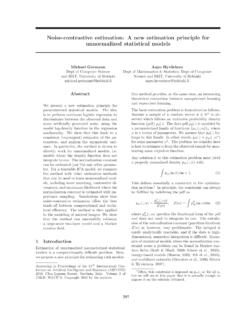
proceedings.mlr.pressated noise y. The estimation principle thus relies on noise with which the data is contrasted, so that we will refer to the new method as “noise-contrastive estima-tion”. In Section 2, we formally define noise-contrastive es-timation, establish fundamental statistical properties, and make the connection to supervised learning ex-plicit.
Gender Shades: Intersectional Accuracy Disparities in ...
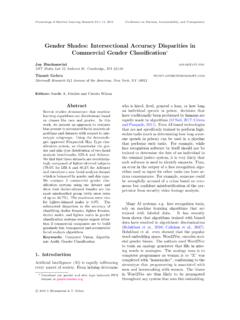
proceedings.mlr.press117 million Americans are included in law en-forcement face recognition networks. A year-long research investigation across 100 police de-partments revealed that African-American indi-viduals are more likely to be stopped by law enforcement and be subjected to face recogni-tion searches than individuals of other ethnici-ties (Garvie et al.,2016).
Related documents

Dueling Network Architectures for Deep Reinforcement …
proceedings.mlr.pressOver the past years, deep learning has contributed to dra-matic advances in scalability and performance of machine learning (LeCun et al., 2015). One exciting application is the sequential decision-making setting of reinforcement learning (RL) and control. Notable examples include deep Q-learning (Mnih et al., 2015), deep visuomotor policies
Soft Actor-Critic: Off-Policy Maximum Entropy Deep ...
arxiv.orgMaximum entropy reinforcement learning optimizes poli-cies to maximize both the expected return and the ex-pected entropy of the policy. This framework has been used in many contexts, from inverse reinforcement learn-ing (Ziebart et al.,2008) to optimal control (Todorov,2008; Toussaint,2009;Rawlik et al.,2012). In guided policy
Abstract - arXiv
arxiv.orgquence model can be applied to reinforcement learning problems without the need for the components usually associated with RL algorithms. 3 Reinforcement Learning and Control as Sequence Modeling In this section, we describe the training procedure for our sequence model and discuss how it can be used for control.
Benchmarking Safe Exploration in Deep Reinforcement …
cdn.openai.comrange of prior work on safe reinforcement learning, we propose to standardize constrained RL as the main formalism for safe exploration. Second, we present the Safety Gym benchmark suite, a new slate of high-dimensional continuous control environments for measuring research progress on constrained RL. Finally, we
Deep Reinforcement Learning Nanodegree Program Syllabus
d20vrrgs8k4bvw.cloudfront.netaddition of reinforcement learning theory and programming techniques. This program will not prepare you for a specific career or role, rather, it will grow your deep learning and reinforcement learning expertise, and give you the skills you need to understand the most recent advancements in deep reinforcement learning,
Algorithms for Reinforcement Learning
sites.ualberta.caReinforcement learning is a learning paradigm concerned with learning to control a system so as to maximize a numerical performance measure that expresses a long-term objective. What distinguishes reinforcement learning from supervised learning is that only partial feedback is given to the learner about the learner’s predictions. Further,
Lecture 1: Introduction to Reinforcement Learning
www.davidsilver.ukLecture 1: Introduction to Reinforcement Learning The RL Problem Reward Rewards Areward R t is a scalar feedback signal Indicates how well agent is doing at step t The agent’s job is to maximise cumulative reward Reinforcement learning is based on thereward hypothesis De nition (Reward Hypothesis) All goals can be described by the ...