Atomic Absorption Spectrometry (AAS) - IntechOpen
Atomic Absorption Spectrometry (AAS) is a te chnique for measuring qu antities of chemical elements present in environmental samples by measuring the absorbed radiation by the chemical element of interest. This is done by reading the spectra produced when the sample
Download Atomic Absorption Spectrometry (AAS) - IntechOpen

Information
Domain:
Source:
Link to this page:
Documents from same domain
The Oil Palm Wastes in Malaysia - InTech - Open
cdn.intechopen.comThe Oil Palm Wastes in Malaysia 77 All economic activity begins with physical materials and energy carriers such as fuels and electric power.
Corrosion Inhibitors Principles, Mechanisms and …
cdn.intechopen.comChapter 16 Corrosion Inhibitors – Principles, Mechanisms and Applications Camila G. Dariva and Alexandre F. Galio Additional information is available at the end of the chapter
Thermoplastic Elastomers - InTech
cdn.intechopen.com8 Thermoplastic Elastomers Robert Shanks and Ing Kong Applied Sciences, RMIT University, Melbourne Australia 1. Introduction An elastomer is defined by mechanical response not by chemical structure.
Combined Pulmonary Fibrosis and Emphysema …
cdn.intechopen.comEmphysema 80 patients and paraseptal emphysema in 11 of 31 patients (35%). Honeycombing, which is one of the most common findings of usual interstitial pneumonia, was present in 24 of the 31
Critical Factors Affecting Supply Chain …
cdn.intechopen.comCritical Factors Affecting Supply Chain Management: A Case Study in the US Pallet Industry 35 2.1.2 Government support The level of support that the company receives from the government when importing raw
Current Trends and Future Developments in …
cdn.intechopen.comCurrent Trends and Future Developments in Occupational Health and Safety Risk Management 5 survey as the main measurement method. On the other hand, safety management
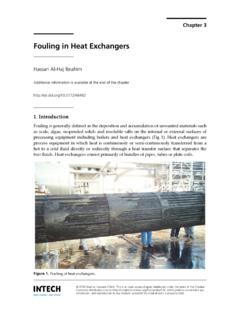
Fouling in Heat Exchangers - InTech - Open
cdn.intechopen.comFouling in Heat Exchangers Hassan Al-Haj Ibrahim Additional information is available at the end of the chapter ... between the feed inlet and outlet sides of the heat exchanger. In a shell and tube heat exchanger, the conventional segment baffle geometry is largely responsible for higher
Amoebiasis in the Tropics: Epidemiology and Pathogenesis
cdn.intechopen.comEntamoeba histolytica is a protozoan parasite that causes amebic dysentery and liver abscess. ... In developed countries amebiasis tends to be more common in older patients and occurs mostly among men who have sex with men or in institutions. However, in tropical regions, the epidemiology of amoebiasis is completely ...
Salmonella in Fish and Fishery Products - InTech
cdn.intechopen.com5 Salmonella in Fish and Fishery Products úlkan Ali Olguno ù lu University of Adiyaman Vocational School of Kahta Turkey 1. Introduction With more than 30.000 known species, Þsh form the biggest group in the animal kingdom

689 ' # '7& *#6 & 1 - InTech
cdn.intechopen.comFailure to thrive (FTT) is a common and potentia lly serious growth problem identified in the first three years of life, affecting 5% to 10% of children seen in the primary care setting (Schwartz, 2000).
Related documents
Chapter 2 Flame Atomic Absorption and Emission …
people.whitman.eduFlame Atomic Absorption and Emission Spectrometry 2.1 Introduction and History of AAS The first observation of atomic emission dates back to at least the first campfire where hominoids/humans observed a yellow color in the flame. This color was caused by the relaxation of the 3p electron to a 3s orbital in sodium

Concepts, Instrumentation and Techniques in Atomic ...
iitk.ac.inThe science of atomic spectroscopy has yielded three techniques for analytical use: atomic emission, atomic absorption, and atomic fluorescence. In order to un - derstand the relationship of these techniques to each other, it is necessary to have an understanding of the atom itself and of the atomic process involved in each technique.
9100 - Lead in Surface Wipe Samples - Centers for Disease ...
www.cdc.govof lead by atomic spectrometry: ASTM ES 36. [7] Ibid. Standard test method for analysis of digested samples for lead by inductively coupled plasma atomic emission spectrometry (ICP-AES), flame atomic absorption (FAAS), or graphite furnace

(ATOMIC ABSORPTION) Method Number: ID-121 OSHA …
www.osha.govmodifiers are added. The sample is then aspirated into the flame of an atomic absorption or emission spectrophotometer (AAS or AES) and the molecules in the sample solution are subjected to the following processes: 2 of 25 T-ID121-FV-02-0202-M
Chapter 3 Flame Atomic Absorption and Emission …
www.whitman.eduFlame Atomic Absorption and Emission Spectrometry 2.1 Introduction and History of AAS The first observation of atomic emission dates back to at least the first campfire where hominoids/humans observed a yellow color in the flame. This color was caused by the relaxation of the 3p electron to a 3s orbital in sodium

Chapter 9: Atomic Absorption Spectrometry
www2.chemistry.msu.eduChapter 9: Atomic Absorption Spectrometry. Read: pp. 230 – 249 Problems: 9-1,3,5,6,8. Figure 9-13a. A(λ)= ε(λ)bC = log P. o /P