ATOMIC STRUCTURE Notes
38 MODULE - 2 Chemistry Notes Atomic Structure and Chemical Bonding Fig 3.2: Schematic representation of Rutherford’s Fig 3.3 : Schematic representation -ray scattering experiment.of Rutherford’s model These results led Rutherford to conclude that : the atom contained some dense and positively charged region located at the center
Download ATOMIC STRUCTURE Notes

Information
Domain:
Source:
Link to this page:
Documents from same domain

OPEN BASIC EDUCATION PROGRAMME
nios.ac.inAPPENDIX - J Guidelines and Standard Operating Procedure for Implementation of OPEN BASIC EDUCATION PROGRAMME 2015 (Revised) (Bye-Laws Governing Examinations …
24 ENVIRONMENTAL LAW Notes
nios.ac.inMODULE - VIIA Environmental Law and Sustainable Development 1 Environmental Law INTRODUCTION TO LAW Notes 24 ENVIRONMENTAL LAW The ‘Environment’ is very important for us to understand because it constitutes
14 - National Institute of Open Schooling
nios.ac.in104 :: Certificate in Construction Supervision (CIVIL) 14 FLOORING 14.1 INTRODUCTION The job of protecting slabs of roofs on the different floors in building and providing suitable finish of floor surfaces is known as flooring.
34 - National Institute of Open Schooling
nios.ac.in34 Chemistry Notes Environmental Chemistry OPTIONAL MODULE - 1 34.3.2 Ground Water Pollution When the polluted water seeps into the ground and enters an aquifer it results intoground
PETROCHEMICALS Notes
nios.ac.inChemistry and Industry 32 PETROCHEMICALS ... polyester, plastics, synthetic detergents, rocket fuels, etc. Since every area of human activity makes use of petrochemicals or the materials made ... large quantities as a by product of petroleum refining. The major petrochemicals produced from methane are: 1. Chlorinated products 2. Unsaturated ...
SHOOT SYSTEM - National Institute of Open Schooling
nios.ac.inReduced, flattened discoid stem with crowded nodes bearing overlapping fleshy (inner) and dry (outer) scale leaves. Terminal bud (in centre) forms foliage (green) leaves. Adventitious roots grow from discoid base. Swollen tips of underground lateral branches of stem, store food as starch, bear eyes . Each eye is a node which bears bud

17 PRODUCTION FUNCTION
nios.ac.inProduction Function ECONOMICS MODULE - 7 Producer's Behaviour 17 PRODUCTION FUNCTION When you go to the market to buy commodities such as note-books, fountain pens, shirts, bread, butter, fruits, vegetables etc. do you ever think about how these things came into the market. In previous lessons, you have studied about
12 PERFORMING ARTS: MUSIC, DANCE AND DRAMA
nios.ac.inPerforming Arts: Music, Dance and Drama Notes 168 Indian Culture and Heritage Secondary Course MODULE - V Painting, Performing Arts and Architecture 12 PERFORMING ARTS: MUSIC, DANCE AND DRAMA M usic, dance, drama, folk theatre or puppetry our country India, had all of it in abundance.
Formulas, Functions and Charts
nios.ac.inFormulas, Functions and Charts :: 177 8.4 CHARTS Charts allow you to present data entered into the worksheet in a visual format using a variety of graph types. Before you can make a chart, you must first enter data into a worksheet. This section explains how you can create simple charts from the data.
MODULE 2 MEDIEVAL INDIA
nios.ac.inmodule 2 medieval india lesson 9establishment and expansion of the delhi sultanate lesson 10 establishment of the mughal rule lesson 11 emergence of regional states in india: twelfth to eighteenth century lesson 12 administrative system and institutions lesson 13 economy lesson 14 cultural developments in medieval india lesson 15 understanding eighteenth century india
Related documents
The Free High School Science Texts: A Textbook for High ...
www.nongnu.orgChapter 3 The Atom (Grade 10) †Energy quantization and electron conflguration †The Periodic Table of the Elements: Periodicity of ionization energy to

LigandScout User Manual
www.inteligand.comChemical features always refer to the ligand side, but take the macromolecule geometry into account in many cases (e.g. hydrogen bond vectors, where the vector target points to the macromolecule counterpart).
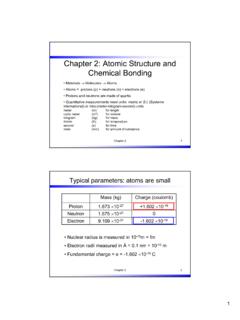
Chapter 2: Atomic Structure and Chemical Bonding
physics.uwo.caChapter 2 9 Periodic Table of Elements Chapter 2 10 Valence electrons • The electrons in the outer shell (largest n) are called valence electrons • Very important for chemical reactions and holding matter together • If the outer shell is filled, the atom is inert • If not, there is a tendency for the outer shell to become filled

Chapter 2 Polymer Crystallization – Literature review
vtechworks.lib.vt.eduCHAPTER 2 29 Chapter 2 Polymer Crystallization – Literature review 2.1 Introduction While it is not possible to cover the subject of polymer crystallization in a review of this size, it is important in light of author’s research to review the fundamental features that are essential to the study of polymer crystallization.

Home - Brooklyn City School District
www.brooklyn.k12.oh.usC. to identify all of an element’s physical and chemical properties. D. to determine the differences between ionic and covalent bonding. Use the table below to answer questions 6 - 8. _____6. Which substance is electrically neutral? ... These pictures show different models of the atom proposed by scientists. Which of these is the
The Free High School Science Texts: A Textbook for High ...
www.nongnu.orgChapter 3 The Atom (Grade 10) †Energy quantization and electron conflguration †The Periodic Table of the Elements: Periodicity of ionization energy to

Chap. 1 Introduction to Biochemistry Reading Assignment
www.uwyo.eduSpace-filling models show van der Waals radii of the atoms in molecules, i.e., the surfaces of closest possible approach by neighboring molecules. B. Chemical bonding. If necessary, please review the supplemental notes at the end of this section concerning the atomic and molecular (bonding) orbitals of carbon, nitrogen, and oxygen. sp3 and sp2

Chapter 1 Structure and Bonding - Chemistry
www2.chemistry.msu.eduOrganic chemistry is study of carbon compounds. Why is it so special? 90% of more than 30 million chemical compounds contain carbon. Examination of carbon in periodic chart answers some of these questions. Carbon is group 4A element, it can share 4 valence electrons and form 4 covalent bonds. Origins of Organic Chemistry Review ideas from general chemistry: atoms, …