B.Sc. - FIRST YEAR
reactions, Mechanisms of nucleophilic substitution reactions of alkyl halides, SN2 and S N1 reactions with energy profile diagrams; Polyhalogen compounds : Chloroform, carbon tetrachloride; Methods of formation of aryl halides, nuclear and side chain reactions; The addition-elimination and the elimination-addition mechanisms of
Download B.Sc. - FIRST YEAR

Information
Domain:
Source:
Link to this page:
Documents from same domain
STATE LEVEL SYLLABUS OF - Mahatama Jyotiba …
mjpru.ac.in6 Theory, Linear and Cyclical theories of Social change. Unit 3: OTHER CONCEPTS RELATING TO SOCIAL CHANGE: Social process: Industrialization, Urbanization, Mordernization and Sanskritization
LL.B (Three Year Course) Odd Sem and Back And …
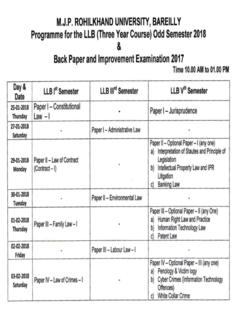
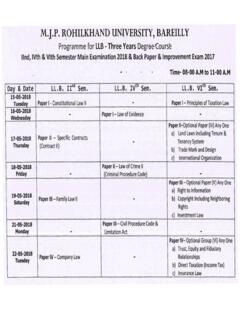
mjpru.ac.in05-02-2018 Monday 06-02-2018 Tuesday 2. 3. 4. Paper IV — Public International Law Paper V — Law of Tort including MV Accident and Consumer

MAHATMA JYOTIBA PHULE ROHILKHAND …
mjpru.ac.inS.L. Code COLLEGE District Course Subject SeatSeat Incre. Total Seats Seat Incre. Seat Incre. Total Seats ENGLISH 60 20 80 POLITICAL SCIENCE …
M.J.P. ROHILKHAND UNIVERSITY
mjpru.ac.inB.Sc. Part - I Paper I Inorganic Chemistry 60 Hrs (2 Hrs/week), Max. Marks: 50 I Atomic Structure 6 Hrs Idea of de-Broglie matter waves, Heisenberg uncertainty principle,
mjpru.ac.in
mjpru.ac.in23-05-2018 Wednesda 24-05-2018 Thursday 1. 2. 3. 4. 5. Paper V Paper IV — Property Law Labour Law Il Paper VI General English & Legal Language
B.Sc. - FIRST YEAR
mjpru.ac.inB.Sc. - FIRST YEAR CHEMISTRY There shall be three written papers and a practical examination as follows: Max. Marks Paper – I Inorganic Chemistry 50
mjpru.ac.in
mjpru.ac.inBACHELOR OF COMMERCE (B.COM-II) COURSE INPUT DETAILS GROUP-A: PAPER-I COMPANY LAW OBJECTIVE The objective of this course is to provide basic knowledge of the provisions of the
Ordinances - mjpru.ac.in
mjpru.ac.inP a g e | 3 1.7) In no case the admission governed by Para 1.2 to 1.4 shall exceed 10% of the total number of the seats. 1.8) The eligibility of the candidates under the categories mentioned in Para’s
B.Ed. (Bachelor of Education) Syllabus Two Year Course ...
mjpru.ac.in1 B.Ed. Course Faculty of Education of Colleges affiliated to M.J.P. Rohilkhand University, Bareilly Preparatory Note: These Ordinances pertain to the two year Bachelor of Education programme of the B.Ed course of colleges affiliated to M.J.P. Rohilkhand University, Bareilly.
Related documents
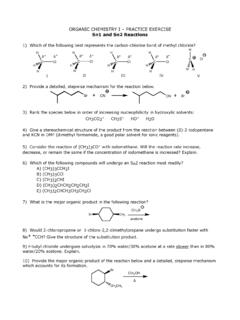
ORGANIC CHEMISTRY I – PRACTICE EXERCISE Sn1 and Sn2 …
personal.utdallas.eduand KCN in DMF (dimethyl formamide, a good polar solvent for ionic reagents). 5) Consider the reaction of (CH3)3CO-with iodomethane. Will the reaction rate increase, decrease, or remain the same if the concentration of iodomethane is increased? Explain. 6) Which of the following compounds will undergo an Sn2 reaction most readily? A) (CH3)3CCH2I

CHAPTER 11 Mechanism of Enzyme Action
www4.unifr.chEnormous variety of chemical reactions within a cell 2. Mediated by Enzymes 3. ... nucleophilic group on enzyme attacks an electrophilic group on the substrate ... Stabilization through H bridges and ionic interactions . The interactions of lysozyme
![Class - XII Multiple Choice Question Bank [MCQ ] Term I ...](/cache/preview/2/2/d/1/9/1/7/6/thumb-22d19176a1dd6102cff77672154d578a.jpg)
Class - XII Multiple Choice Question Bank [MCQ ] Term I ...
roraipur.kvs.gov.inrotation mechanism of substitution reactions. Haloarenes: Nature of C–X bond, substitution reactions (Directive influence of halogen in ... mechanism of nucleophilic addition, reactivity of alpha hydrogen in aldehydes, uses. Carboxylic Acids: Nomenclature, acidic nature, methods of preparation, physical and chemical ... Ionic solid (B ...
CSIR-UGC National Eligibility Test (NET) for Junior ...
csirhrdg.res.in10. Pericyclic reactions – electrocyclisation, cycloaddition, sigmatropic rearrangements and other related concerted reactions. Principles and applications of photochemical reactions in organic chemistry. 11. Synthesis and reactivity of common heterocyclic compounds containing one or two heteroatoms (O, N, S). 12.

AMIDES AND RELATED FUNCTIONAL GROUPS
webhome.auburn.eduB. Nucleophilic-Electrophilic Reactions and Hydrolysis Because of the resonance delocalization of the NBEs in these compounds, amides are significantly less nucleophilic than amines, and generally less electrophilic than esters. Again, the low nucleophilicity of amides relative to amines is a result of the reduced availability of NBEs to
1) Stability of Carbocations - Rutgers University
crab.rutgers.edu1 This big chapter will cover: 1) Stability of Carbocations 2) Formation of Carbocations (a) ionization (b) addition to a πbond (c) Alkyl Halide and a Lewis Acid 3) The Fate of Carbocations 4) Rearrangements of Carbocations 5) Electrophilic Addition (a) Regiospecificity (b) Stereochemistry 6) Acid catalyzed Reactions of Carbonyl Compounds (a) Hydrolysis of Carboxylic Acids …
Chemistry
d2cyt36b7wnvt9.cloudfront.netreactions take place → gas is absorbed by KOH solution. Thus, a mixture of inert gases are obtained. 24. Consider the following statements. I. does not exist while does. II. Both and are paramagnetic. III. The three bonds are not equal in carbonate ion. IV. Head prefers to form tetravalent compound.