BASIC TOOLS FOR DATA COLLECTION - INTRAC
community participatory tools. This includes exercises such as mapping, ranking, timelines, calendars and diagrams. These can be used as tools for collecting data from community level, and are often included as basic tools in M&E exercises. However, they are more properly used as participatory methods of data collection and analysis that
Download BASIC TOOLS FOR DATA COLLECTION - INTRAC

Information
Domain:
Source:
Link to this page:
Documents from same domain

Theory of Change - INTRAC
www.intrac.org1 1. The reality of change Theory of Change is nothing new. It is not just a donor fad or yet another hoop to jump through. It is an on-going process of reflection to explore change and how
Theory of Change - INTRAC
www.intrac.orgA Theory of Change approach to planning and evaluation is increasingly being considered an essential practice for many organisations, programmes and projects. Theories of Change can be
PARTICIPATORY LEARNING AND ACTION (PLA)
www.intrac.orgPLA was originally called Participatory Rural (or Rapid) Appraisal (PRA). It became very popular in the 1980s and 1990s, and has since kept its popularity with many CSOs. PRA was originally designed for use during appraisals and needs assessments in rural areas. However, it can be used at any stage of the project cycle – design, planning,
Monitoring and Evaluation: New Developments and …
www.intrac.orgConference overview As development organisations, we are all finding ourselves placing a greater emphasis on measuring for results, on looking for evidence of impact, on justifying our effectiveness and on responding to a growing demand for accountability. Development organisations are continually experimenting with innovative

PROCESS TRACING
www.intrac.orgPROCESS TRACING . Process tracing is a qualitative analysis methodology. The main purpose of process tracing is to establish whether, and how, a potential cause or causes influenced a specified change or set of changes. This is done by applying formal tests to examine the strength of evidence linking potential causes to the changes.
QUANTITATIVE AND QUALITATIVE METHODS - INTRAC
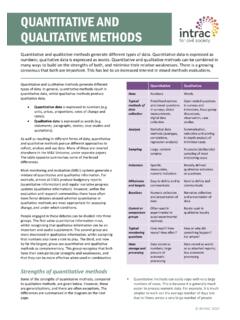
www.intrac.orgquantitative methods are seen as weaker, qualitative methods are seen as (relatively) stronger. Some of the main strengths of qualitative methods are listed below, and are summarised in the diagram above. As with the section on quantitative methods, these are general rules only, and there are often exceptions. Quantitative methods ...
SECONDARY DATA SOURCES - INTRAC
www.intrac.orgFurther papers in the M&E Universe explain other simple data collection tools and methods. To access these papers directly, click on the relevant links below. Author(s): INTRAC . Contributor(s): ... Interviews Focus group discussions Observation Photography and video Surveys and questionnaires Case studies and stories of change
QUALITATIVE COMPARATIVE ANALYSIS (QCA) - INTRAC
www.intrac.orgQualitative Comparative Analysis (QCA), developed by Charles Ragin in the 1970s, was originally developed as a research methodology. Lately, it has increasingly been applied within monitoring and evaluation (M&E). QCA is a methodology that enables the analysis of multiple cases in complex situations, and can help explain why change
THEORY OF CHANGE
www.intrac.orgTheories of Change can be developed in many ways. Common elements include ... stakeholder analysis or gender analysis might also be used. And if others have conducted similar assessments in the past then their findings can be used to arrive at a consensus.
CASE STUDIES AND STORIES OF CHANGE - INTRAC
www.intrac.orgCase studies are usually written, but can also be presented as photographs, drawings or videos. In some circumstances case studies have been presented as songs or dramas. There is no fixed size for a written case study. A case study can vary in length between a few lines of text and an entire book. Stories of change are similar to case studies ...
Related documents

Rapid Rural Appraisal and Participatory Rural Appraisal
www.crs.orgAbout this Manual. Intended Audience: CRS field staff, partners, and those who support them at headquarters. Purpose: To familiarize users with RRA and PRA methods, to demonstrate the applicability of these

49094Engish.indd 1 2/16/09 10:03:02 AM - UNICEF
www.unicef.orgof techniques for promoting achievement of learning ... that offers guidance and tools for addressing environmental risks and vulnerabilities to climate ... for empowerment include participatory risk-mapping and facilities-based environmental solutions to support children and their communities in adapting to changing conditions and reducing ...
ENTREPRENEURSHIP DEVELOPMENT TRAINING MANUAL
orange.ngoParticipatory methods and creative tools are employed throughout the modules, to facilitate learning on entrepreneurial topics and other relevant contents. Moreover, as this manual ... to conduct a training workshop and includes methods and techniques that are needed to
Working with Community Based Child Protection ... - …
reliefweb.intAcknowledgements This handbook was developed under the guidance of the Child Protection Working Group in Sudan Organizations participating in …

A Qualitative Case Study on Conflicts between Teachers and ...
files.eric.ed.govParticipatory observation technique and semi-structured interviews were used to collect data. ... inadequate tools and equipments and sharing of ... Observation and interview techniques were applied in order to gather the necessary information for the case study. The model