
BOUNDARY LAYER THEORY
Boundary Layer Thickness : δ at 5 0.99 (Table) 5 5 Re Re x x U u yy xU UUx x x ηη δ ν δδ νν ∞ ∞∞ ==⇒=→= ≅≅= δ:defined as the distance from the wall for which u=0.99U∞ Boundary Layer Parameter (thicknesses) Most widely used is δ but is rather arbitrary y=δ when u=0.99 U∞
Download BOUNDARY LAYER THEORY

Information
Domain:
Source:
Link to this page:
Documents from same domain

NON-DESTRUCTIVE TESTING
web.itu.edu.trNON-DESTRUCTIVE TESTING Objective To gain experience with and understanding of the types, advantages and applications of various NDT methods. To be able to choose the best NDT method for a given part.

Lecture Slides
web.itu.edu.trWelding Symbols Welding symbol standardized by American Welding Society Specifies details of weld on machine drawings Shigley’s Mechanical Engineering Design Fig. 9–4
OPERATIONS RESEARCH LECTURE NOTES
web.itu.edu.trINTRODUCTION TO OR ... “Operations Research ... [RESEARCH into (military) OPERATIONS] was coined as a suitable description of
IMPACT TESTING - İTÜ
web.itu.edu.trIMPACT TESTING Objective To conduct Charpy V-notch impact test and determine the ductile-brittle transition temperature of steels. Equipment Coolants
Chapter 4 Open Channel Flows - İTÜ
web.itu.edu.tr2 Prof. Dr. Atıl BULU Figure 4.1 Mathematical definition of the Uniform Steady Flow is, 0, 0 1 2 0 x y t y y y y (4.1) y0 = Normal depth d) Non-Uniform Steady Flows: The water depth changes along the channel cross- sections but does not change with time at each every cross section with time.
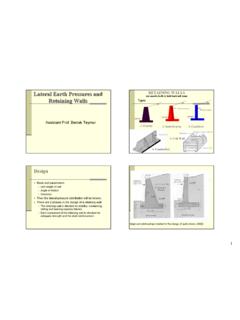
Lateral Earth Pressures and Retaining Walls
web.itu.edu.tr1 Lateral Earth Pressures and Retaining Walls Assistant Prof. Berrak Teymur RETAINING WALLS are usually built to hold back soil mass 1. Gravity 2. Semi-Gravity

Spark Ignition Engine Combustion - İTÜ
web.itu.edu.trProf.Dr. Cem SORUŞBAY - ITU Automotive Laboratories Engine Efficiency Thermal efficiency p ~ V diagram, compression ratio Heat losses cooling system , …

BASICS OF ELECTRICAL CIRCUITS LABORATORY …
web.itu.edu.trBASICS OF ELECTRICAL CIRCUITS LABORATORY EXPERIMENT SHEET JANUARY 2013 . 1-1 ITU Faculty of Electrical and Electronics Eng. Department of Electronics and ...

WEAVING TECHNOLOGY II - İTÜ
web.itu.edu.trTEK332E Weaving Technology II Prof. Dr. Emel Önder/ Assoc. Dr.Ömer Berkalp 3 Samples for different fabric structures Handbook of Weaving
JOMINY HARDENABILITY TEST - İTÜ
web.itu.edu.trJOMINY HARDENABILITY TEST Objective To study hardness as a function of quench rate and investigate the hardenability of steels. Introduction The hardenability of a steel is defined as that property which determines the depth and
Related documents

Fluid Mechanics for Chemical Engineers
ptgmedia.pearsoncmg.com7.11 Wave Motion in Deep Water 396 ... 420 8.3 Simplification of the Equations of Motion 422 8.4 Blasius Solution for Boundary-Layer Flow 425 8.5 Turbulent Boundary Layers 428 Example 8.2—Laminar and Turbulent Boundary Layers Compared 429 8.6 Dimensional Analysis of the Boundary-Layer Problem 430. Contents xi 8.7 Boundary-Layer Separation ...

Rocket Nozzle Geometries - gatech.edu
seitzman.gatech.edufor wall boundary layers) –must account for variable speed of sound • Approximate optimization method of Rao –initial (near throat) section spherical –transition to parabola Rao, Jet Propulsion 28, pp. 377-382 (1958) Rao, J. Amer. Rocket Soc. 31, pp. 1488-1494 (1961) Allman and Hoffman, AIAA J. 19, pp. 750-751 (1981)

Chebyshev and Fourier Spectral Methods
depts.washington.eduChebyshev and Fourier Spectral Methods Second Edition John P. Boyd University of Michigan Ann Arbor, Michigan 48109-2143 email: jpboyd@engin.umich.edu

Introduction toIntroduction to ANSYS FLUENT
imechanica.org– Prescribe boundary conditions at all boundary zones problem will provide valuable experience with the models and solver settings for your problem in a short – Provide initial values or a previous solution – Set up solver controls Set up convergence monitors amount of time. – Set up convergence monitors L2-12 ANSYS, Inc. Proprietary
Introduction toIntroduction to ANSYS FLUENT
imechanica.orgε model in the outer portion of the boundary layer. – Contains a modified turbulent viscosity formulation to account for the transport effects of the principal turbulent shear stress. – SST model generally gives accurate prediction of the onset and the size of separation under adverse pressure gradient L6-16 ANSYS, Inc. Proprietary

Wireless Networks - Rutgers University
www.ece.rutgers.eduabstraction layers. The type of information grows in abstraction from physical signals and streams of symbols to software objects. In this chapter I consider the bottom three layers: physical, link, and networking. As will become apparent below, the separation of functions between layers is not as clean as it is with point-to-

Zeta potential - An introduction in 30 minutes
www.research.colostate.eduless firmly associated. Within the diffuse layer there is a notional boundary inside which the ions and particles form a stable entity. When a particle moves (e.g. due to gravity), ions within the boundary move it. Those ions beyond the boundary stay with the bulk dispersant. The potential at this boundary (surface of hydrodynamic shear) is the ...

Modeling Turbulent Flows Introductory FLUENT Training
www.southampton.ac.ukseparation, such as supersonic/transonic flows over airfoils, boundary-layer flows, etc. Embodies a relatively new class of one-equation models where it is not necessary to calculate a length scale related to the local shear layer thickness. Designed specifically for aerospace applications involving wall-bounded flows.